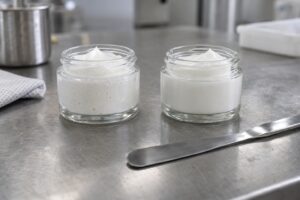
You can produce cream without air bubbles by preventing air entrainment at source, building the emulsion with controlled shear and removing residual air under suitable process conditions. Applying vacuum alone is usually insufficient: a vortex, incorrectly added powders, leaking suction lines or unsteady filling can immediately reintroduce air. The relevant question is therefore not only how you deaerate a cream, but above all where the air enters and why it is retained by the viscosity.
Air entrainment is the incorporation and distribution of gas in a liquid or semi-solid product during mixing, dispersing, pumping or filling. Visible bubbles are only part of the problem. Finely dispersed air can make the cream lighter and whiter, affect its apparent viscosity, promote oxidation and subsequently coalesce into larger bubbles in the packaging.
Air enters before the bubbles become visible
Air bubbles in cream usually arise at a free liquid surface, during powder addition or on the suction side of a pump. The mixer does not create the air from nothing; it draws existing air into the product and then distributes it into smaller bubbles. The finer the bubbles and the higher the viscosity, the longer they remain trapped in the cream.
Three diagnostic questions generally identify the source quickly. Does a funnel extending down to the mixing element form during mixing? Do the bubbles appear immediately after powder addition or only during cooling and thickening? Is the cream smooth before the filling machine, but does the packaging still contain air pockets? These observations indicate surface entrainment, air from powder or aeration during transport and filling, respectively.
| Process stage | Air entrainment mechanism | Typical observable effect | Logical intervention |
|---|---|---|---|
| Mixing at a free surface | A vortex draws air towards the mixing element | Foam or a growing layer of fine bubbles | Keep the mixing element submerged and adjust the bulk flow |
| Adding powder | Air between powder particles is entrapped | Dry lumps with aerated cores or a porous cream | Wet the powder in a liquid stream in a controlled manner |
| High-shear dispersing | Large bubbles are divided into many smaller bubbles | No coarse foam, but a milky or compressible product | Use shear only where droplet or agglomerate size reduction is required |
| Pumping and recirculating | Leakage on the suction side or unfavourable inlet flow entrains air | A product that becomes more aerated after every pass | Check seals, connections, product level and pump inlet |
| Cooling and thickening | Increasing viscosity inhibits the rise of bubbles | Bubbles that remain visible only after cooling | Deaerate before the structure has fully developed |
| Filling | Free fall, turbulence or an interrupted product stream traps air | Voids or varying fill weights in the packaging | Fill gently and, where possible, from the bottom with a continuous stream |
The location where you see bubbles is therefore not necessarily where they originated. A cream may appear visually smooth during the hot phase, while microbubbles only become visible when the product cools, thickens and settles in transparent packaging.
Why a viscous cream retains air for so long
A viscous or thixotropic cream slows the upward movement and coalescence of air bubbles. Small bubbles have little buoyancy and must simultaneously overcome the internal resistance of the continuous phase. Once thickeners, fat structures or polymers form a network, a bubble can effectively become fixed in place.
The viscosity during the process step is therefore more important than only the final viscosity on the product specification sheet. A formulation may be thin and fluid during heating, thicken suddenly during neutralisation or gradually develop structure during cooling. Do you know at what point in your batch the viscosity peaks? That point determines whether air can still escape and when deaeration is beneficial within the process.
Rheology also matters. A thixotropic cream temporarily becomes thinner under high shear, but develops structure again after the mixer stops. This can assist deaeration while the cream is moving, but can fix residual bubbles in place as soon as the shear stress disappears.
A low-air cream process is built up in this sequence
The most reliable approach first prevents new air entrainment and then removes only the residual air. Degassing while the process reintroduces air further downstream shifts the problem to a later stage and makes batch results difficult to reproduce.
-
Prepare both phases without excessive surface movement. Heat, dissolve and mix with sufficient circulation, but prevent a deep vortex and splashing against the tank wall.
-
Add raw materials below or close to the liquid surface. A considerable free fall entrains air, particularly with light powders and liquids falling into the tank as a thin stream.
-
Wet powders before they form a floating layer. Once formed, powder lumps may retain a dry, aerated core that subsequently breaks open during dispersing.
-
Emulsify with targeted shear. Use sufficient shear stress to achieve the desired droplet size distribution, but do not operate a rotor-stator for longer or at an unsuitable liquid level than the process requires.
-
Deaerate before the cream has fully thickened. In a continuous phase that is still mobile, bubbles can expand, coalesce and reach the surface more easily.
-
Cool with controlled bulk circulation. Good flow along the wall prevents local cold, highly viscous zones in which air becomes trapped, without unnecessarily disrupting the surface.
-
Transfer and fill without free fall. Keep lines filled, limit abrupt flow changes and match the filling nozzle, product feed and container movement to the rheology.
For an oil-in-water cream, this process sequence must also suit the selected emulsifier, phase temperatures and order of addition. The background to droplet formation and emulsion structure is explained in more detail under producing oil-in-water emulsions.
More shear can make air more difficult to remove
High shear is required when the cream needs a fine droplet size distribution, a high degree of homogeneity or effective deagglomeration. A rotor-stator generates high local shear stress in the gap between the rotor and stator. However, the same action can divide existing large air bubbles into many smaller bubbles, which rise more slowly and coalesce less readily.
The common assumption that dispersing for longer will automatically produce a smoother, air-free cream is therefore incorrect. The cream may appear visually smoother because coarse bubbles disappear, while the total amount of entrapped gas barely decreases. Process quality requires the functions of emulsifying, bulk mixing and deaerating to be separated.
“In practice, we see people trying to drive out bubbles with additional shear. You then merely turn coarse air into microbubbles that do not rise even under vacuum.”
Bart Brouwer
Sales Manager
A rotor-stator should therefore preferably be supplied fully and steadily with product. For inline dispersing, a flooded feed, sufficient inlet pressure and a gas-free recirculation loop are essential. For batch dispersing, the liquid level, head position and flow pattern must prevent the machine from drawing in air from the surface.
Insufficient shear is not the solution either. An inadequately developed emulsion may result in coarse droplets, instability and an uneven texture. The correct setting depends on the formulation, the desired sensory properties, the emulsifier, the temperature and the process route; without a product trial, the amount of shear required cannot be determined reliably.
Powders introduce both air and lumps into the cream
Thickeners, pigments and active ingredients contain air between the particles and may float when fed at the surface. The outside of such a mass of powder becomes wet and forms a viscous skin, while dry powder and air remain inside. Breaking it open later causes both agglomerates and a new stream of small bubbles.
Controlled powder induction introduces powder directly into a liquid stream, so that wetting takes place before a floating layer forms. This reduces dust nuisance and makes the ratio between powder feed and available liquid easier to control. With strongly hydrating thickeners, the addition rate remains critical: when the liquid binds too quickly locally, even a powerful disperser cannot remove the entrapped dry cores without additional stress on the product.
Not every ingredient may simply be added through the same induction route. Sensitive active substances, highly foaming surfactants and ingredients with a specific temperature or hydration sequence may require a separate dosing step. The formulation therefore determines whether inline powder induction is suitable or whether pre-dispersing in a partial stream works better.
Vacuum only deaerates when pressure, viscosity and surface area work together
Vacuum reduces the pressure above the product, causing existing bubbles to expand and allowing dissolved gas to leave the liquid more easily. The larger bubbles have more opportunity to coalesce and break open at the surface. This works best when the cream is still sufficiently mobile and a fresh product surface is continuously created without reintroducing air.
A stationary, highly viscous mass under vacuum is often deaerated only at the top. Gentle bulk circulation transports product from the vessel to the deaeration surface, but an excessively aggressive mixing action causes foaming. A tank must also have sufficient headspace to accommodate expansion of the product when the bubbles become larger under lower pressure.
Vacuum is not always the right solution. Volatile fragrances, solvents or other components may evaporate more readily under reduced pressure; foam-sensitive formulations may expand considerably; and a poorly sealed installation may continuously draw in ambient air. In these situations, controlling the source, using a different order of addition or deaerating before adding volatile components is often more appropriate. More information about this assessment is provided under vacuum mixing of viscous products.
The mixing function determines which equipment is suitable
A low-air process does not automatically require a single universal mixer. Bulk circulation, powder wetting and fine emulsification are different tasks with different flow and shear profiles. The installation must combine these functions without each step undoing the result of the previous step.
-
A jet stream mixer moves the bulk in a targeted manner and can maintain flow along the wall even as the viscosity changes, without having to create a strong vortex.
-
An inline powder dissolving machine draws powder into a liquid stream, limiting floating powder layers and the air trapped within them.
-
An inline dispersing machine provides local rotor-stator shear for emulsification and homogenisation without intensely agitating the entire tank surface.
-
A batch disperser is suitable when direct treatment in the vessel is required, provided that submersion and liquid level are maintained throughout the entire process step.
For cream production, a combination may therefore be more effective than one machine that continuously supplies the same mixing energy. A jet stream provides the bulk flow, a powder induction system limits air during raw material addition and an inline rotor-stator treats only the product stream that requires intensive dispersing. The available jet stream mixer for bulk circulation shows how targeted tank flow can be configured without excessive surface entrainment.
The right machine for your process
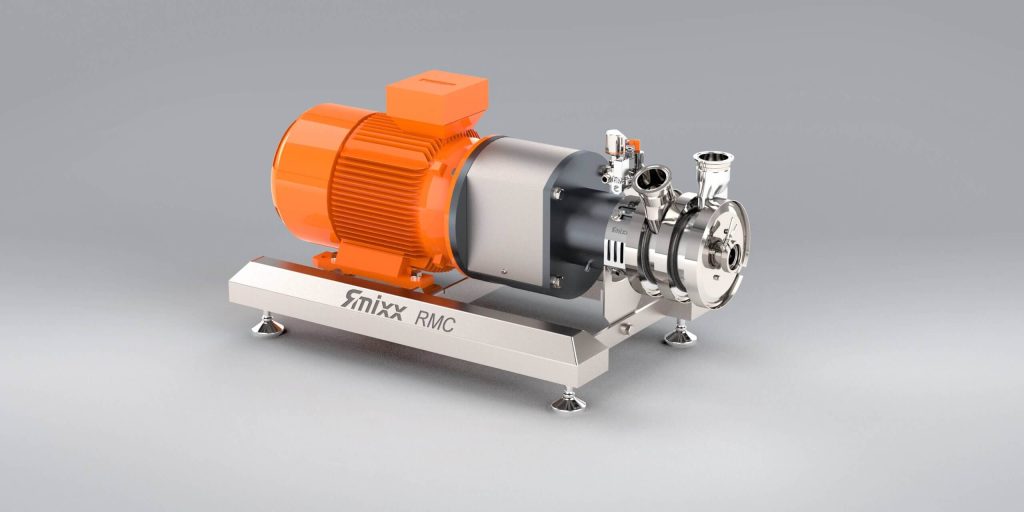 RMC inline powder dissolving machineDraws in powders without dust, dissolves them and disperses them in a single pass. No lumps, no charging losses.Discover the RMC›
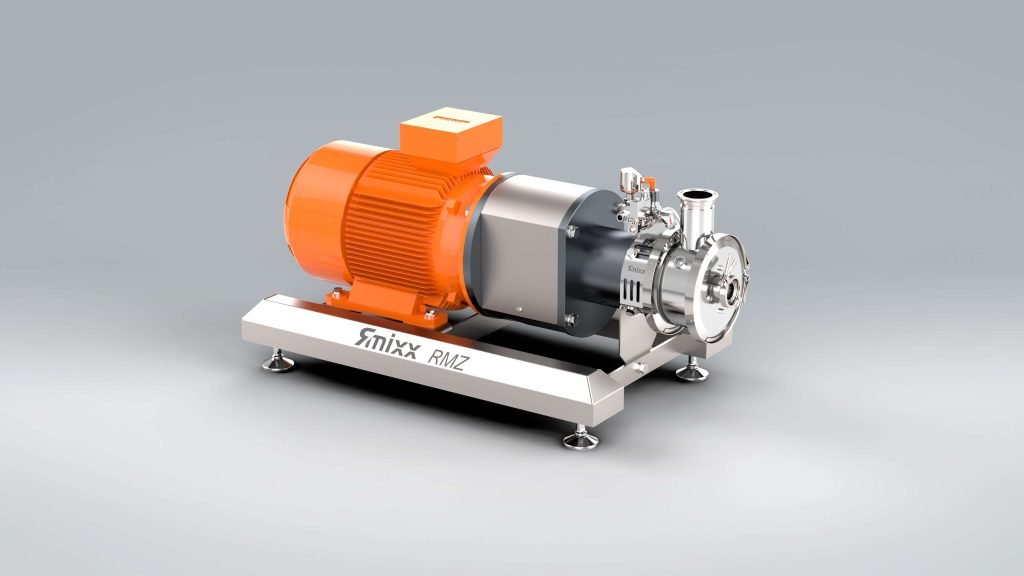 RMZ inline dispersing machineDisperses directly in the line or through recirculation. Produces emulsions and suspensions quickly and reproducibly.Discover the RMZ›
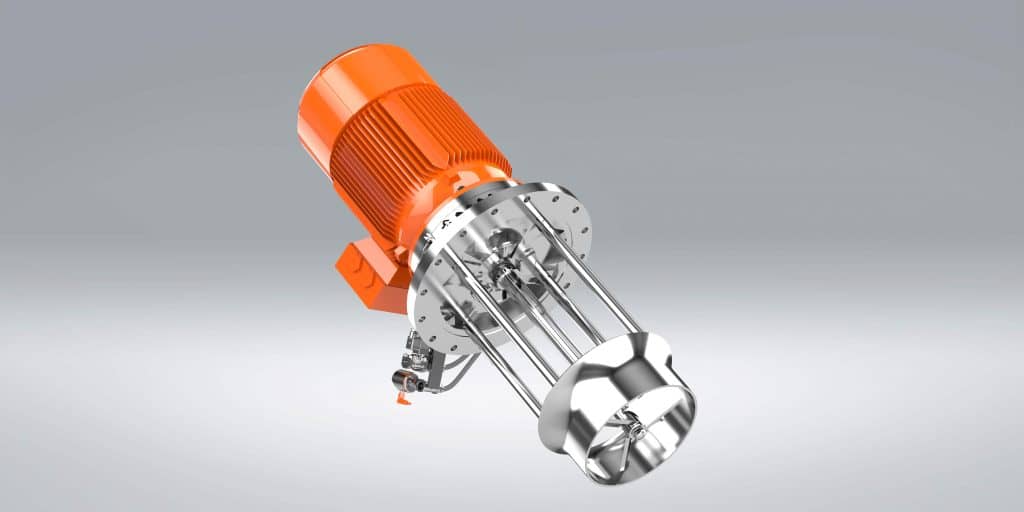 RMY jet stream mixerMixes homogeneously at varying viscosities without air entrainment. Available as top-entry and side-entry versions.Discover the RMY›
The final configuration depends on factors including batch sequence, viscosity profile, density differences, heat transfer, desired droplet size distribution and cleaning regime. RS Contracting can therefore conduct trials with your product in Coevorden or on site, allowing not only the mixing result but also the air content, process sequence and scale-up to be assessed.
Do not assess air by visual inspection alone
A cream can appear air-free while still containing finely dispersed air. Visual inspection is useful for coarse bubbles and foam, but is insufficient for approving a reproducible process. You should therefore combine product observation with measurements appropriate to your quality risk.
-
A density measurement can show whether two batches with the same formulation contain different volumes of entrapped gas.
-
A recorded mass per controlled volume reveals changes between process steps and batches.
-
Microscopic assessment can help distinguish between air bubbles, oil droplets and solid particles.
-
A rest and stability assessment shows whether microbubbles subsequently coalesce or migrate to the surface.
-
Inspection after pumping and filling determines whether the air-free bulk actually reaches the packaging as a low-air final product.
Define in advance what “without air bubbles” means for your product. A visually flawless jar of cream has different requirements from a product for which density, dosing accuracy or oxidation sensitivity is critical. The absolute absence of gas is rarely a useful criterion in industrial production; a demonstrable and reproducible acceptance level is.
Filling can still damage a properly deaerated batch
Filling is often the final source of air entrapment. A cream falling into a jar from a height folds over itself and can trap voids. An interrupted feed, a partly empty product line or a filling nozzle that causes product to splash against the wall intensifies the effect.
When bubbles are visible only in the packaging, the primary solution therefore does not lie with the mixer. Keep the feed line filled, avoid air intake on the pump side and match the filling movement to the cream’s flow properties. For viscous products, filling from the bottom upwards can prevent air from becoming trapped beneath new product layers.
The timing of filling also matters. A cream that is still warm may shrink or change structure after cooling, while a fully cooled thixotropic cream flows less readily and requires more pressure. The correct filling condition must therefore be established in relation to temperature, resting time, shear history and final packaging.
Scale-up requires the same flow mechanism, not the same recipe
A bubble-free laboratory batch does not guarantee a low-air production batch. At production scale, the ratio between liquid surface area and volume, the distance between the mixing element and the wall, the recirculation route and the period for which the product is exposed to shear all change. As a result, a setting that provides gentle mixing on a small scale may create a vortex, dead zone or insufficient flow along the wall on a large scale.
Does your product actually flow along the wall and bottom at production scale, or does mainly the centre of the tank move? If only the central area circulates, local viscous zones remain and some of the cream does not reach the deaeration surface. Correct scale-up therefore considers the flow pattern, pump route, residence time and heat transfer rather than mixing time alone.
A trial installation must also simulate the relevant production operations: powder dosing, emulsification, cooling, recirculation, vacuum, transfer and filling. For cosmetic processes, cleanability, material selection and the avoidance of dead zones are also important. The solutions for cosmetics production must therefore support both the product result and hygienic design and reproducibility.
Frequently asked questions about cream without air bubbles
Why are there small air bubbles in my cream after mixing?
Small air bubbles often arise because a vortex draws in air, powder introduces air or high shear reduces the size of existing large bubbles. As the viscosity increases, these microbubbles can no longer rise. You should therefore check the liquid level, powder feed, submersion of the mixing element and the point at which the cream thickens.
Can I remove all air bubbles from cream with vacuum?
Vacuum can remove much of the entrapped and dissolved gas, but only when the cream is sufficiently mobile and a fresh product surface is formed. Highly viscous, strongly foaming or volatile formulations require additional caution. If a leak, vortex or filling machine reintroduces air, vacuum does not resolve the underlying cause.
Should I mix cream slowly or use high shear?
Use gentle bulk circulation for dissolving, cooling and deaerating, and high shear only for steps requiring droplet size reduction or deagglomeration. Insufficient shear may result in an unstable emulsion; excessive or incorrectly applied shear divides air into microbubbles that are difficult to remove. The optimum combination must be tested with the actual formulation.
Why do air bubbles appear only during cooling?
During cooling, the viscosity increases and a fat or polymer network may form. Bubbles that were barely visible in the warm, thin emulsion consequently become fixed and may coalesce into visible voids. Deaeration must therefore usually take place before the final structure has fully developed.
A stable low-air result starts with the chain of causes
Producing cream without air bubbles requires control of the entire route: raw material addition, wetting, emulsification, bulk flow, deaeration, cooling, transfer and filling. The most robust solution not only removes visible bubbles, but prevents air from being drawn in, finely dispersed and subsequently fixed in place by the rheology.
You should therefore record the function of each process step, the shear required and where a free liquid surface or negative pressure is present. When this process map is linked to density, product temperature, viscosity profile and assessment after filling, air entrainment becomes a controllable process parameter rather than a recurring batch problem.