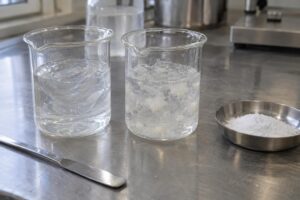
Neutralising and dispersing carbomer works reliably when you first wet the powder completely and uniformly and only then neutralise it in a controlled manner. Neutralisation causes the polymer to swell and builds viscosity; if this happens too early, dry particles become trapped in a viscous gel and persistent agglomerates form. The actual process question is therefore not only which neutralising agent you use, but above all whether every carbomer particle has had sufficient contact with the liquid phase before the increase in viscosity.
Carbomer is a cross-linked polyacrylic acid that expands after wetting and neutralisation, forming a viscous, often gel-forming network. It is used as a rheology modifier, thickener, suspending agent and stabiliser in applications including cosmetics, pharmaceutical formulations and chemical products.
Neutralising and dispersing carbomer: the correct sequence
The robust process sequence is to condition the liquid, add the carbomer in a controlled manner, wet it completely, introduce the neutralising agent in metered doses and then finish the final formulation under controlled mixing. Wetting and neutralising are separate process steps with different mixing requirements. If you try to perform both steps simultaneously, you create high local viscosity before the powder has been distributed homogeneously.
-
Prepare the continuous phase. Ensure that the liquid is homogeneous and that ingredients affecting wetting or the ion balance have been deliberately positioned in the formulation sequence.
-
Add the carbomer uniformly. Prevent powder from remaining on the liquid surface, compacting or being poured directly onto material that has already been wetted.
-
Disperse until all particles are wetted. The liquid must penetrate the exterior of every agglomerate before substantial viscosity develops.
-
Allow the polymer sufficient time to hydrate. An apparently smooth surface does not prove that the dispersion beneath the surface is free of dry cores.
-
Add the neutralising agent in diluted form and distribute it evenly. Local overdosing causes substantial local swelling and may result in a non-uniform gel structure.
-
Check pH, viscosity and flow behaviour after equilibrium has been reached. The immediate reading during dosing is not always representative of the final product.
-
Add critical salts, surfactants and active ingredients according to the validated sequence. Assess the gel only after the complete formulation is present and homogeneous.
Do you know whether the viscosity in your process rises gradually or increases almost immediately in a local area after the neutralising agent is added? A local jump usually does not indicate insufficient mixing power, but rather an unfavourable addition position, insufficient dilution of the neutralising agent or carbomer that has not yet been completely wetted.
Why neutralisation changes viscosity so significantly
Neutralisation ionises the acidic groups of the carbomer, creating repulsion along the polymer chains and causing the cross-linked molecule to unfold further. The occupied hydrodynamic volume increases and the continuous phase develops greater resistance to flow. As a result, a thin, wetted dispersion can transform into a highly viscous structure during neutralisation.
This viscosity build-up is not proof that the preceding dispersion was successful. Dry or only superficially wetted carbomer particles may be shielded from the liquid by the rapidly formed gel layer. This causes fish eyes: lumps that are swollen on the outside and have a dry or poorly hydrated core.
Applying more shear afterwards does not always solve this problem. A rotor-stator can mechanically reduce agglomerates and create new liquid surfaces, but prolonged intensive shearing after the full viscosity has developed can instead lead to a loss of structure in some carbomer grades. The correct balance depends on the polymer grade, concentration, temperature, solvent composition and the sensitivity of the complete formulation.
For a broader explanation of breaking up and distributing solid particles, you can consult the knowledge base article about the meaning of dispersing. With carbomer, however, dispersion must always be assessed in conjunction with wetting, hydration and subsequent neutralisation.
“At production scale, motor power is not the decisive factor; the exact timing of the neutralising agent feed is. Dosing too early permanently traps dry carbomer particles, regardless of how vigorously you stir afterwards.”
Bart Brouwer
Sales Manager
A common assumption is that a more powerful agitator can correct any carbomer problem. At production scale, it is precisely the combination of powder feed, liquid circulation and addition sequence that proves decisive: additional power does not help when powder is supplied faster than the mixing system can wet it.
Dispersing carbomer without fish eyes or floating powder layers
Carbomer forms lumps when the outside of a mass of powder hydrates faster than liquid can penetrate to its core. The material is light, has a large contact area and may remain floating on the surface if added unfavourably. As soon as the outer layer becomes sticky, particles adhere to each other and form an agglomerate that is difficult to wet further.
Do you add the powder to a visible vortex, but does material remain on the tank wall or liquid surface? The vortex may then primarily be drawing in air, while effective powder wetting remains limited. Effective circulation quickly draws the powder beneath the surface, distributes it throughout the tank volume and prevents dead zones without forming a deep air funnel.
The powder feed must match the wetting capacity
The feed rate must not exceed the rate at which the system can supply new powder with liquid. Excessive addition creates a dry layer on top of carbomer that has already been wetted. This layer later sinks as a single mass and forms lumps, even if the tank is ultimately mixed for long enough.
Inline powder induction can improve initial wetting by introducing powder directly into a rapidly moving liquid stream. This is particularly relevant when open pouring causes dust or when a tank agitator does not draw the powder beneath the surface quickly enough. The principles behind wetting powder without lump formation also apply here, but the subsequent viscosity build-up of carbomer requires additional attention to recirculation and pumpability.
A pre-dispersion is useful, but not universal
Depending on the carbomer grade and the supplier’s instructions, the powder can be dispersed directly in water or first distributed in a suitable non-solvating liquid. Such a pre-dispersion can temporarily separate the carbomer particles from one another, reducing their tendency to clump when they come into contact with water. However, the auxiliary liquid must be compatible with the final formulation and must not undesirably delay hydration.
Recommending a standard pre-dispersion without knowing the exact polymer grade is therefore irresponsible. Carbomer is not a single, uniform raw material category: different grades react differently to solvents, electrolytes, surfactants, shear and neutralisation methods. The technical documentation from the raw material supplier remains decisive.
The neutralising agent determines more than just the pH
A suitable neutralising agent brings the acidic groups of the carbomer into the desired state of ionisation without making the formulation unsuitable from a chemical, regulatory or sensory perspective. Common options include inorganic bases and organic amines, but the correct choice depends on the application, the other ingredients and the desired final pH. The quantity cannot be reliably derived from the carbomer dosage alone, because the complete formulation may consume acid or base.
| Decision factor | Effect on neutralisation | Practical check |
|---|---|---|
| Carbomer grade | Different products have their own pH response, shear resistance and compatibility. | Use the processing instructions for the specific supplier and grade. |
| Overall acid-base balance | Acidic active substances and other formulation components may consume neutralising agent. | Base dosing on measured product behaviour, not solely on a theoretical quantity. |
| Electrolyte load | Ions can shield chain expansion and reduce viscosity. | Assess the gel with the complete package of salts and active ingredients. |
| Solvents and surfactants | These can change wetting, clarity and network formation. | Establish the addition sequence during laboratory and pilot trials. |
| Application and regulations | Not every neutralising agent is suitable for cosmetic, pharmaceutical or chemical applications. | Check raw material status, product specifications and applicable quality frameworks. |
The neutralising agent should preferably be added in a way that distributes it rapidly throughout the bulk before a strong local gel forms. A diluted stream, a suitable dosing position and sufficient macromixing limit local pH peaks. Dosing directly at a wall, onto a stationary surface or into a poorly circulated zone increases the likelihood of a non-uniform structure.
Repeatedly correcting with alternating additions of acid and base is not a robust process strategy. Each correction adds ions, changes the local environment of the polymer and makes the batch history more difficult to reproduce. In the event of systematic overshoot, you should adjust the concentration of the dosing solution, the dosing step and the measurement time instead of merely tightening the operator instructions.
Electrolytes can still thin a successful gel
In many carbomer systems, electrolytes reduce the effective repulsion between ionised groups, allowing the polymer network to become more compact and lose viscosity. An attractive base gel without active ingredients therefore says little about the stability of the final product. Salts may originate from minerals, plant extracts, buffers, preservative systems, active substances and even from the neutralisation reaction itself.
Is your carbomer base stable until you add the final aqueous ingredient? The cause is then probably not insufficient carbomer or an excessively short mixing time, but the ion load, pH shift or solvent composition of that ingredient. The solution may be a different addition sequence, a more compatible carbomer grade or a different rheology system; simply adding more polymer may increase costs, stickiness and processing problems without removing the cause.
Surfactants and emulsifiers also affect the final rheology. In an emulsion, carbomer must not only thicken the water phase, but also function alongside droplet formation, emulsifier adsorption and any oil-soluble components. If you use carbomer in an oil-in-water product, you must therefore assess formation of the oil-in-water emulsion and the neutralisation step as one interconnected process.
Mixing before and after the viscosity peak requires different equipment
Rapid wetting and fine distribution are important during powder feeding; after neutralisation, the requirement shifts to complete tank circulation at a higher viscosity and with as little air entrainment as possible. A single mixing principle can sometimes handle both regimes, but not automatically. The tank geometry, batch size, inlet positions, recirculation loop and viscosity development determine whether additional functions are required.
An inline rotor-stator is suitable when intensive dispersion or recirculation is required, while a powder induction system can wet powder directly in the liquid stream. A jet stream mixer subsequently supports macromixing and helps prevent only the area around the mixing head from moving. Choosing between these functions requires an assessment of both the thin initial phase and the viscous neutralised phase.
The right machine for your process
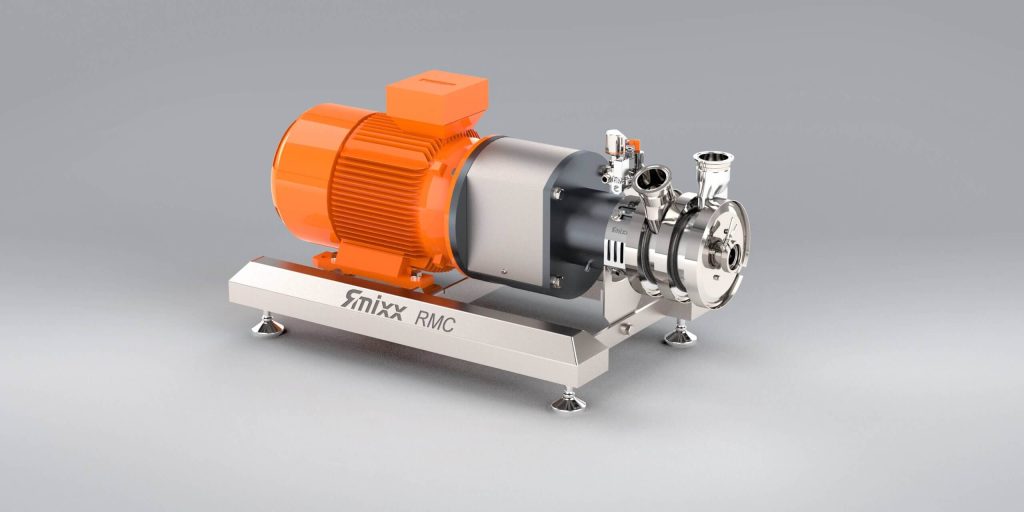 RMC inline powder dissolving machineDraws in powders without dust, dissolves them and disperses them in a single pass. No lumps, no charging losses.Discover the RMC›
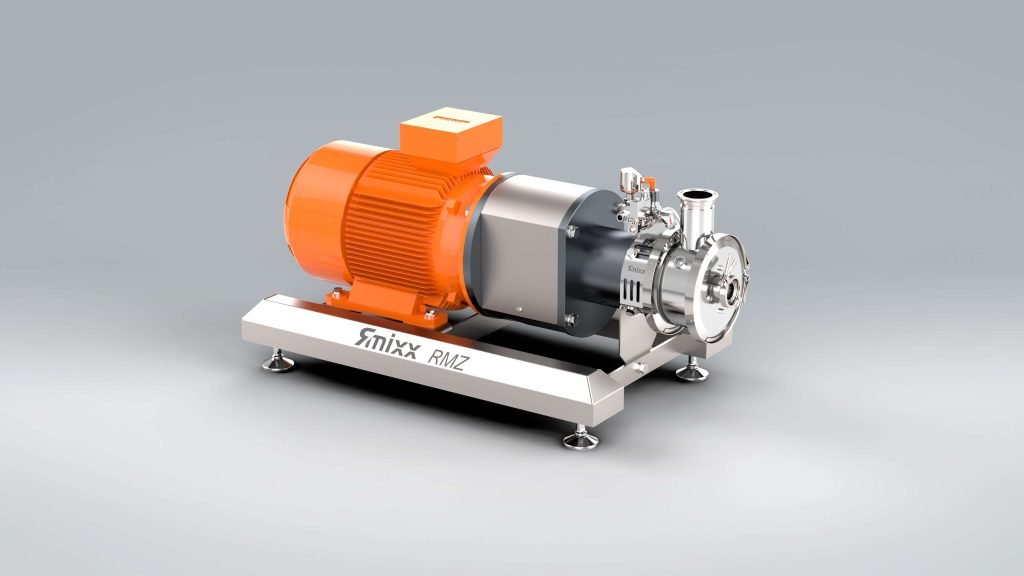 RMZ inline dispersing machineDisperses directly in the pipeline or through recirculation. Produces emulsions and suspensions quickly and reproducibly.Discover the RMZ›
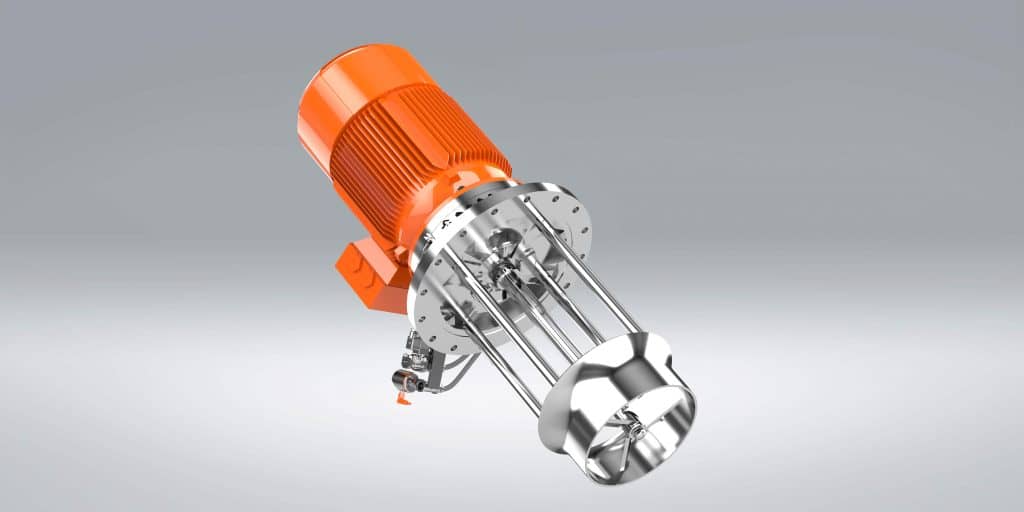 RMY jet stream mixerMixes homogeneously at a wide range of viscosities, without air entrainment. Available as top-entry and side-entry versions.Discover the RMY›
With an existing tank, you must also check whether the entire contents actually flow through the active mixing zone. A smooth surface and movement around the shaft do not rule out dead zones along the wall, bottom or in corners. For a carbomer gel, a poorly circulated zone can lead to local differences in pH, hydration and viscosity that only become apparent during filling or quality control.
Tracing problems back to the process step where they arise
Carbomer problems are resolved most quickly when you distinguish between the symptom, the time at which it arose and the mechanism. Low final viscosity, for example, may result from insufficient neutralisation, over-neutralisation, electrolytes, mechanical stress or the wrong raw material grade. Simply mixing for longer does not make it possible to distinguish between these causes.
| Observable problem | Probable process cause | Targeted intervention |
|---|---|---|
| Fish eyes or soft lumps | Neutralisation began before all particles had been completely wetted. | Separate wetting and neutralisation and reduce the local powder load. |
| Floating powder layer | Insufficient draw-down or excessively rapid open pouring. | Improve liquid circulation or use controlled powder induction. |
| Local gel lumps after adding base | The neutralising agent entered a poorly mixed zone in concentrated form. | Dilute it, dose it gradually and move the injection point to an active flow. |
| Loss of viscosity after the final addition | Electrolytes, surfactants, solvent or a pH shift disrupt the network. | Test the ingredient separately and assess the grade and addition sequence. |
| Many air bubbles in the gel | A deep vortex or high shear draws in air that is retained by the viscosity. | Limit surface entrainment and use vacuum or a different mixing geometry if necessary. |
| Difference between the top and bottom | Macromixing collapses as soon as the viscosity rises. | Improve axial circulation and check the position of the mixer and return line. |
Air entrainment requires additional attention because carbomer slows the escape of trapped air. Air affects appearance, the reproducibility of volumetric processing and sometimes viscosity measurements as well. More intensive mixing to remove air is often counterproductive; the process must limit air entrainment at the source or, when required by the product, deaerate it under suitable conditions.
Scaling up based on circulation and addition, not just mixing time
A laboratory formulation cannot be scaled up reliably by maintaining the same mixing time in a larger tank. The distance that the powder and neutralising agent must travel increases, while surface addition, local shear and total tank circulation change differently. As a result, a formulation may be smooth on the test bench but still exhibit lumps or pH differences at production scale.
During scale-up, record at least where the powder enters, how much liquid is available there, how quickly material is removed from that zone and how circulation changes during viscosity build-up. Do not check samples at only one point. A representative sample requires the tank to be homogeneous, not merely for the sample itself to contain no visible lumps.
A trial with the actual product is useful when the carbomer grade, electrolyte load or viscosity development is uncertain. RS Contracting can conduct trials in Coevorden or on site, allowing wetting, powder induction, neutralising agent dosing and mixing to be assessed under relevant process conditions. For initial guidance on equipment, you can also use the machine configurator for mixing processes.
When carbomer is not the right rheology modifier
Carbomer is not automatically the best choice when there is a high electrolyte load, an unsuitable pH range, a strong solvent influence or an application in which the desired structure does not match the polymer network. A process that can only be pumped under very high mechanical stress may also be unfavourable for a shear-sensitive grade. In such situations, a different carbomer grade or another thickening system is often more appropriate than adding ever more neutralising agent or polymer.
The desired user and processing properties also matter. A product may be sufficiently firm at rest but become too thin during pumping or recover insufficiently after shearing. Therefore, assess not only a single viscosity value, but also thixotropy, yield stress, recovery behaviour, pumpability, dosing capability and stability throughout the intended product life cycle.
In regulated pharmaceutical production, the choice of raw materials, process sequence, measurement methods and cleaning must comply with the applicable GMP framework. For cosmetic and pharmaceutical installations, hygienic design, material selection, drainability and cleanability are also relevant design criteria. Mixing technology can enable a robust process, but does not replace product-specific formulation assessment or process validation.
Frequently asked questions about neutralising and dispersing carbomer
Must carbomer always be fully dispersed before neutralisation?
Yes, as a basic principle, carbomer must be distributed uniformly and fully wetted before the substantial viscosity build-up begins. Otherwise, the neutralised outer layer may seal off dry cores. The required hydration conditions differ by grade and liquid composition, which means that the supplier’s instructions and a product-specific trial remain decisive.
Which neutralising agent is suitable for carbomer?
The suitable neutralising agent depends on the carbomer grade, desired final pH, overall acid-base balance, application and regulations. Both inorganic bases and organic amines can be used. Do not make your choice based solely on viscosity build-up: compatibility, odour, ion load, product specifications and approval for the application are also decisive.
Why does my carbomer gel become thin after active substances are added?
Active substances can introduce salts, acids, bases, surfactants or solvents that change the ionisation and expansion of the carbomer network. You should therefore measure pH and flow behaviour before and after each critical addition. If the gel structure consistently collapses, a different addition sequence, carbomer grade or rheology modifier is often more effective than additional carbomer.
Can high shear remove all carbomer lumps?
High shear can reduce agglomerates and accelerate wetting, but does not correct an unsuitable formulation or premature neutralisation without risk. Prolonged intensive shearing can damage some neutralised carbomer systems and entrain air. Therefore, use high shear selectively before or during the early dispersion stage and confirm the appropriate regime through product trials.
Why does the viscosity differ between the laboratory and production?
At production scale, powder feed, local shear, tank circulation, dosing position and heat transfer change. During the rise in viscosity, macromixing may also decrease, resulting in uneven pH and hydration. Therefore, scale up based on the wetting mechanism, circulation and addition conditions, not solely on time or rotational speed.