Wetting powder and preventing lump formation can be achieved by bringing each particle into controlled contact with sufficient liquid before a wet outer layer can enclose a dry core. This requires coordinated powder dosing, liquid circulation, feed position and local shear stress; simply mixing harder or for longer will usually not resolve poor initial wetting. The determining question is therefore not how much mixing power is available, but what happens at the moment of first contact between powder and liquid.
Powder wetting is the displacement of air from the particle surface by a liquid, enabling particles to disperse, hydrate or dissolve. If this process occurs too quickly or incompletely locally, agglomerates, floating islands of powder, build-up, air entrainment and variable batch quality will result.
Lump formation begins at the first contact with liquid
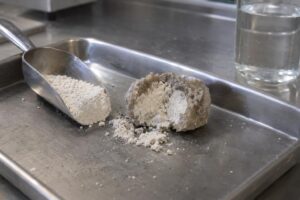
A lump forms when the outer powder particles become wet while the liquid does not reach the interior of the powder mass. With rapidly hydrating powders, the outside may also form a viscous or gel-like skin. This skin slows further liquid penetration and encloses a dry core.
This mechanism occurs in gums, starch, proteins, thickeners, pigments and fine mineral powders, among other products, but not every product behaves in the same way. Wettability depends on surface tension, porosity, particle shape, fat content, particle size distribution and the affinity between the solid and liquid phases. A formulation that runs without problems with one powder may immediately agglomerate with a powder that appears similar.
Air also plays a central role. A dry powder mass contains air between and around the particles; the liquid must displace this air to wet the entire surface. When powder falls onto the liquid surface as a compact stream, trapped air can block liquid penetration and cause the powder to float.
Do your lumps form immediately during pouring and still contain dry powder when cut open? In that case, the primary cause lies in wetting rather than insufficient mixing time. If the lumps are completely wet but do not break down any further, the available shear, residence time or rotor-stator geometry may instead be the limiting factor.
Wetting, dispersing, hydrating and dissolving are different steps
Effective wetting is a prerequisite for further processing, but it is not the same as dispersing, hydrating or dissolving. During dispersing, solid particles and agglomerates are distributed through a continuous liquid phase. During dissolving, the solid ultimately disappears at molecular level, while hydrating means that a substance absorbs water and consequently changes its structure or viscosity.
-
Wetting brings the liquid into contact with the available particle surface and displaces the air present.
-
Deagglomeration breaks down cohesive groups of particles through shear stress and turbulent loading.
-
Dispersing distributes the wetted particles as evenly as possible throughout the liquid phase.
-
Hydrating gives suitable substances time to absorb liquid and develop their functional properties.
-
Dissolving continues until no separate solid phase remains, insofar as solubility and process conditions permit.
These steps can take place in the same installation, but not always simultaneously or under the same optimum conditions. High local shear can break down agglomerates, while a calm residence phase may be needed for complete hydration. The process sequence must therefore match the actual material behaviour, not only the desired final viscosity.
Symptoms reveal where wetting is failing
The form and location of the defect often indicate which process step must be adjusted. A dry core indicates entrapment during initial wetting, while sediment may instead indicate insufficient circulation, a density difference or inadequate stabilisation. The diagnosis below prevents all problems from being addressed incorrectly by increasing the rotational speed.
| Observation | Probable mechanism | Targeted process intervention |
|---|---|---|
| Lump with a dry core | The outside hydrates or gels before liquid can penetrate. | Reduce the local powder load and introduce the powder directly into an active liquid stream. |
| Floating powder layer | Air remains attached to hydrophobic or poorly wettable particles. | Avoid pouring onto a calm surface and create controlled liquid contact without excessive vortexing. |
| Wet, tough groups of particles | The particles have been wetted, but the available shear stress does not break down the agglomerates. | Apply local high shear or a suitable rotor-stator zone. |
| Foam and volume increase | A vortex or unstable powder feed draws air into the product. | Stabilise the liquid flow and feed powder below the surface or directly into the product stream. |
| Build-up on the wall or liquid line | Powder contacts a wet surface outside the active circulation zone. | Relocate the feed point and prevent poorly circulated zones in the tank and pipework. |
An additional assessment of agglomerates during dispersing helps distinguish between lumps that form during feeding and structures that were already present in the dry powder. This distinction determines whether you need to intervene in storage and dosing, at the feed point or in the dispersing zone.
The correct process sequence prevents lumps from forming in the first place
Powder must be added in a controllable mass flow to a liquid stream with sufficient absorption capacity. The process operates most reliably when feed rate, circulation and shear are coordinated. Adding a large quantity of powder all at once locally exceeds the wetting capacity, even if the installation appears to have sufficient capacity on average.
-
Prepare the liquid phase for processing. Ensure the correct formulation sequence, temperature and composition before adding the critical powder, because these factors affect viscosity, surface tension and solubility.
-
Establish complete liquid circulation. The flow must not only move the centre of the tank, but also renew product along the wall, bottom and liquid surface.
-
Stabilise the powder feed. A consistent mass flow prevents peak loading, bridging in the hopper and sudden plugs of powder.
-
Introduce powder into the active liquid stream. The feed point must quickly provide every part of the powder stream with liquid, without allowing powder to first reach a wet wall or calm surface.
-
Apply shear at the correct moment. Shear stress is most effective during or immediately after wetting, before agglomerates become stronger through hydration or thickening.
-
Give the product the required residence time. After deagglomeration, dissolving, hydration and stabilisation can continue under conditions appropriate to the formulation.
Do you know during which phase of addition your viscosity increases most sharply? If the viscosity already rises during powder intake, liquid circulation decreases and the same feed rate may suddenly become too high. Constant powder dosing is then not automatically controlled dosing; dosing must follow the product’s changing absorption capacity.
“The common mistake in practice is to increase the rotational speed when lumps occur. You only heat the product, while the cause lies in powder dosing at the first point of contact.”
Bart Brouwer
Sales Manager
The most critical moment often occurs before an operator can see a lump. Once a gel skin or compact wet mass has formed, recovery requires more shear and residence time than if the individual particles had been wetted immediately. Prevention also reduces the risk of overprocessing the product fraction that has already been dispersed correctly.
More shear does not correct inadequate macromixing
High shear only acts on product that actually flows through the active dispersing zone. A rotor-stator can generate high local shear stress, but it does not compensate for dead zones, short-circuit flow or a powder layer that never reaches the zone. The combination of macromixing and local deagglomeration therefore determines the result.
Does every part of your batch demonstrably reach the dispersing zone, or does mainly the product around the mixing head move? If bulk circulation is too low, the centre of a tank may appear active while the wall and bottom zones are barely renewed. A jet stream mixer, adjusted positioning or a recirculation loop may then be more relevant than a higher local tip speed.
A narrower or more intensive rotor-stator zone generally increases the local load and can break down wet agglomerates further. Possible disadvantages include increased heating, air entrainment, damage to fragile structures and unnecessary particle size reduction. The appropriate shear is therefore determined by the desired product effect, not by the maximum available power.
Batch and inline processing require different control of powder wetting
Batch processing provides direct control over one charge, while inline powder induction can introduce the powder into a moving liquid stream in a controlled manner. Neither principle is universally better. The choice depends on formulation variation, viscosity development, dust control, available recirculation and sensitivity to air entrainment, among other factors.
| Process criterion | Batch feeding | Inline powder induction |
|---|---|---|
| Initial liquid contact | Highly dependent on the feed position and flow at the tank surface. | Takes place in a controlled manner in a liquid stream or mixing zone. |
| Powder load | Peak loading occurs quickly during manual pouring or unstable dosing. | The feed can be linked to the absorption capacity of the liquid stream. |
| Air and dust | Open pouring increases the risk of dust and air entrainment. | Closed induction can limit dust emissions, provided that the hopper and feed operate correctly. |
| Product control | Suitable when the addition sequence and control per charge are central considerations. | Suitable for reproducible induction, direct processing or recirculation. |
| Process limitation | The free liquid surface and macromixing are often decisive. | Pressure relationships, viscosity and pipe resistance can limit induction. |
In inline processing, powder intake does not occur automatically simply because a pipe is present. There must be a usable pressure differential, the liquid must be able to absorb the powder stream and the installation must provide sufficient wetting and dispersing after induction. The operation of inducing powders inline must therefore be assessed as a complete flow process.
Product behaviour determines the appropriate process configuration
The best configuration follows from the combination of powder properties and the changing behaviour of the liquid phase. A free-flowing, readily soluble powder requires a different approach from a hydrophobic pigment, a rapidly swelling gum or a protein that is sensitive to foaming. For critical formulations, it is not possible to predict reliably which geometry and process sequence will produce the best result without a product trial.
-
Rapid hydration: dose so that each particle immediately encounters sufficient free liquid before a gel skin forms.
-
Poor wettability: increase effective liquid contact and limit air that remains attached to the particle surface.
-
Sharp increase in viscosity: safeguard bulk circulation throughout the entire addition process and assess the process phase with the poorest flow.
-
Foam sensitivity: avoid a deep vortex and select a feeding method that does not entrain unnecessary air.
-
Fragile particles or structures: do not use more shear than is necessary for wetting and deagglomeration.
-
Abrasive powders: include wear, material selection and maintenance access in the installation design.
These criteria may lead to powder induction and dispersing in a single inline process, recirculation through a dispersing machine or a batch process with powerful jet stream mixing. The batch powder induction mixers, for example, show how powder intake can form part of the overall mixing concept instead of being a separate pouring operation. For other formulations, direct inline processing or homogeneous tank circulation is more appropriate.
The right machine for your process
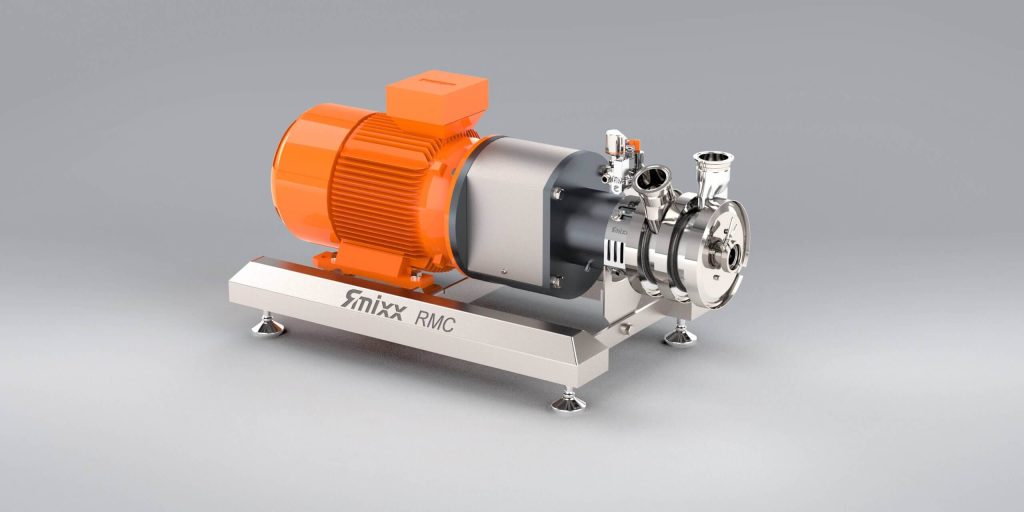 RMC Inline powder dissolving machineInduces powders without dust, dissolves them and disperses them in a single pass. No lumps, no charging losses.Discover the RMC›
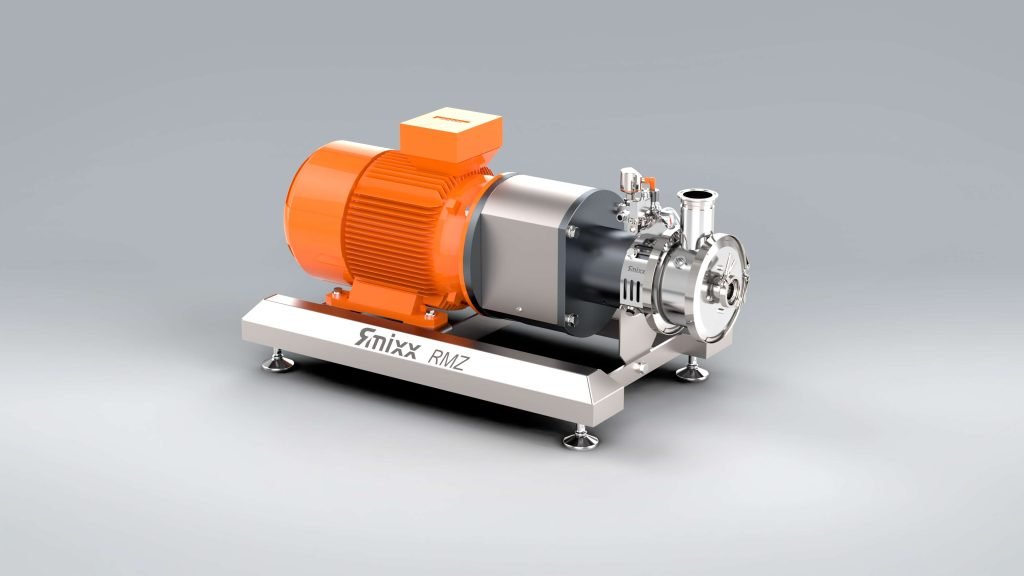 RMZ Inline dispersing machineDisperses directly in the pipe or via recirculation. Produces emulsions and suspensions quickly and reproducibly.Discover the RMZ›
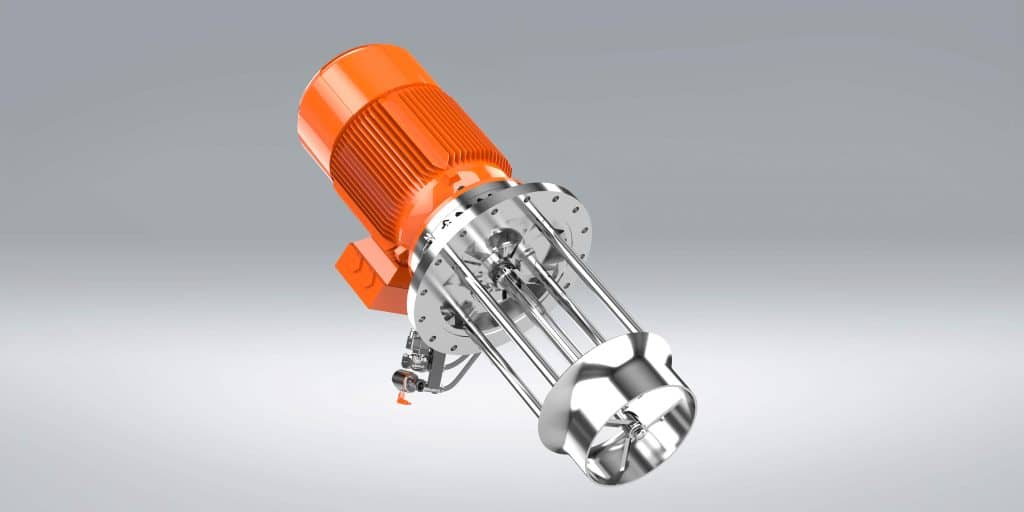 RMY Jet stream mixerMixes homogeneously at a range of viscosities without air entrainment. Available as top entry and side entry.Discover the RMY›
Machine selection remains subordinate to the process route. A powerful inline dispersing machine does not correct an unstable powder feed, and a good jet stream mixer cannot always break down poorly wettable agglomerates to the desired particle size distribution. Where problems are combined, powder handling, macromixing and local shear must be designed as one system.
Air, dust and cleaning are part of the lump formation problem
A process that prevents lumps but introduces a great deal of air or dust is not truly controlled. Air entrainment can cause foam, oxidation, volume errors and variable product properties. Dust can cause product loss and contamination and, with combustible powders, create an explosion risk.
For dust-generating powders, the complete route from bag dumping or bulk feeding to liquid contact must be assessed. If an explosive dust atmosphere may arise, zone classification, ignition sources and suitable equipment are relevant elements of the design under the applicable ATEX framework, including Directive 2014/34/EU for equipment. The considerations relating to explosion-safe powder handling therefore also apply when the final product is a liquid suspension.
Cleanability also affects reproducibility. Residual product in a hopper, induction pipe, rotor-stator chamber or dead pipe section may become detached during a subsequent batch as an already hydrated lump. Hygienic design, drainability, surface accessibility and a validated CIP or SIP strategy are particularly important in food, cosmetics and pharmaceuticals.
EHEDG guidelines, 3-A Sanitary Standards and GMP frameworks can provide guidance on design and cleanability, depending on the industry and application. However, a hygienic design is not merely a smooth surface; welds, seals, product retention and the position of cleaning provisions also matter. More background information is available under hygienic installation design.
Scale-up requires maintaining the moment of contact and circulation
A laboratory trial is representative only if the same determining mechanisms remain present at production scale. Using only the same formulation and mixing time is insufficient. Tank geometry, filling height, powder feed, circulation path, local shear stress and residence time do not automatically change in the same proportion during scale-up.
On a small scale, an operator can distribute powder slowly over a relatively large liquid surface. At production scale, the same operation is often replaced by bag dumping or a hopper, resulting in a much more compact powder stream. Consequently, a process that appeared lump-free in R&D may still form a wet outer layer and dry cores during production.
During trials, therefore, record not only the final quality but also the sequence and condition during the process. Relevant factors include the point at which viscosity increases, the appearance of the liquid surface, the location where powder disappears, the presence of air, circulation along the wall and bottom, and the number of passes through an inline zone. RS Contracting can conduct trials with customer product in Coevorden or on site.
When other measures are more important than mixing technology
Mixing and dispersing technology is not always the correct primary solution for lump formation. Lumps that have already formed during storage due to moisture absorption, temperature fluctuations or mechanical compaction must first be addressed through powder handling and storage. A lump breaker, fluidiser or controlled dosing system may then be more important than additional shear in the liquid.
The formulation may also be a limiting factor. A different addition sequence, pre-dilution, dry premix or suitable wetting agent may improve liquid contact, provided that product quality and regulations permit this. In the case of chemical incompatibility, limited solubility or undesirable reaction products, no mixer can make the formulation processable without restriction.
For fragile products, intensive rotor-stator processing may even be undesirable. If the desired particle structure, fibre length or functional agglomeration must be retained, a gentler mixing method is more appropriate. The objective is not the highest shear, but the lowest process load with which the required wetting, distribution and stability can be achieved reproducibly.
Frequently asked questions about powder wetting and lump formation
Why do lumps not disappear if I mix for longer?
Lumps do not disappear by themselves when a hydrated or gel-like outer layer seals off a dry core. The liquid then penetrates only slowly, while normal tank circulation provides insufficient local shear stress to break the structure open. You must first determine whether improved initial wetting, more targeted shear or both are required.
Must powder always be added below the liquid level?
No, but the powder must enter an active and sufficiently strong liquid stream immediately. Feeding below the surface can limit dust and floating powder, but an incorrect design may draw in air or block pipes. The appropriate position depends on wettability, viscosity, dosing method and available circulation.
Does a rotor-stator always prevent lump formation?
A rotor-stator can effectively subject wet agglomerates to stress, but it does not automatically prevent them from forming. If powder compacts before the rotor-stator, builds up on the wall or does not leave a poorly circulated tank zone, insufficient material reaches the active zone. Macromixing, powder dosing and positioning therefore remain just as important as the mixing head.
How do I know whether a product trial is required?
A product trial is advisable when wettability is unknown, viscosity changes significantly, the product is sensitive to foaming or the desired particle size distribution is critical. During scale-up and formulation changes, a trial also prevents machine selection from being based exclusively on theoretical properties. Assess both intermediate phases and the final product during the trial.
A lump-free process begins before the dispersing zone
Systematic control of lump formation begins with controlled powder feeding, immediate liquid contact and sufficient circulation throughout the entire installation. Rotor-stator action, recirculation or jet stream mixing then provides the shear stress and residence time required by the specific product. By assessing these functions separately, you prevent additional mixing time from masking a fundamental wetting problem.
The final configuration depends on the formulation, viscosity development, density, particle behaviour, air sensitivity and cleaning requirements. A well-founded selection therefore uses product trials and process observations rather than a general rotational speed or standard machine. In this way, powder wetting becomes a reproducible process step rather than a correction after the event.