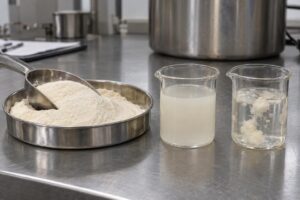
Dissolving thickener with xanthan without lumps is only possible when each powder particle is first dispersed individually and only then fully hydrates. Therefore, do not add xanthan as a compact layer of powder to stagnant water, but dose it in a controlled manner into a liquid stream with sufficient circulation and local shear stress, or prepare a well-distributed dry premix or slurry beforehand. The real process question is not how much mixing power you apply, but whether that mixing power reaches every particle before a hydrated outer layer forms.
Dissolving xanthan is the controlled dispersing and hydration of xanthan gum in a liquid phase, so that the polymers build viscosity without entrapped dry powder or agglomerates.
Lumps often form within moments. The outside of a powder cluster absorbs water and forms a viscous gel skin, while the core remains dry. Such an agglomerate can circulate in the batch for a long time without actually breaking apart, resulting in reprocessing, clogged screens, deviating viscosity or a batch that fails release.
The gel skin around xanthan makes wetting decisive
Xanthan gum is a hydrocolloid that binds water and already builds considerable local viscosity during initial wetting. When several dry particles are wetted at the same time, they stick together and the hydrated exterior seals off the dry core. More mixing time does not automatically correct this error, because the liquid can then barely reach the entrapped powder.
A common assumption is that xanthan must first “dissolve” like salt or sugar. This is not correct: xanthan must first be distributed as individual particles throughout the continuous phase, after which water penetrates the polymer and the viscosity develops. Dispersing and hydration are therefore different process steps, even if they take place almost simultaneously in the same installation.
Does your xanthan land on the liquid surface as a cloud, or is each particle immediately incorporated into a moving liquid stream? In the first case, the outer powder layer is likely to hydrate before the underlying particles have been distributed. In the second case, a sufficiently high liquid velocity reduces the local powder concentration and allows the liquid to reach a larger specific powder surface area.
A rotor-stator can reduce formed agglomerates through shear stress, but prevention is more effective from a process perspective than breaking them up afterwards. Proper introduction of the powder limits the quantity of persistent “fish eyes” and prevents unnecessary energy and time from being required for correction. The physics behind this phenomenon is explained further in wetting powder without lumps.
Dissolving thickener with xanthan in six process steps
A reproducible xanthan process follows the sequence of liquid conditioning, powder distribution, wetting, hydration, homogenisation and final inspection. If this sequence is reversed, the viscosity may already increase before the remaining powder is transported throughout the batch.
- Set the continuous phase in motion. Ensure circulation throughout the entire vessel before dosing begins; a deep vortex is not proof that the bottom, wall and corners are also being refreshed sufficiently.
- Prepare the powder for uniform feeding. Break up compacted sections and prevent bridging in the bag, hopper or dosing device, so that a sudden plug of xanthan does not fall into the liquid.
- Dose xanthan in a controlled manner. Match the feed rate to what the liquid stream can immediately incorporate and wet; an excessive feed rate causes a local powder surplus.
- Disperse before the bulk viscosity peaks. Use sufficient local shear to keep powder clusters apart, while also ensuring sufficient macromixing to transport fresh product to that high-shear zone.
- Allow the polymer time to hydrate. Hydration continues after visible powder has disappeared; the required time depends on the type of xanthan, the formulation, temperature and composition of the liquid phase.
- Check the final condition. Assess not only the appearance, but also the viscosity according to a fixed measurement method, the presence of soft gel particles and reproducibility between batches.
The transition from step four to step five in particular is underestimated. A product that appears smooth may not yet be fully hydrated, causing a viscosity measurement taken immediately to be too low and a later measurement to be higher. Adding more xanthan based on that first measurement then leads to overdosing and an unnecessarily high final viscosity.
“If you try to adjust xanthan based on viscosity shortly after dosing, you will almost always dose too much. You only see the actual viscosity once hydration has been fully completed.”
Bart Brouwer
Sales Manager
Do you measure viscosity immediately after dosing, or only after a defined hydration and resting condition? Only the second approach allows batches to be compared fairly. Therefore, record the product temperature, elapsed hydration time, shear history and measurement procedure; xanthan is strongly shear-thinning, so the measured value depends on the load applied during measurement.
Choosing a premix, slurry or direct powder induction
The best feeding method depends on the formulation, dust control, batch size, available equipment and permitted auxiliary ingredients. No method is universally superior: a dry premix can be simple and robust, while closed powder induction is more suitable when dust, ergonomics and reproducibility are key considerations.
| Method | Operating principle | Key strength | Main limitation |
|---|---|---|---|
| Dry premix | Xanthan is first distributed uniformly throughout a larger quantity of free-flowing dry ingredient. | Reduces the local xanthan concentration as soon as the premix contacts the liquid. | Only works if the formulation contains a suitable dry carrier material and the premix does not segregate. |
| Slurry in oil or a compatible liquid | The particles are separated from each other beforehand in a medium in which they do not hydrate immediately. | Allows time to distribute the powder evenly throughout the water phase. | Is unsuitable when the carrier medium does not fit the formulation or the slurry is stored for too long. |
| Surface dosing into a tank | Powder is gradually sprinkled into a visible vortex or onto a strongly moving surface. | Can be useful for simple, small-scale processes with sufficient tank circulation. | Creates a greater risk of dust, air entrainment and floating powder islands. |
| Closed powder induction | A liquid stream draws in the powder in a controlled manner and conveys it directly to a mixing or dispersing zone. | Combines a low local powder load with controllable feeding and less open dust formation. | Requires the correct balance between powder feed, liquid flow rate, pipework and increasing viscosity. |
| Recirculation with rotor-stator | Product circulates from the vessel through an inline dispersing zone and back. | Provides reproducible local shear stress and can reduce remaining agglomerates. | Works inadequately if dead zones in the tank are not refreshed or the product feed to the machine becomes unstable. |
A slurry in oil is therefore not automatically the best way to process xanthan. Oil temporarily separates the powder particles, but does not hydrate the polymer; viscosity only develops after contact with the water phase. In addition, the slurry must remain sufficiently fine and uniformly distributed, otherwise oil-borne powder clusters will still be introduced into the water phase as a single mass.
A dry premix works according to the same dilution principle. Sugar, salt or another formulation component can act as a carrier if permitted by the product specification and process sequence. Suitability must be determined for each formulation, because moisture in the premix, segregation during transport and irregular tipping can negate the intended effect.
Temperature and formulation determine the hydration conditions
The claim that xanthan must be processed exclusively in cold or exclusively in warm water is too general. Temperature affects the viscosity of the liquid phase, wetting and the hydration rate, but other formulation components also determine how much water is available to the polymer. Therefore, follow the xanthan supplier’s product specification and validate the selected sequence using the complete formulation.
Dissolved substances change the available water
Sugars, salts, acids and other hydrocolloids can affect hydration because they bind water or alter interactions in the liquid phase. With a concentrated formulation, it may therefore be beneficial to hydrate xanthan first in a less heavily loaded water phase and add other substances later. This is not a fixed rule: some products require a different sequence because of stability, pH or heat treatment.
Oil assists pre-dispersing, not hydration
Xanthan is intended to function in the water phase. Pre-dispersing in oil can limit lump formation, but an excessively large or poorly distributed slurry can delay transfer to the water. For emulsions, it must also be determined whether the viscosity build-up is desired before, during or after emulsion formation, because an early increase in viscosity can affect droplet size reduction and tank circulation.
Powder quality and storage conditions remain evident in the process
Moisture absorption and compaction during storage impair dosing characteristics. A powder that does not flow uniformly from a hopper causes alternating underfeeding and overfeeding, even when the mixer technically provides sufficient shear. Lump breakers, fluidisation or modified hopper geometry can therefore be just as important as the dispersing machine itself.
Tank circulation becomes more critical as xanthan thickens
A xanthan batch can be well dispersed locally yet still fail to become homogeneous as a whole if macromixing is inadequate. As viscosity increases, turbulence decreases and the flow may become more laminar. A rapidly rotating centre with a calm zone near the wall then means that only part of the product repeatedly passes through the active mixing zone.
After viscosity has built up, does your product still flow along the bottom and wall, or does only the area around the mixing head move? You can answer this through flow observation, samples from different positions and a check of batch uniformity. If the values differ by sampling location, circulation must be improved through different positioning, a jet stream, recirculation or a suitable combination of mixing and dispersing.
A jet stream mixer supports large-scale product movement, while a rotor-stator provides high local shear stress. These functions are not interchangeable. For a robust installation, the powder feed must support both local wetting and circulation of the entire batch; depending on the process, this may lead to a closed powder dissolving machine, an inline disperser or a jet stream mixer.
The right machine for your process
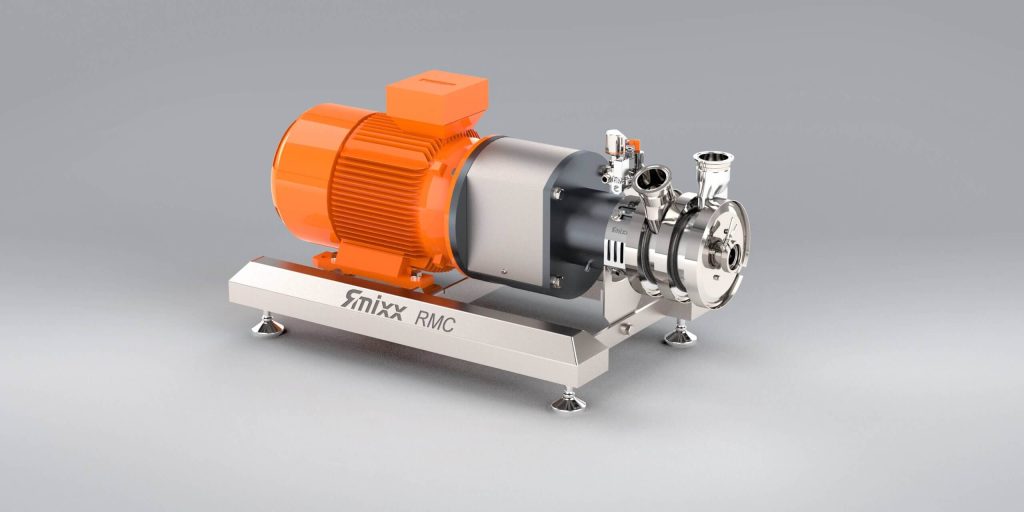 RMC Inline powder dissolving machineDraws in powders without dust, dissolves them and disperses them in a single pass. No lumps, no charging losses.Discover the RMC›
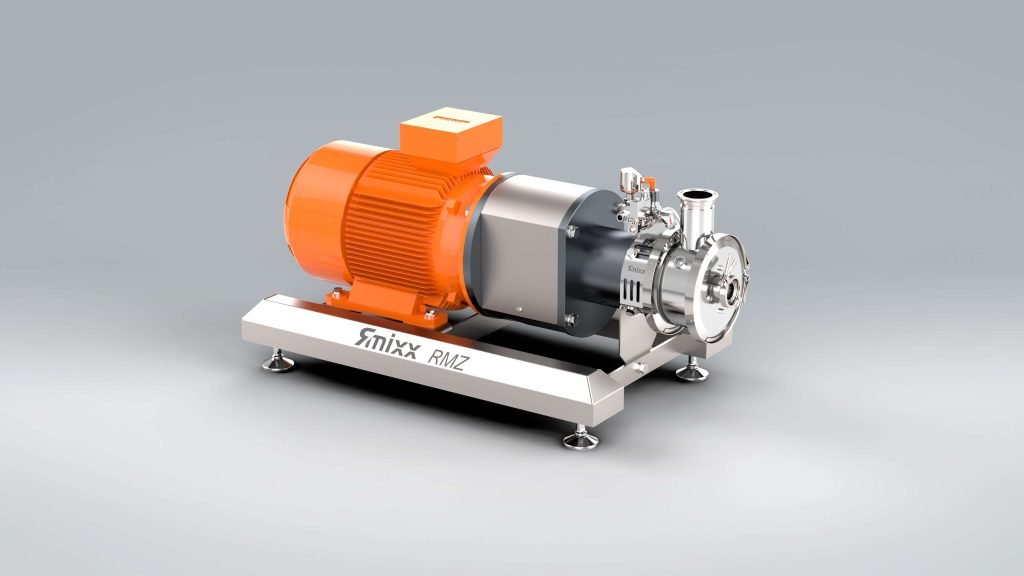 RMZ Inline dispersing machineDisperses directly in the line or through recirculation. Produces emulsions and suspensions quickly and reproducibly.Discover the RMZ›
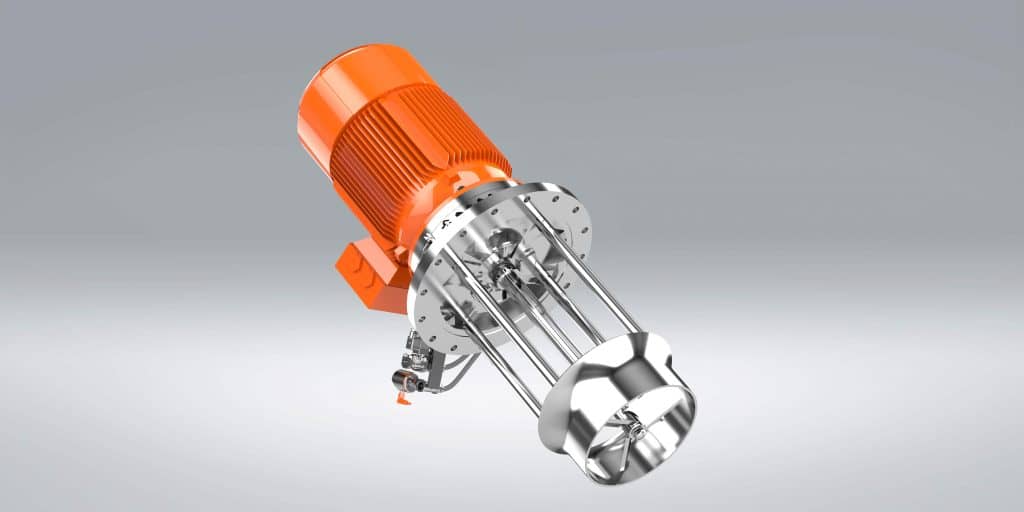 RMY Jet stream mixerMixes homogeneously at a range of viscosities, without air entrainment. Available as top entry and side entry.Discover the RMY›
With direct induction, the pipework must be designed as part of the process. Increasing viscosity changes the pressure loss, feed to the mixing zone and recirculation through the vessel. The inline powder dissolving machine combines powder feeding, wetting and dispersing, but a product trial remains necessary to determine how a specific xanthan variant and formulation respond.
Targeted diagnosis of lumps, air and viscosity deviations
A deviation in xanthan processing must be traced back to the process stage in which it occurs. Simply mixing for longer often masks the cause and can increase air entrainment, heating or batch variation.
- Lumps with a dry core indicate an excessively high local powder concentration or wetting from the outside in.
- Floating powder islands indicate insufficient surface renewal, poor wettability or excessively rapid open tipping.
- Foam and entrained air are often caused by a deep vortex, an above-surface return flow or a powder stream that draws in air.
- An excessively low initial viscosity may result from incomplete hydration and is not automatically evidence of underdosing.
- Different viscosities at each sampling point are more indicative of insufficient macromixing than a problem with the xanthan concentration.
- Varying batches with the same formulation require checks of the dosing sequence, powder feed, temperature, hydration time and measurement conditions.
Prolonged high-shear mixing is not always the right corrective action. Xanthan is relatively robust mechanically, but excessive process loading can cause undesirable heating, air entrainment or changes in viscosity in certain formulations. Once all particles have been properly distributed, hydration primarily requires time and available water; additional shear stress does not then automatically add value.
When high shear or xanthan itself is not the answer
High shear is not the answer when the main problem stems from tank geometry, poor powder dosing or insufficient hydration time. A rotor-stator can only process product that reaches its active zone. In a highly viscous batch with dead zones, a more powerful dispersing head may therefore have less effect than better macromixing or an adjusted process sequence.
Nor is xanthan the right thickener for every texture. It produces strongly shear-thinning flow behaviour: under movement, the apparent viscosity decreases, and after the load is reduced, the structure builds up again. This is useful for pumping, dosing and stabilising suspensions, but can produce an undesirable mouthfeel, stringiness or a different processing characteristic from starch, carbomer or another hydrocolloid.
Without a product trial, no reliable statement can be made about the best mixing head, dosing sequence or final condition. Xanthan type, particle behaviour, water quality, pH, dissolved substances, oil content and desired rheology interact with each other. A laboratory- or pilot-scale trial must therefore demonstrate not only that the formulation becomes lump-free, but also which process parameters are required for reproducible scale-up.
Scaling up requires equivalent process conditions
A laboratory method cannot be scaled up reliably by merely maintaining the same mixing time. On a production scale, the powder feed, liquid circulation, distance to the mixing head, residence time in a rotor-stator and the rate at which bulk viscosity increases all change. The critical question is whether each powder particle is still wetted quickly enough and whether the entire batch passes through the active zone often enough.
During scale-up, the dosing strategy, flow path, local shear, recirculation and hydration conditions must therefore remain at least functionally equivalent. An inline process generally provides more control over local treatment, while batch dispersing may offer greater flexibility per batch. The considerations between the two concepts are described in inline and batch dispersing.
Cleanability also matters in production. Xanthan residues swell on contact with water and can accumulate in seals, connections, undrained pipes and dead spaces. In food, cosmetics and pharmaceuticals, the choice of materials, surfaces, drainability and accessibility for cleaning media must therefore align with hygienic design under relevant frameworks such as EHEDG, GMP or 3-A Sanitary Standards, insofar as they apply to the process.
Is your installation demonstrably clean after a product changeover in the locations where hydrated gum may remain? This cannot be answered by inspecting only the tank, but requires assessment of the entire product route and the CIP process. You can find design principles for this check in hygienic design and cleaning.
Frequently asked questions about dissolving xanthan
Should xanthan be dissolved in cold or warm water?
Depending on its grade and the formulation, xanthan can be processed within different temperature ranges. More important than temperature alone are powder distribution, water availability, the presence of salts or sugars and the specified process sequence. Use the supplier’s product specification and confirm the selected condition with a trial using the complete formulation.
Why do lumps remain in xanthan?
Xanthan lumps form because the outside of a powder cluster hydrates quickly and forms a gel skin around dry powder. The solution is a lower local powder concentration: dose gradually into a powerful liquid stream, use a dry premix or slurry, or draw the powder into a dispersing zone in a controlled manner.
Can xanthan first be mixed into oil?
Yes, when oil is part of the formulation, xanthan can be pre-dispersed in it. The oil temporarily keeps the particles separate, but does not hydrate them. The slurry must then be distributed uniformly throughout the water phase; otherwise, powder clusters will still form. Also check whether this sequence is compatible with the desired emulsion formation and final texture.
How do I know when xanthan is fully hydrated?
Full hydration is demonstrated by stable viscosity under defined measurement conditions, a homogeneous appearance and the absence of soft gel particles or gel particles filled with dry powder. Always measure at the same temperature, after the same hydration and resting time and using the same measurement procedure. Only then can you distinguish between incomplete hydration and an actual formulation deviation.
Is a rotor-stator always required for xanthan?
No. With a suitable dry premix, limited batch size and good tank circulation, another mixing concept may be sufficient. A rotor-stator becomes particularly relevant when rapid, reproducible wetting, closed powder induction or agglomerate size reduction is required. The choice must suit the viscosity development, dust control and scale-up.
A lump-free process starts before hydration
Xanthan is dissolved reproducibly when the installation treats powder dosing, individual wetting, local dispersing, macromixing and hydration time as a single process. The decisive step takes place before viscosity has fully developed: each particle must come into contact with the water phase individually. More power or longer mixing only compensates for incorrect feeding to a limited extent.
RS Contracting can conduct trials with your product in Coevorden or on site, from laboratory and pilot scale through to production preparation. These trials can assess not only lump formation and final viscosity, but also powder handling, air entrainment, recirculation, cleanability and scalability. For sauces and other food products, the information on producing sauces and dressings also provides relevant process context.