Producing a pharmaceutical suspension requires controlled wetting, deagglomeration and distribution of solid drug particles in a continuous liquid phase, followed by adjustment of the correct rheology and stability. A robust production process prevents hard sedimentation, unwanted particle size reduction, air entrainment and variation in dose uniformity. The critical insight is that a visually homogeneous vessel does not yet prove that a suspension is stable: particle size distribution, degree of wetting, flocculation state and flow throughout the vessel determine whether the product remains reproducible.
A pharmaceutical suspension is a liquid formulation in which undissolved solid particles are distributed in a continuous liquid phase.
The common assumption that more mixing time or more shear automatically produces a better suspension is incorrect. Too little energy leaves agglomerates intact, but too much energy can damage crystals, shift the particle size distribution undesirably, introduce heat or damage shear-sensitive excipients. As a result, a batch may appear acceptable upon release but may still cake, separate or become difficult to redisperse later.
Producing a pharmaceutical suspension starts with the desired particle behaviour
The desired product properties must be translated into measurable process objectives before selecting the machine. This concerns not only the average particle size, but also the distribution, crystal form, wettability, sedimentation rate, redispersibility, viscosity and doseability.
A suspension is not thermodynamically stable: the solid phase tends to separate from the liquid. Formulation and process engineering slow or control this separation, but do not eliminate the underlying difference in density. A sediment is therefore not necessarily a defect; a compact sediment that can no longer be redispersed generally is.
Do you know whether the sediment in your current product becomes freely suspended again or remains on the bottom as a hard cake? A loose sediment produced by controlled flocculation can be redistributed by shaking. A hard cake is more indicative of a combination of fine particles, strong mutual attraction, prolonged storage and insufficient protection by the continuous phase.
Wetting determines whether shear reaches the particles at all
A dry powder can only be dispersed effectively after the liquid has wetted the particle surface. When powder is added faster than liquid can penetrate between the particles, a wet outer layer forms around a dry core. These lumps can continue circulating in the batch for a long time without actually breaking apart.
Surface tension, contact angle, porosity, particle shape and entrapped air affect wetting. A suitable wetting agent can reduce interfacial tension, but its dosage, order of addition and compatibility with the active ingredient must be pharmaceutically justified. Simply mixing more vigorously rarely compensates efficiently for unfavourable surface chemistry.
Practical measures to prevent dry cores and fish eyes are explained in more detail under wetting powder without lumps. The relevant distinction is that wetting brings liquid to the surface, while dispersing breaks apart already wetted agglomerates using shear stress and pressure gradients.
Particle size reduction and deagglomeration are not the same process objective
Deagglomeration separates weakly bound primary particles without necessarily reducing the size of the crystal itself. Wet milling or intensive rotor-stator processing can also affect the primary solid particles. This difference is important in pharmaceuticals because primary particle size affects dissolution rate, bioavailability, physical stability and, in some cases, crystal form.
Is your process objective to break apart soft agglomerates, or must the active particle itself also be made smaller? If the objective is exclusively deagglomeration, the energy input must be limited and demonstrably reproducible. When actual particle size reduction is required, wear, heat generation, the milling mechanism and possible contamination are additional design and validation issues.
The production sequence prevents formulation and mixing from working against each other
A reproducible suspension is created by performing the process steps in a fixed, substantiated sequence. The exact sequence depends on the active ingredient, the excipients and the validated preparation method, but the process model below shows where the main risks arise.
-
Prepare the continuous phase. Dispense the products and dissolve fully soluble excipients under conditions appropriate to their solubility and stability. Incompletely dissolved salts, preservatives or buffers may later be incorrectly measured as active particles or contaminants.
-
Hydrate rheology modifiers in a controlled manner. Polymers, gums and other suspending agents require sufficient contact with the liquid and often a specific hydration sequence. A premature increase in viscosity inhibits powder wetting and bulk circulation; adding them too late can entrap agglomerates that have already formed.
-
Make the active powder suitable for controlled dosing. Break up unwanted lumps before or during feeding and prevent bridging, irregular mass flow and dust dispersion. The feed rate must correspond to the rate at which the system can wet and convey away the powder.
-
Wet the particle surface. Introduce powder into a zone with sufficient liquid renewal and controlled energy input. Pouring powder onto a poorly moving liquid surface increases the risk of floating layers, air entrapment and dry cores.
-
Deagglomerate to the defined end point. A rotor-stator can generate high local shear stress, while recirculation determines how often each volume element passes through that active zone. The end point should be established using a relevant method, rather than solely by means of a fixed mixing time.
-
Set the final formulation. Add the remaining excipients and make corrections only in accordance with the approved preparation instructions. Changes in pH, ionic strength or solvent composition can alter the rheology, flocculation and solubility of the active ingredient.
-
Homogenise without subjecting the product to unnecessary further stress. Once the desired degree of dispersion has been achieved, complete tank circulation is generally the main remaining requirement. Excessive further processing can cause air entrainment, heat and additional particle size reduction without providing any further product benefit.
Do you know during which process phase the viscosity of your batch is at its highest? This peak is often more decisive for the equipment than the final viscosity. A system that mixes the thin initial phase effectively may provide insufficient circulation after hydration, leaving wall zones and bottom areas outside the effective mixing pattern.
The combination of order of addition, local shear and tank circulation therefore determines whether all particles have the same process history. During scale-up, it is not sufficient merely to adopt a rotational speed or mixing time; comparable wetting, energy distribution, residence time and passage frequency through the dispersion zone are required.
“Customers often ask for more shear force, but in practice a suspension usually fails because of insufficient bulk circulation when the viscosity reaches its peak.”
Bart Brouwer
Sales Manager
It becomes particularly apparent at production scale that a powerful dispersion head cannot compensate for a lack of bulk flow. When only the area around the rotor-stator is moving actively, powder accumulations and concentration gradients persist elsewhere. Conversely, strong tank circulation can transport agglomerates, but cannot break them apart completely without sufficient local shear stress.
Controlling sedimentation without making the product unusably thick
The stability of a pharmaceutical suspension is based on a balance between particle interactions and the rheology of the continuous phase. A higher viscosity generally reduces the sedimentation rate, but does not automatically improve the product: it can make pumping, filling, dosing and redispersion more difficult.
Many suspensions are therefore designed to be pseudoplastic or thixotropic. During storage, the structure provides resistance to sedimentation, while the viscosity decreases during shaking, pumping or dosing. Once shear is removed, the structure must recover in a controlled manner; recovery that is too rapid can impede filling, while recovery that is too slow can allow separation after filling.
Controlled flocculation can be better than maximum deflocculation
Completely separate, very fine particles may sediment slowly but eventually pack closely together. Strong attractive forces can then produce a cake that is difficult to redisperse. With controlled flocculation, the particles form looser structures that may settle more quickly but provide a greater sediment volume and better redispersibility.
The sedimentation rate must therefore never be used as the sole stability criterion. Also assess sediment structure, supernatant, resuspendability, particle size distribution after storage and the uniformity of successive doses. The desirable flocculation state depends on the dosage form, formulation and product specification.
Temperature, pH and ionic strength change the product during production
Process conditions affect both the active ingredient and the excipients. Temperature can reduce viscosity, accelerate hydration, change solubility and promote crystal growth. During cooling, temporarily dissolved material may recrystallise, causing the final particle distribution to differ from the distribution immediately after dispersion.
pH and ionic strength can also change the charge on the particle surface and the performance of polymers. A small formulation adjustment at the end of the batch can consequently cause a major change in flocculation or viscosity. Process samples must therefore be assessed at a defined time and under representative conditions.
Batch, inline and recirculation configurations solve different mixing problems
The correct configuration depends on whether the dominant problem occurs in the tank, at the powder feed or in the dispersion zone. Batch mixing provides direct treatment in the vessel, inline dispersion provides a defined active zone in a pipe and recirculation combines that zone with repeated passage of the tank contents.
| Configuration | Strength | Key consideration | Suitable application |
|---|---|---|---|
| Tank mixer | Bulk circulation and maintaining uniformity during preparation | Local shear may be insufficient for persistent agglomerates | Dissolving, homogenising and keeping the suspension moving |
| Batch disperser | Local rotor-stator processing directly in the vessel | The tank geometry must convey all product to the active zone | Controlled deagglomeration for each batch |
| Inline disperser | Reproducible processing in a defined process zone | A uniform feed and suitable residence time are necessary | Continuous processing or treatment in recirculation |
| Inline powder induction | Powder is drawn into a liquid stream and wetted | Powder flow and liquid capacity must be matched | Reducing floating layers, dust and dry lumps |
| Recirculation loop | Combines tank mixing with multiple inline passes | Short-circuit flows can cause an uneven process history | Batch dispersion with control over the end point |
A more detailed technical assessment is provided under inline and batch dispersing. Neither principle is universally better. A product with fragile crystals may benefit from short, limited treatment, while a powder that is difficult to wet may require an intensive but well-controlled induction and dispersion zone.
Pharmaceutical suspensions often require a combination of homogeneous tank circulation, metered powder induction and reproducible rotor-stator processing. Depending on the formulation, this can be performed using inline dispersion, inline powder dissolution or a jet stream mixer that circulates phases with varying viscosities without unnecessary air entrainment.
The right machine for your process
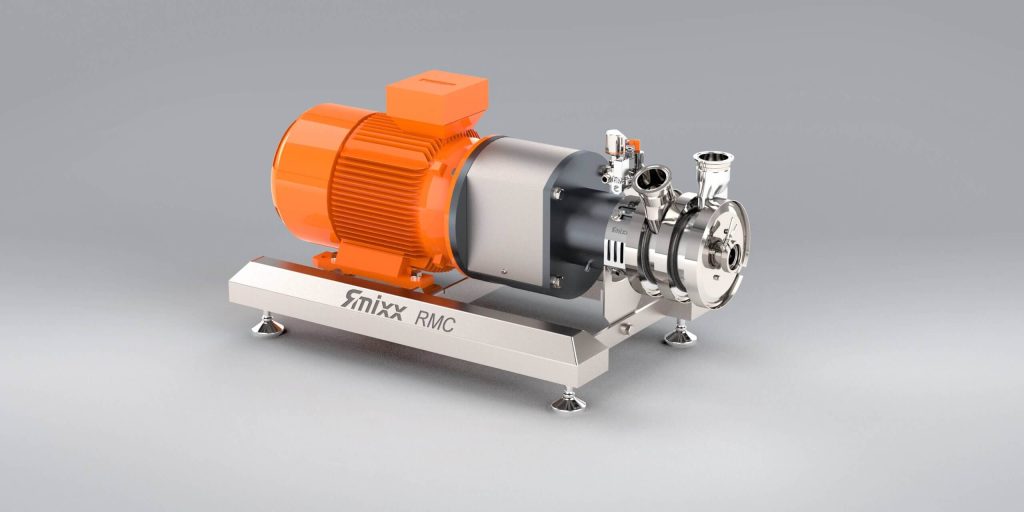 RMC Inline powder dissolving machineDraws in powders without releasing dust, dissolves them and disperses them in a single pass. No lumps, no charging losses.Discover the RMC›
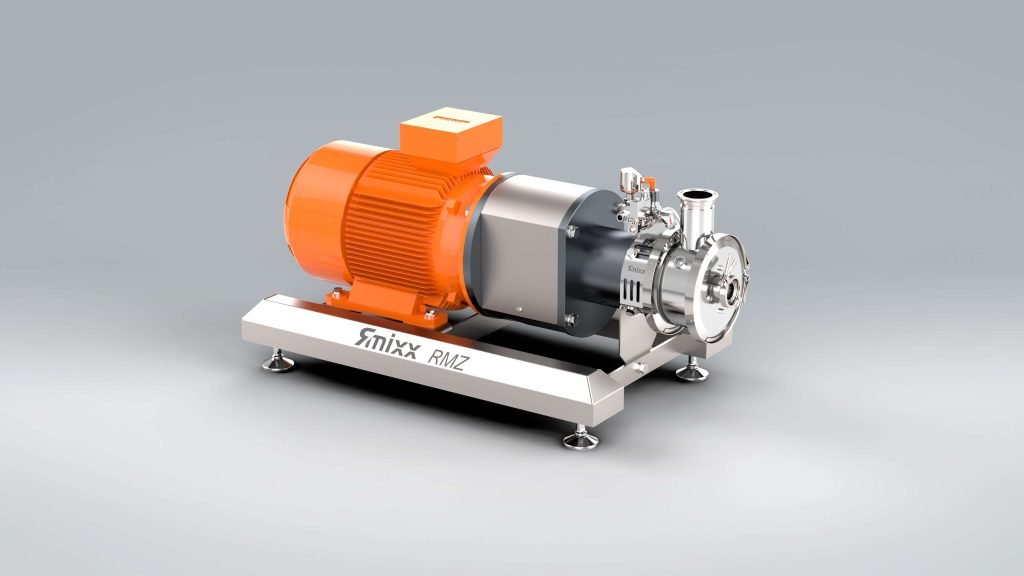 RMZ Inline dispersing machineDisperses directly in the pipe or via recirculation. Produces emulsions and suspensions quickly and reproducibly.Discover the RMZ›
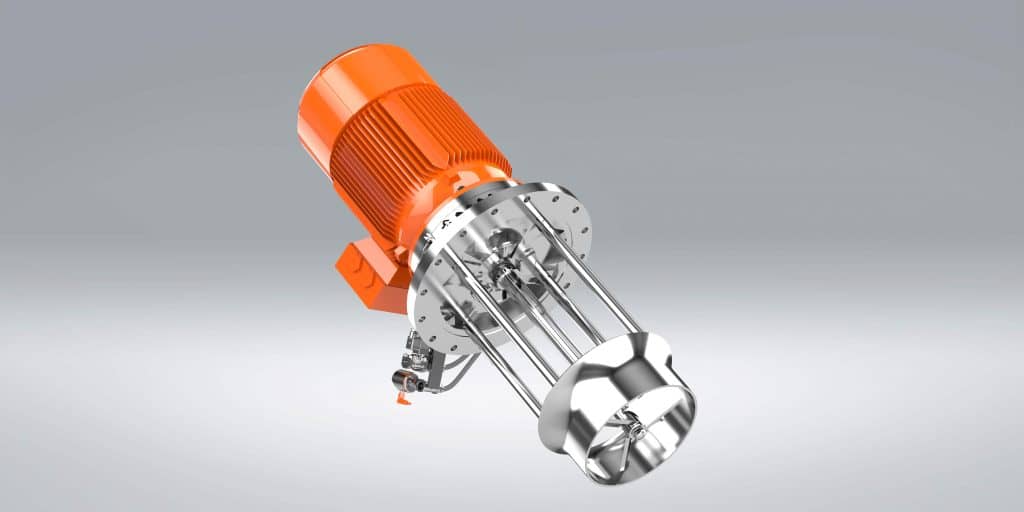 RMY Jet stream mixerMixes homogeneously at varying viscosities without air entrainment. Available as top entry and side entry.Discover the RMY›
A machine selection cannot be based reliably on batch volume and final viscosity alone. RS Contracting can conduct trials with the customer’s product in Coevorden or on site, allowing wetting, shear response, air behaviour and scalability to be investigated before final implementation. The available solutions for this sector are listed under process equipment for pharmaceuticals.
High shear is not always the right treatment
High shear is suitable when agglomerates must be broken up using high local shear stress, but it is not automatically suitable for every pharmaceutical suspension. The active ingredient, crystal structure, excipients and desired end point determine how much mechanical stress is acceptable.
Intensive rotor-stator processing may be undesirable when crystal breakage changes the dissolution rate or stability, when polymorphic transformation poses a risk or when long polymer chains degrade through shear. Highly foaming formulations or products with a fragile structure may also require a gentler mixing method, vacuum treatment or separate process steps.
The correct question is therefore not how much shear a machine can provide, but how much energy and which type of energy the product requires. The geometry of the rotor and stator, gap size, passage frequency and flow through the head jointly determine the result. Without a product trial, it is often impossible to predict responsibly where the optimum operating range lies for a new formulation.
Air entrainment disrupts both the process and quality control
Air in a pharmaceutical suspension can interfere with density measurements, fill volumes, pump behaviour and visual assessment. Foam at the surface is only the visible part; microbubbles can remain trapped in a viscous matrix and only be released later.
Air can enter through pouring powder above the liquid surface, an insufficiently submerged mixer, a vortex, leakage on the suction side or an unfavourable return line. Higher viscosity slows deaeration, meaning that a problem arising early in the batch may only become visible during filling or final inspection.
Vacuum can be useful for removing entrapped air and drawing powder below the liquid surface, but it is not a universal remedy. Reducing pressure can cause evaporation, cooling or foam expansion and must be compatible with the volatility and stability of the formulation. Limiting air entrainment at its source remains preferable.
Producing a pharmaceutical suspension under GMP requires a controlled design
Producing a pharmaceutical suspension under GMP requires equipment, process parameters, cleaning and sampling to be demonstrably controlled. A good mixing result is insufficient if product residues remain, samples are not representative or critical process parameters cannot be recorded reproducibly.
Hygienic design starts with accessibility and complete drainage
Product-contact parts must be cleanable, inspectable and suitable for the cleaning agents used. Dead zones, poorly draining pipe sections, seal cavities without through-flow and inaccessible connections increase the risk of carry-over and microbiological growth. A CIP process only works when cleaning liquid reaches every product-contact zone with sufficient action.
Is every product-contact zone of your mixer, recirculation loop and sampling point demonstrably within the cleaning boundary? This is established through a design review, a defined cleaning cycle and cleaning validation at the most difficult-to-clean locations. Practical design principles are described under hygienic design and cleaning.
Sterile suspensions impose additional requirements
For a sterile pharmaceutical suspension, mixing technology is only one part of the contamination control strategy. EU GMP Annex 1 is relevant to sterile production and imposes requirements concerning design, aseptic processing, monitoring and control of interventions, among other matters. A machine that disperses well mechanically does not automatically make a process aseptic.
Terminal sterilisation is generally preferred within the sterile framework where possible, but it is not technically suitable for every suspension. Heat or radiation can change the active ingredient, excipients, rheology or crystal structure. When aseptic preparation is required, sterilizability, SIP, closed transfer and the effects of filters or other barriers must already be taken into account during process development.
The end point must be linked to product quality
A fixed mixing time is only defensible when it has been demonstrated that it consistently delivers the required quality within the validated process window. Relevant controls may include particle size distribution, viscosity profile, sedimentation behaviour, redispersibility, assay, dose uniformity, pH and the visual absence of agglomerates.
The sampling location is critical in this respect. A sample from a rapidly moving upper layer may appear homogeneous while a concentrated fraction is present at the bottom. Sampling from multiple representative positions during development shows whether the tank is actually homogeneous and subsequently helps to define a defensible routine sampling point.
Scale-up requires preservation of process functions, not one machine parameter
A laboratory formulation cannot be scaled up reliably simply by keeping the mixing time or rotational speed the same. Vessel proportions, liquid height, pump characteristics, powder feed and the distance the product must travel to the active mixing zone all change with scale.
During scale-up, at least the following functions must be preserved:
-
At every scale, the powder must be capable of being wetted and conveyed away faster than it is supplied.
-
Tank circulation must connect the bottom, wall and liquid surface without an unwanted vortex or air entrainment.
-
The dispersion zone must provide sufficient shear stress without damaging the active particle beyond the permitted level.
-
The residence time and passage distribution must prevent one part of the batch from being overprocessed and another part from being underprocessed.
-
Temperature development and heat removal must remain within the permitted product window.
-
The selected measurement and sampling points must remain representative of the entire batch.
A pilot trial is particularly valuable when the scale-up risk results from multiple linked phenomena, such as simultaneous hydration, viscosity build-up and deagglomeration. A transparent model product can make flow visible, but it does not replace a trial with the actual formulation when wettability, crystal behaviour or shear sensitivity are decisive.
Frequently asked questions about pharmaceutical suspensions
How do you prevent lumps in a pharmaceutical suspension?
Lumps are prevented by matching the powder feed to the available wetting and dispersion capacity. Add powder in a zone with continuous liquid renewal and prevent the viscosity from becoming too high before the active powder is introduced. A rotor-stator can break apart wetted agglomerates, but does not always eliminate a dry core efficiently.
Why does a pharmaceutical suspension settle?
A pharmaceutical suspension settles because the solid particles and continuous liquid phase have different densities. The sedimentation rate is also affected by particle size distribution, particle shape, viscosity and flocculation state. Settling does not automatically mean rejection; the sediment must remain within the product specification and be sufficiently readily and uniformly redispersible.
When do you choose inline dispersion for a suspension?
Inline dispersion is appropriate when a defined, reproducible rotor-stator zone is required or when powder induction and recirculation must be combined. The technology is less suitable if the crystals can withstand virtually no mechanical stress or if tank circulation conveys insufficient product to the inline loop. Product properties and the validated end point remain decisive.
How do you determine whether a suspension has been mixed sufficiently?
A suspension has been mixed sufficiently when representative samples from the relevant process zones meet predefined quality attributes. Visual homogeneity or an elapsed mixing time alone is not sufficient. Depending on the product, assess assay, particle distribution, viscosity, pH, sediment structure, redispersibility and the uniformity of successive doses, among other factors.
A robust process window is more important than maximum mixing power
A reliable pharmaceutical suspension is created when formulation, powder feed, wetting, dispersion, bulk circulation and cleanability are designed as a single process. The best installation does not simply provide maximum shear, but keeps the product within a demonstrable window in which agglomerates disappear without unwanted crystal breakage, air entrainment or rheological damage.
Therefore, first define which particle behaviour, sediment and viscosity profile are acceptable for the dosage form. Then test the critical process steps using the actual product and translate the results into equipment, measurement points and a reproducible preparation sequence. This makes a suspension not only manufacturable, but also scalable, cleanable and validatable.