An oil-in-water emulsion is a dispersion of oil droplets in a continuous water phase, generally stabilised with an emulsifier. You produce this emulsion by first forming a suitable interface and then breaking up the oil phase with sufficient shear stress into droplets that do not quickly coalesce again. Applying more shear alone therefore does not guarantee stability: the formulation, addition sequence, temperature, viscosity and flow through the mixing zone must be aligned.
An incorrect combination leads to creaming, coalescence, phase separation, air entrainment or a batch that falls outside specification after storage. The main process question is therefore not only how small the droplets become, but also what keeps them separated after emulsification.
In an oil-in-water emulsion, water determines product behaviour
In an oil-in-water emulsion, water forms the continuous phase and oil is distributed within it as separate droplets. The continuous phase largely determines how the product flows, dilutes, conducts electricity, dries and feels, although thickeners and a high concentration of the oil phase can significantly change this behaviour.
Definition: an oil-in-water emulsion is a multiphase liquid system in which oil droplets are dispersed in a continuous water phase.
Oil and water are thermodynamically immiscible. Mechanical energy can temporarily distribute oil into droplets, but in doing so increases the total interface between the two phases. The system then attempts to reduce this interfacial energy by allowing droplets to collide and coalesce.
An emulsifier adsorbs at the oil-water interface. The hydrophobic part is oriented towards the oil and the hydrophilic part towards the water phase, creating a protective interfacial layer. This layer can keep droplets apart through electrostatic repulsion, steric hindrance or a combination of the two.
| Characteristic | Oil-in-water | Water-in-oil |
|---|---|---|
| Continuous phase | Water phase | Oil phase |
| Dispersed phase | Oil droplets | Water droplets |
| Dilution | Generally dilutable with the water phase | Generally dilutable with the oil phase |
| Electrical conductivity | May conduct when the water phase contains ions | Generally conducts considerably less |
| Typical product behaviour | Often less greasy and easier to rinse off | Often greasier, more occlusive and water-repellent |
Does your product actually dilute homogeneously with water, or do strands, flakes or a separate layer form? A dilution test provides an initial indication of the continuous phase, but is not a complete stability test. Thickeners, a concentrated oil phase and phase inversion can affect the observed behaviour.
Instability begins with moving and colliding droplets
An oil-in-water emulsion becomes unstable when droplets move, adhere to one another or actually coalesce. The visible defect indicates which mechanism is dominant and therefore where you need to intervene in the formulation or process.
Creaming moves oil without immediately destroying the droplets
During creaming, oil droplets move upwards due to a difference in density, creating a concentrated emulsion layer. The droplets may remain intact, meaning that slight creaming can sometimes still be reversed by gentle mixing. A smaller droplet size, higher viscosity of the water phase and lower droplet mobility slow this phenomenon.
Flocculation brings droplets together
During flocculation, droplets form loose clusters without immediately coalescing. This can occur when electrostatic or steric repulsion is insufficient, for example due to changes in pH, salt loading or emulsifier coverage. Flocculation often accelerates creaming and increases the likelihood of subsequent coalescence.
Coalescence increases the size of individual droplets
During coalescence, the interfacial layer between colliding droplets breaks and the oil phases merge. This process cannot be reversed by simple stirring; the emulsion must be rebuilt and dispersed again. Insufficient emulsifier at the newly formed surface, an unsuitable emulsifier or excessively slow adsorption are common causes.
Phase inversion changes which medium is continuous
During phase inversion, an oil-in-water system can change into water-in-oil. This may be caused by the phase ratio, addition sequence, temperature, emulsifier chemistry or local overconcentration of oil. A formulation that appears stable at laboratory scale may invert at production scale when oil is added locally faster than the tank circulation can handle.
The practical mistake is often that all instability is treated as a shortage of shear. More shear does not help when the interface is chemically insufficiently protected or when the continuous phase provides too little structure. In that case, it may actually create more unprotected droplet surface.
“In practice, phase separation rarely results from insufficient shear. Usually, the oil phase is dosed faster than the emulsifier can adsorb or the tank circulation can handle.”
Bart Brouwer
Sales Manager
If you identify the fault pattern as creaming, flocculation, coalescence or phase inversion, you can make targeted corrections. Without this diagnosis, the emulsifier, thickener and mixing energy are often adjusted simultaneously, making it impossible to determine which change actually had an effect.
The formulation must protect new droplet surface immediately
A stable formulation contains an emulsifier system that suits the oil phase, water phase, process conditions and desired continuous phase. The hydrophilic-lipophilic balance can guide selection, but does not independently predict how proteins, polymers, electrolytes, active substances and temperature changes affect the interface.
During droplet formation, the emulsifier must adsorb quickly enough at the expanding interface. When dispersing creates new surface faster than the emulsifier can cover it, partially unprotected droplets collide and coalesce again. Additional mechanical energy then provides hardly any more durable particle size distribution.
A stabiliser and an emulsifier do not automatically perform the same function. An emulsifier primarily protects the interface, while a hydrocolloid or other rheology modifier mainly structures the continuous phase and slows droplet movement. Some proteins and polymers can contribute to both, but their action remains dependent on hydration, pH, ionic strength and temperature.
Do you know at which process stage the viscosity peaks: during emulsification, during cooling or only after complete hydration? That point determines whether the mixer still generates sufficient tank circulation and whether all parts of the product reach the active mixing zone. More background on this relationship is available under viscosity in mixing processes.
The correct dosage and combination cannot be reliably derived from an ingredient list alone. Oil polarity, density, solubility of components, wettability and interactions with preservatives differ for each formulation. A product trial is therefore necessary when stability, texture or scale-up is critical.
Producing an oil-in-water emulsion in seven process steps
A reproducible oil-in-water emulsion is created by preparing both phases under controlled conditions, forming a pre-emulsion and only then developing the desired droplet distribution. The correct sequence prevents local overconcentrations, poorly hydrated thickeners and unnecessarily high thermal loading.
-
Prepare the water phase completely. Dissolve water-soluble ingredients and hydrate thickeners under conditions appropriate to their chemistry. Poorly wetted powders form agglomerates with a dry core, which may later be incorrectly mistaken for oil droplets or product contamination.
-
Prepare the oil phase separately. Mix oil-soluble components into a uniform phase. Solid fats or waxes must be fully processed before droplet formation begins; otherwise, the local composition changes during emulsification.
-
Bring both phases to suitable process conditions. A large difference in temperature or viscosity can disrupt droplet formation and cause local solidification. The required conditions depend on the melting behaviour, the emulsifier and the sensitivity of active substances.
-
Form a uniform pre-emulsion. Dose the oil phase in a controlled manner into a well-circulating water phase, unless the formulation deliberately uses a phase inversion method. The feed rate must not exceed the uptake capacity of the mixing zone.
-
Reduce the droplet size with controlled shear. A rotor-stator generates strong velocity gradients and shear stress, causing larger oil droplets to deform and break up. Dispersing as a process includes both droplet size reduction and uniform distribution throughout the product.
-
Cool while maintaining circulation. During cooling, fats may crystallise, polymers may hydrate further and viscosity may increase sharply. The tank flow must therefore remain intact long enough to prevent temperature and concentration differences.
-
Add sensitive components and remove unwanted air. Fragrances, active ingredients or volatile substances are often added only under appropriate final conditions. Vacuum or gentle post-treatment may be required when air entrainment affects density, oxidation, filling accuracy or visual quality.
The addition sequence is not a universal rule. Some emulsions are deliberately built up through phase inversion, and certain emulsifiers must be dissolved in a specific phase. Deviating from the sequence may therefore be correct, but only when the mechanism is controlled in the formulation and during scale-up.
Shear reduces droplet size, but product flow determines uniformity
A rotor-stator can only reduce the size of droplets that actually pass through the narrow active zone between the rotor and stator. High local shear stress has little value when part of the tank remains outside the main flow or when only the product around the mixing head is recirculated.
Does every tank volume repeatedly pass through the active mixing zone, or is mainly the centre of the batch moving? This question is answered by the flow pattern: mixer placement, tank geometry, liquid level, viscosity profile and any wall flow determine circulation. Dead zones produce a broad droplet size distribution, even when the dispersing head provides sufficient local shear.
During inline emulsification, the product flows through a defined rotor-stator zone in a pipe or recirculation loop. This makes the mechanical treatment easier to control, provided that flow rate, pressure behaviour, heat generation and the number of passes are aligned. An inline dispersing machine may therefore be suitable for reproducible emulsion formation, but it does not correct an incorrect formulation.
Batch technology provides direct treatment in the vessel and may be attractive when formulation steps, levels and viscosity change significantly during the batch. Inline and batch are not absolute quality levels; the correct choice follows from residence time, desired particle size distribution, heat sensitivity, cleaning and the extent to which the batch can circulate homogeneously.
| Process criterion | Batch treatment | Inline or via recirculation |
|---|---|---|
| Additions during the batch | Can be monitored directly in the process vessel | Requires controlled dosing towards the pipe or vessel |
| Mechanical treatment | Dependent on tank circulation and the position of the mixing head | Clearly defined in the inline mixing zone |
| Viscosity change | May restrict circulation in the vessel | May restrict pumpability and pressure loss |
| Scale-up | Requires maintenance of the flow pattern and circulation time | Requires maintenance of the load per pass and residence time |
| Cleaning | The tank, shaft and mixing head must be accessible or suitable for CIP cleaning | The pipework, rotor-stator and recirculation loop must be fully cleanable |
A robust process line therefore combines functions instead of relying exclusively on a single mixing head: low-dust powder induction and hydration for the water phase, sufficient jet stream mixing for tank homogeneity and targeted rotor-stator treatment for the emulsion. This allows powders to be dissolved without persistent agglomerates, while oil is dispersed in a controlled manner and the entire batch remains in motion.
The right machine for your process
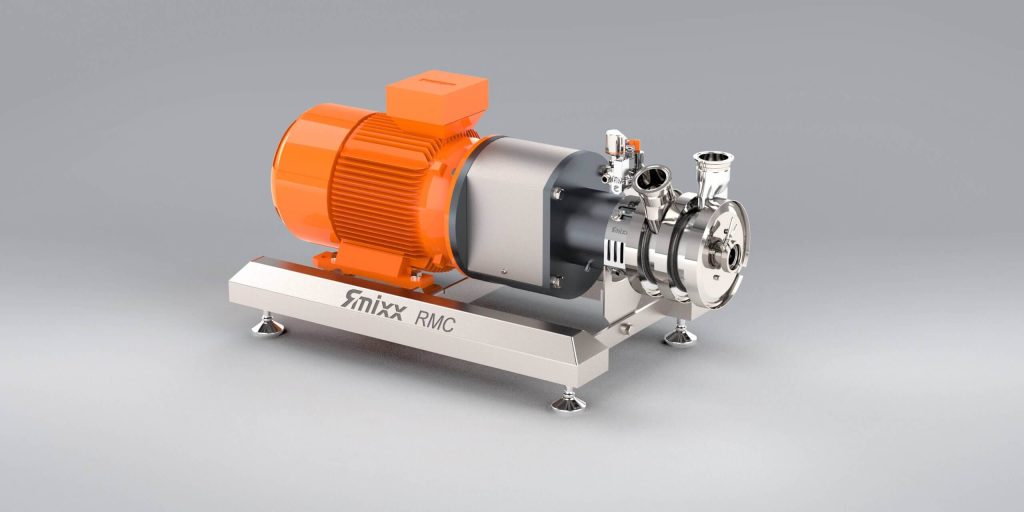 RMC Inline powder dissolving machineInducts powders without dust, dissolves them and disperses them in a single pass. No lumps, no charging losses.Discover the RMC›
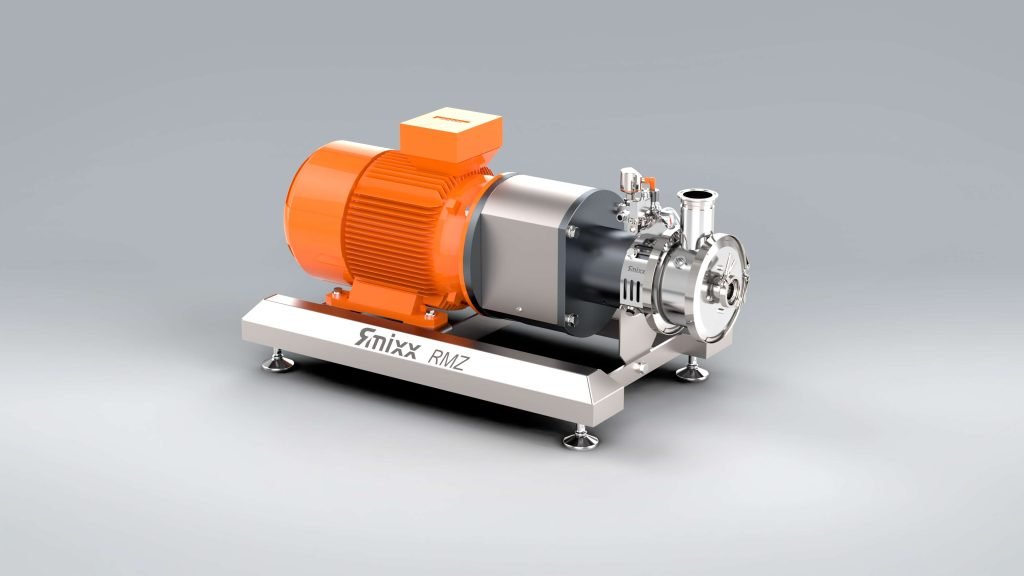 RMZ Inline dispersing machineDisperses directly in the pipe or via recirculation. Produces emulsions and suspensions quickly and reproducibly.Discover the RMZ›
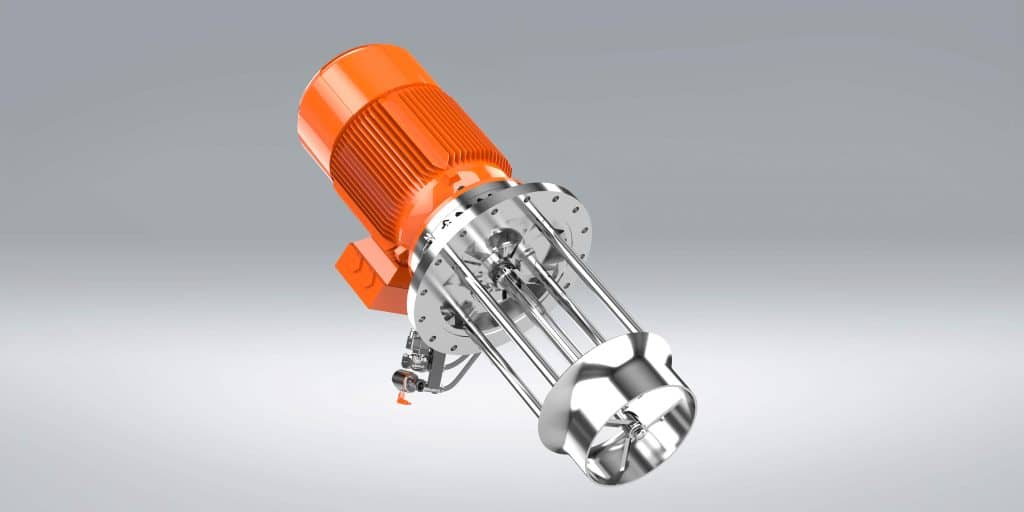 RMY Jet stream mixerMixes homogeneously at a range of viscosities, without air entrainment. Available as top entry and side entry.Discover the RMY›
A higher tip speed or narrower rotor-stator geometry generally produces more local shear, but also more heat generation and potentially additional air entrainment. Shear-sensitive polymers, proteins or crystal structures may lose their function through overprocessing. The final setting must therefore be determined on the basis of product quality, not maximum available machine power.
Assessing stability requires more than a smooth appearance
A fresh emulsion may appear homogeneous yet still be insufficiently stable. A useful test plan links measurement methods to the expected failure mechanisms and monitors the droplet distribution, rheology and macroscopic phase separation.
-
Microscopy or an appropriate particle analysis shows whether the droplet size distribution is already broad immediately after production or changes during storage.
-
Viscosity and flow behaviour measurements show whether the continuous phase retains sufficient structure and whether thixotropy affects behaviour during use.
-
Storage under relevant temperature conditions reveals creaming, crystallisation, coalescence and changes caused by temperature cycles.
-
Centrifugal loading can provide early indications of a tendency to separate, but does not replace a product-specific shelf-life assessment.
-
pH, conductivity and visual assessment help identify changes in the water phase, phase inversion and chemical interactions.
Take samples at representative locations and times. A sample taken only from the top of the tank may overestimate creaming, while a sample taken only at the outlet misses local deviations elsewhere in the vessel. During scale-up, the acceptance plan must therefore also include homogeneity throughout the batch and reproducibility between batches.
For food, cosmetics and pharmaceutical applications, process stability must be combined with controllable cleaning and product safety. CIP, drainage, seals, material selection and the avoidance of product traps must be considered from the design stage; hygienic design of mixing installations cannot be corrected afterwards with a more intensive cleaning programme. In pharmaceutical processes, GMP, validation and, where relevant, EU GMP Annex 1 are additional process frameworks.
When an oil-in-water emulsion is not the right product form
An oil-in-water emulsion is not automatically the best choice when water resistance, occlusion, solubility or chemical stability is more important than rinseability. The desired properties in use and the solubility of the active component must be established before selecting the machine.
A water-in-oil emulsion may be more suitable when the oil phase must form the external medium or the product must be highly water-repellent. A solution or solubilised system may be more suitable when optical clarity is required and the oil phase can be formulated accordingly. When solid particles are the dominant issue, you are essentially treating a suspension or combined emulsion-suspension, with different requirements for wetting and sedimentation stability.
A nanoemulsion should likewise not be regarded as a universal quality step. A finer droplet distribution can slow creaming and change the appearance, but requires suitable interfacial chemistry and process energy. Without a product-specific trial, it is not possible to determine which droplet distribution is technically necessary, achievable and stable during the required storage period.
Frequently asked questions about oil-in-water emulsions
The following answers address the practical questions that usually arise during formulation, production and fault diagnosis.
How do you know whether an emulsion is oil-in-water?
An oil-in-water emulsion can generally be diluted homogeneously with the water phase and may conduct electricity when that water phase contains sufficient ions. A dye that dissolves only in water is distributed mainly through the continuous phase. Combine several tests, because high viscosity, a concentrated oil phase or incipient phase inversion can make a single test misleading.
Why does an oil-in-water emulsion separate after production?
Separation usually occurs because droplets are too mobile, have insufficient interfacial protection or coalesce during storage. First determine whether creaming, flocculation, coalescence or phase inversion is occurring. Only then should you make targeted corrections to the emulsifier, water-phase viscosity, addition sequence, temperature control, droplet distribution or tank circulation.
Is more shear always better for an emulsion?
No. More shear can further reduce the size of larger droplets, but at the same time creates a new interface that must be protected immediately by emulsifier. Excessive treatment may introduce heat and air or damage polymers, proteins and crystal structures. The optimum shear has been reached when the required droplet distribution is produced reproducibly without any undesirable change to the product structure.
Which emulsifier is suitable for oil-in-water?
The suitable emulsifier depends on the composition and polarity of the oil phase, the pH and ionic strength of the water phase, the temperature range and interactions with other ingredients. The hydrophilic-lipophilic balance provides initial guidance for selection, but a stability trial remains necessary to assess adsorption, droplet formation, rheology and storage behaviour together.
How do you scale up an oil-in-water emulsion?
Scale-up requires maintaining more than rotational speed or mixing time. You must achieve comparable droplet loading, residence time in the active zone, addition intensity, tank turnover, temperature development and cooling. You must also check whether the viscosity causes dead zones at production scale. Trials at laboratory, pilot and production scale reveal which parameter is actually decisive.
A stable emulsion begins with a product-specific process trial
The best combination of emulsifier, addition sequence, rotor-stator treatment and tank circulation differs for each formulation. RS Contracting can conduct trials with the customer’s product in Coevorden or on site, allowing droplet formation, viscosity development, air entrainment, cleanability and scale-up to be assessed before a final installation is selected.
Define in advance what stable means: no visible phase separation, a limited particle size distribution, a specific flow behaviour or reproducibility between batches. Without such acceptance criteria, an emulsion may look good while still not being technically suitable for storage, filling or release.mixed