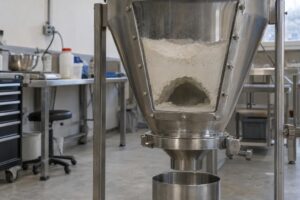
You prevent bridging in a powder hopper by matching the powder strength and wall friction to the hopper geometry, outlet and powder discharge system. A steeper wall or larger outlet can help, but only when it is clear whether cohesion, mechanical interlocking, consolidation, moisture, wall friction or an incorrectly selected feeder is causing the blockage. Otherwise, a vibrator, knocker or air pulse merely treats the symptom and may even compact the powder further.
Bridging is a stable arch of powder above a hopper outlet that causes the product flow to stop completely or periodically. The question is therefore not only how you break the bridge, but especially why the powder develops sufficient strength to support its own weight above the outlet. Without this insight, production downtime, inaccurate dosing, dust nuisance and manual interventions will recur.
A powder bridge forms due to an unfavourable balance of forces
A powder bridge remains in place when the cohesion or mechanical interlocking between the particles is greater than the stress that sets the material in motion again at the outlet. The arch is supported by opposing hopper walls. The smaller the outlet and the higher the wall friction, the more easily the powder can form such a load-bearing structure.
Fine, moisture-sensitive or irregularly shaped particles are often more cohesive than coarse, dry and round particles, but particle size alone does not predict flow. Capillary forces caused by moisture, van der Waals forces, electrostatic effects, fatty constituents and interlocking particles can all contribute. Even an apparently free-flowing powder can become cohesive after storage under load.
The most common assumption is that the angle of repose or the impression gained during manual pouring provides sufficient information about hopper performance. This is not always correct. A powder that flows freely from a bag can develop a much higher unconfined yield strength under consolidation pressure and still form a stable bridge in a production hopper.
Cohesive bridges differ from mechanical blockages
In a cohesive bridge, small particles adhere to one another and form a cohesive arch. In a mechanical bridge, relatively coarse, fibrous, plate-shaped or irregular particles become wedged across the outlet. Both stop the discharge, but they do not automatically require the same solution.
A larger outlet is often beneficial for both mechanisms, but the required design depends on the product and outlet shape. A lump breaker can be useful when soft agglomerates or product lumps block the opening. For a cohesive fine powder, the structural solution is more likely to lie in the hopper geometry, wall material, controlled storage and a suitable discharge system.
Bridging and rat-holing require different diagnoses
With bridging, the product forms an arch above the outlet and the flow generally stops completely. With rat-holing, only a vertical channel above the outlet empties while product remains along the walls. A rat-hole may collapse after this channel has emptied, but it may also remain stable.
The distinction is important because rat-holing usually indicates funnel flow and insufficient mobilisation of product along the wall. Bridging is primarily determined by the relationship between powder strength and outlet geometry. A generic vibrator may temporarily affect both phenomena, but it does not automatically restore the desired flow pattern.
These process factors determine whether bridging recurs
Recurring bridging usually results from a combination of product behaviour, storage conditions, hopper design and discharge control. Assess these factors as one system; a hopper with a well-designed cone can still become blocked if the feeder activates only a small part of the outlet.
| Factor | Mechanism | Practical indication | Direction for the solution |
|---|---|---|---|
| Moisture and temperature | Moisture forms capillary bonds, and temperature differences can cause condensation. | Problems increase after cleaning, seasonal changes or the introduction of warm product. | Control moisture ingress, condensation and residence time. |
| Consolidation during storage | Prolonged or higher loading increases the powder strength. | A newly filled hopper discharges properly but becomes blocked after a standstill. | Test time consolidation and limit unnecessarily long storage. |
| Hopper wall and geometry | High wall friction and unfavourable transitions support the powder arch. | Product remains on welds, deformations or flat sections. | Select the wall angle and finish based on wall friction. |
| Outlet and feeder | A small or partially activated outlet provides insufficient deformation in the powder bed. | The flow starts locally or stops as soon as the feeder setting changes. | Match the outlet shape, dimensions and discharge device to one another. |
| Particles and formulation | Fine fractions, fats, fibres or deformable particles increase cohesion or interlocking. | The problem begins after a change in supplier, grinding process or formulation. | Characterise every relevant product variant under process conditions. |
| Air displacement | Insufficient venting or uncontrolled airflow affects the effective stress in the powder. | The discharge changes during rapid filling, emptying or filter switching. | Check the venting, filters and pressure balance. |
Does the flow change after the powder has remained in the hopper for some time? If so, time consolidation is probably more relevant than the free flow immediately after filling. A design calculation or trial with fresh product may then underestimate the actual behaviour.
Contamination of the hopper wall is also often noticed too late. Deposits, scratches, damaged coatings, protruding gaskets and deformations increase wall friction and provide an attachment point for build-up. Hammering against the wall can therefore be counterproductive: dents make the geometry more irregular and can damage the structure.
“With persistent bridging, people almost always look for the fault in the hopper angle. In practice, an incorrectly selected valve or dosing screw underneath often proves to be the real culprit.”
Bart Brouwer
Sales Manager
The decisive question is whether you need mass flow. With mass flow, all the powder moves as soon as the outlet is active, including the material along the wall. This reduces the risk of stagnant zones, time consolidation, segregation and old product, but requires a hopper shape and wall finish designed for the powder concerned.
Systematically diagnosing bridging in a powder hopper
A proper diagnosis begins while the problem is occurring, not after an operator has already dislodged the blockage. Record what the hopper, feeder and process conditions were doing immediately before the discharge stopped. Only then can you distinguish an incidental blockage from a reproducible design fault.
-
Safely establish the flow pattern. Use the available inspection facilities to determine whether there is a complete bridge, rat-hole, adhesion to the wall or a blockage in the discharge device. Never open or enter a hopper without a formal safe working method, isolation of energy sources and an assessment of asphyxiation, engulfment and explosion risks.
-
Record when the blockage occurs. Note whether the problem arises after filling, after a standstill, at a low fill level, during high withdrawal or when restarting. The timing links the malfunction to consolidation, venting, feeder operation or product variation.
-
Check the product condition. Compare moisture, temperature, fine fraction, lumps, bulk density and origin with batches that flowed properly. Take a representative sample; material at the top of the hopper may differ from material at the outlet.
-
Inspect the complete discharge path. Check the transition to the valve, rotary valve, screw, dosing device or conveying line. A blockage directly below the hopper can appear identical on the control screen to a bridge above it.
-
Assess how the feeder activates the outlet. A feeder must withdraw product across the outlet in such a way that no stagnant zones form. Localised withdrawal can create a preferential channel and further consolidate product elsewhere.
-
Have the flow properties determined under the relevant load. A flow function describes how the unconfined yield strength changes with consolidation. A wall-friction test using the actual wall material supports the selection of the hopper angle, while time consolidation may need to be assessed when powder is stored for prolonged periods.
-
Test the measure with the actual product. Product behaviour depends on the formulation, moisture, temperature and process history. A trial on a laboratory, pilot or production scale is more reliable than a choice based solely on the product name.
Does your discharge stop at the same point in the batch, or only after an unplanned standstill? A fixed point is more likely to indicate the fill level, pressure distribution or feeder geometry; a problem after a standstill is more likely to indicate time consolidation, moisture migration or adhesion. Recording this prevents an incidental operator action from being incorrectly regarded as a technical solution.
The hopper, outlet and feeder must operate as one system
You prevent bridging structurally by designing the hopper wall, outlet and feeder together based on measured powder properties. The critical outlet dimension is not a universal value and also differs between a circular opening and an elongated slot. The hopper shape also influences how stresses are directed towards the outlet.
Do not use the angle of repose as the design angle
The angle of repose is not a reliable substitute for the wall-friction angle. The angle of repose describes how a loosely poured powder forms a pile; wall friction describes how that powder slides along a specific surface under load. Stainless steel with a particular finish, a coating and a contaminated wall can therefore produce different behaviour.
The required hopper slope follows from the combination of wall friction, hopper shape and the desired flow pattern. A steeper wall generally promotes discharge, but simply extending a cone is not always spatially or structurally feasible. Moreover, an outlet that is too small remains susceptible to cohesive arching.
Avoid abrupt transitions and internal obstructions
Welds, ridges, flanges, bolts, sensors and poorly fitting seals can retain product and support a bridge. An asymmetrical transition can also distribute stress unevenly. Hygienic design additionally requires accessible, cleanable surfaces without product traps, particularly in food, cosmetics and pharmaceuticals.
In hygienic processes, a solution for bridging must therefore also be compatible with cleaning and contamination control. Adding an internal moving component may improve the flow while also introducing additional seals, wear parts and difficult-to-access surfaces. The principles of EHEDG, GMP or 3-A Sanitary Standards may be relevant, depending on the industry, application and validation requirements.
A feeder must not empty the outlet locally
A feeder supports stable hopper discharge only when product withdrawal across the outlet matches the selected flow profile. Does your screw mainly draw product away from one side? Material then remains elsewhere, consolidation increases and a rat-hole or bridge may form, even if the hopper itself is sufficiently steep.
The pitch, fill and geometry of a screw or other discharge device must therefore match the outlet. The same applies to valves and rotary valves: a restriction directly below a large hopper outlet merely relocates the problem. Design the smallest effective passage in the entire chain, not just the visible hopper opening.
Discharge aids only work for the correct failure mechanism
A discharge aid is useful when modifying the product, hopper or outlet is not feasible, but it must suit the type of blockage. No single aid reliably compensates for every combination of cohesion, lumps, moisture and poor feeder activation.
-
A vibrator can set dry bulk material in motion, but may compact a cohesive powder further if incorrectly positioned or controlled.
-
A pneumatic knocker provides a local mechanical impulse, but loads the structure and does not correct unsuitable outlet geometry.
-
Aeration or fluidisation temporarily reduces internal friction in suitable fine powders, but may cause dust generation, segregation and uncontrolled discharge.
-
An air pulse can break an existing bridge, but requires dry, suitable compressed air and an assessment of pressure, dust and explosion risks.
-
A stirrer or agitator can actively convey cohesive product towards the outlet, but adds a drive, wear, heat input and cleaning points.
-
A lump breaker is suitable for friable agglomerates, but not for correcting an incorrectly designed hopper for a homogeneous cohesive powder.
A vibrator is therefore not the correct first measure when it is unknown whether the powder stops because of cohesion, mechanical interlocking or a blocked feeder. Fluidisation is also unsuitable for products that segregate severely, oxidise or disperse unwanted dust when air is introduced. Establishing the failure mechanism first prevents the solution from introducing a new process risk.
When powder handling is directly linked to induction, dissolving or dispersing, the uptake capacity of the downstream process must also match the hopper discharge. Hoppers, bunkers, fluidisers and lump breakers from the supporting equipment can be combined with controlled powder induction and inline processing. This addresses not only the bridge but also controls the transfer to the liquid phase.
The right machine for your process
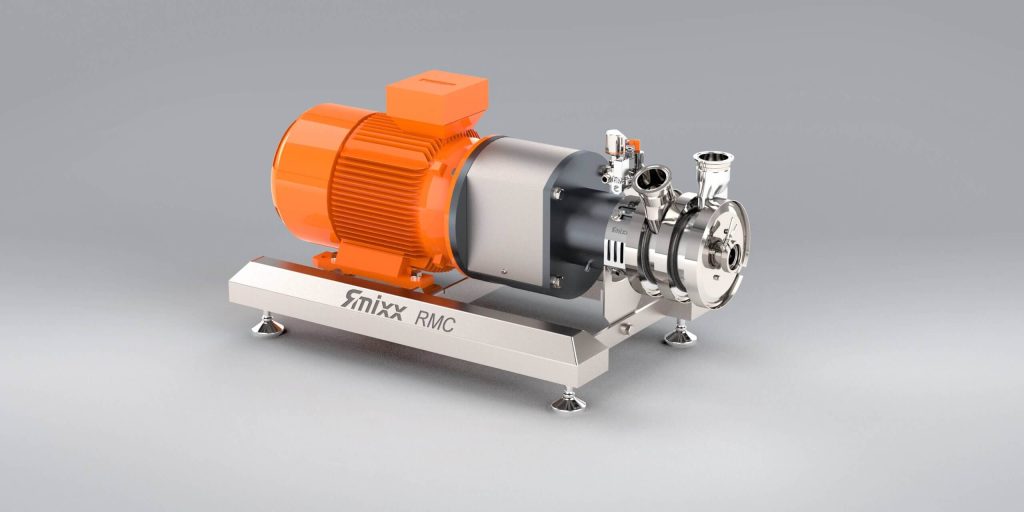 RMC Inline powder dissolving machineInducts powders dust-free, dissolves them and disperses them in a single pass. No lumps, no spillage losses.Discover the RMC›
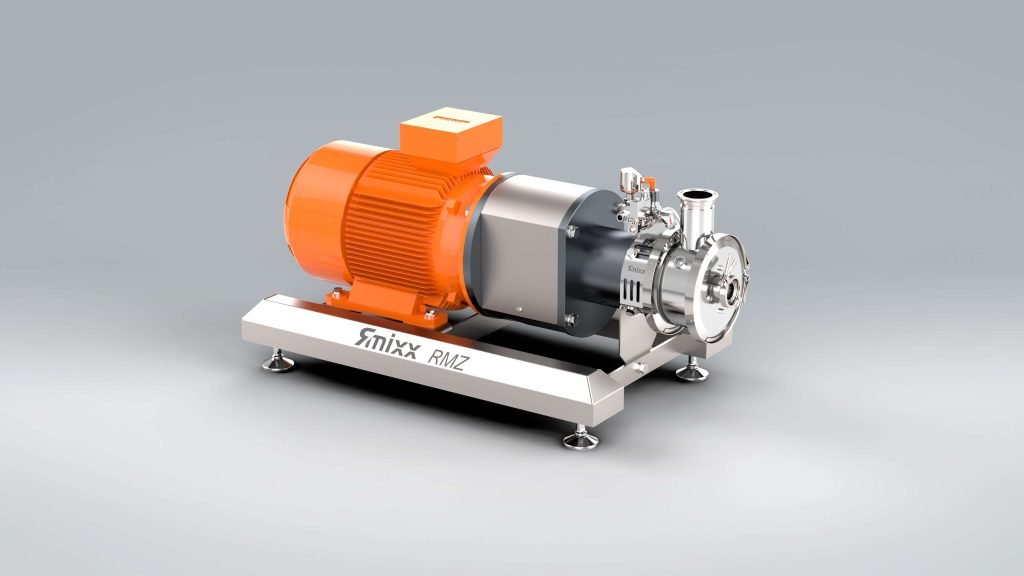 RMZ Inline dispersing machineDisperses directly in the line or through recirculation. Produces emulsions and suspensions quickly and reproducibly.Discover the RMZ›
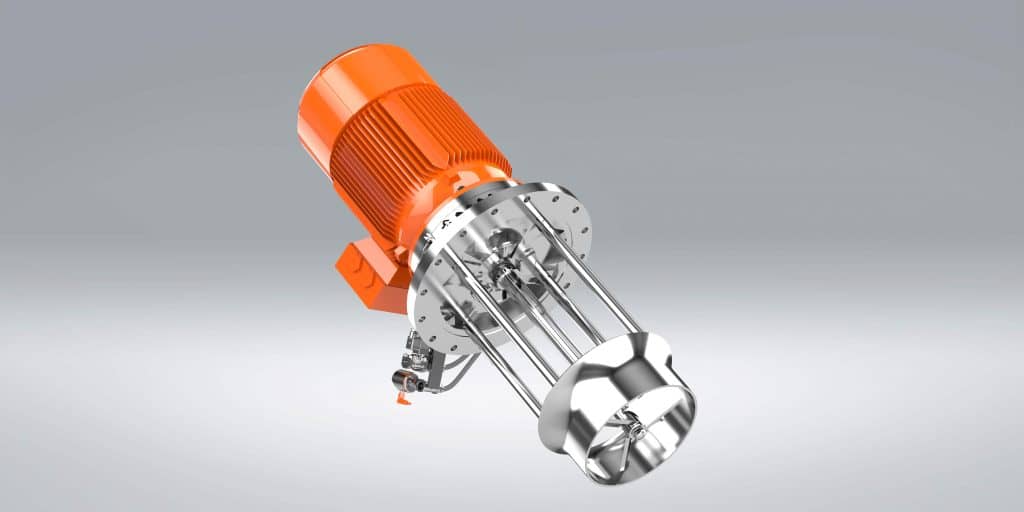 RMY Jet stream mixerMixes homogeneously at varying viscosities without introducing air. Available as top entry and side entry.Discover the RMY›
For powders that agglomerate rapidly as soon as they contact liquid, the analysis does not end at the dry hopper. Stable discharge may still lead to lumps when the powder feed rate exceeds the wetting and dispersing capacity. The choice between inline powder induction and batch induction must therefore be matched to wettability, viscosity build-up, recirculation and the desired particle size distribution.
Moisture, cleaning and product changes alter flowability
A hopper that functions properly during initial commissioning may subsequently exhibit bridging because of changed environmental or product conditions. Cleaning residues, condensation, wear, finer grinding or a different raw material supplier alter the forces between particles and their interaction with the wall.
Does product remain on the wall mainly after wet cleaning? If so, check whether the installation is completely dry before powder is added and whether cold surfaces cause condensation. For hygroscopic products, a small change in moisture exposure may be sufficient to noticeably increase adhesion and cohesion.
For food and pharmaceuticals, unrestricted use of release agents or wall coatings is usually not a straightforward option. Material compatibility, migration, cleanability and validation determine what is permissible. Furthermore, a smooth surface only helps if it retains low wall friction under actual process conditions.
The dust explosion risk determines which intervention is safe
For combustible powders, every measure against bridging must form part of the explosion safety assessment. Vibrators, sensors, drives, electrostatic charging and compressed-air supply can affect ignition or dispersion risks. Equipment intended for use in an explosive atmosphere falls, where applicable, within the framework of ATEX Directive 2014/34/EU.
The zone classification, dust properties, earthing strategy and potential ignition sources determine the design. An air pulse is not automatically safe simply because there is no electric motor in the hopper. Further background on selection and management is provided in explosion-safe powder handling.
Manual probing, striking or opening during operation is not a control measure. In addition to damage to the hopper, there are risks from sudden product collapse, moving feeders and dust exposure. Establish a safe fault procedure and include the structural cause in maintenance and change management.
When a trial is needed for a reliable choice
A trial is needed when the product properties are insufficiently known, several formulations differ significantly or the powder flow is directly linked to a sensitive mixing or dispersing process. Without representative product, it cannot be reliably determined whether a fluidiser, lump breaker, modified outlet or another induction method will produce the best result.
During a trial, use product with a realistic process history: the same storage period, temperature, moisture exposure and degree of consolidation as in production. Assess not only whether the powder discharges once, but also its restart behaviour, dosing stability, dust generation, cleanability and the response of the downstream process. RS Contracting can conduct trials with customer product in Coevorden or on site; for a product-specific assessment, you can have your process data assessed.
Frequently asked questions about bridging in powder hoppers
Why does a vibrator sometimes make bridging worse?
A vibrator can rearrange particles and pack them more closely together. In cohesive powders, this increases consolidation and sometimes also the strength of the powder bridge. The effect depends on the frequency, positioning, activation duration, hopper construction and product behaviour. Therefore, use vibration only when a trial or flow analysis shows that mechanical excitation is appropriate for the failure mechanism.
Is a larger hopper outlet always the best solution?
A larger outlet generally reduces the probability of a stable bridge, but it is not always sufficient or technically feasible. A restriction in the valve or feeder can negate the benefit, while rat-holing may persist. The required shape and dimensions must be determined from the powder strength, consolidation, hopper geometry and wall friction.
How do you know whether moisture is causing bridging?
Moisture is suspect when blockages are associated with wet cleaning, seasonal changes, warm product feed, cold hopper walls or prolonged open storage. Compare representative samples from batches with good and poor flow and also check for condensation and caking. A moisture measurement alone is insufficient when fats, fine fractions or time consolidation are changing at the same time.
When do you need a lump breaker?
A lump breaker is appropriate when friable agglomerates or compacted pieces of product block the outlet or downstream installation. It is not intended as a general correction for an outlet that is too small, high wall friction or cohesive arching throughout the hopper. Also check whether breaking causes unwanted fine fractions, heat, wear or product damage.
What is the most durable approach to recurring powder bridges?
The most durable approach combines representative powder tests with an assessment of the hopper wall, outlet, feeder, venting, storage period and downstream process. Only then do you choose between a geometric modification, process control or an active discharge aid. This addresses the cause of bridging instead of repeatedly dislodging it during production.