Maintenance, safety and hygiene must be treated as a single control system in industrial mixing processes: a machine is only ready for use when it is technically reliable, safely released and demonstrably clean. Proper maintenance prevents excessive wear and unplanned downtime, safety isolation protects employees against mechanical, electrical and process-related energy, and validated cleaning prevents product contamination and cross-contamination. The underestimated factor is their interdependence: an incorrectly fitted seal can simultaneously cause a technical defect, a safety risk and a source of microbiological or chemical contamination.
Simply cleaning more frequently or replacing parts preventively is therefore not enough. The installation must be designed for maintainability and cleanability, the procedure must distinguish between cleaning, disinfection and inspection, and every intervention must end with a controlled release. Otherwise, problems can arise precisely after maintenance, such as tools left behind, an incorrect direction of rotation, leakage, product residues in dead spaces or a guard that has not been refitted.
Maintenance, safety and hygiene meet at the same process boundary
Maintenance, safety and hygiene come together wherever people, machines and products can affect one another. Examples include mechanical seals, rotor-stator sets, bearings, couplings, manholes, sampling points, valves, pipes and CIP connections. The technical condition of these components determines not only availability, but also whether product can escape, cleaning agent can remain behind or an employee can come into contact with moving parts.
In this context, hygienic maintenance means carrying out technical work in a controlled manner without introducing new contamination or safety risks into the process. This includes preparation, safety isolation, disassembly, handling of product-contact parts, assembly, cleaning and documented release.
A common assumption is that maintenance ends as soon as the machine is mechanically operational again. In the process industry, that point is only an intermediate step. A mixer can function technically while a seal is incorrectly positioned, a CIP spray pattern is obstructed or lubricant can reach the product side. The correct final question is therefore not only whether the machine runs, but whether it may process product safely and under controlled conditions.
Maintenance itself can become a source of contamination
Maintenance temporarily increases the risk of contamination because closed product zones are opened and protected surfaces are exposed. Hands, tools, wiping materials, spare parts, lubricants and ambient dust can enter the product-contact area in the process. Even a component that appears clean may contain residues in threads, grooves, elastomer surfaces or damaged areas.
After an intervention, can you demonstrate which product-contact parts were opened, cleaned, inspected and released again? If you cannot, the technical repair may have been performed correctly, but the hygienic status is unknown. A good work order therefore records not only the replaced component, but also the opened process boundary, materials used, cleaning performed, assembly check and release.
In food, cosmetics and pharmaceutical applications, the separation between workshop tools and tools for product-contact zones deserves particular attention. Contaminated toolboxes, damaged brushes and linting cloth materials transfer contamination directly to difficult-to-reach surfaces. In chemical processes, the emphasis is more often on incompatible product residues, hazardous substances and unwanted reactions, but the underlying control principle remains the same.
Practical experience shows that problems often do not become apparent during the repair, but during the first production batch afterwards. A forgotten gasket, the wrong elastomer or an incorrectly fitted rotor-stator can cause leakage, abnormal shear stress, metal-to-metal contact or inadequate cleaning. The first batch must therefore not serve as an uncontrolled functional test.
“A machine is only truly ready for use when it is technically reliable, safely released and demonstrably clean.”
Bart Brouwer
Sales Manager RS Contracting
A maintenance procedure must take into account that product properties can change during the batch. Viscosity, temperature, particle behaviour and foaming affect emptying, drainage and cleanability. An installation that appears to drain completely when filled with water may still retain a film or pocket of product when handling a viscous or adhesive product.
Safety isolation begins before the first bolt is loosened
Safe maintenance begins with identifying, isolating and checking all energy sources present. Simply switching off the main electrical switch is insufficient when pressure, vacuum, gravity, thermal energy, hydraulics, pneumatics or stored mechanical tension remain present. A process medium or cleaning agent can also constitute hazardous residual energy.
- Define the work boundary. Record which machine, pipe sections, valves, drives and auxiliary systems will be worked on and which product zones will be opened.
- Identify all energy sources. Include the electrical supply, pressure, vacuum, heat, moving parts and possible feed from adjacent installations.
- Isolate and lock out the installation. Prevent re-energisation or unintended feed by means of a documented procedure for isolation, lockout and tagging.
- Neutralise residual energy. Release pressure in a controlled manner, ensure that parts cannot descend or rotate, and take hot, corrosive or reactive media into account.
- Check the zero-energy state. Verify at the workplace that the isolation is genuinely effective before disassembly begins.
- Release in a controlled manner. Check assembly, guards, direction of rotation, leakage, cleanliness and documentation before the machine returns to production.
Is a safety device temporarily bypassed or removed during maintenance? If so, the machine must remain outside normal use, the temporary situation must be controlled and, before release, it must be verified that guards, interlocks and emergency stop functions have been restored. A verbal agreement is insufficient for this, particularly during shift changes or work involving multiple disciplines.
Regulation (EU) 2023/1230 on machinery provides a relevant European framework for machinery safety requirements and, following the applicable transition, replaces the existing Machinery Directive. For existing installations, the specific obligations also remain dependent on the year of manufacture, modifications, assembly and operating situation. A substantial modification must therefore not be treated as routine maintenance without reassessing which safety and conformity obligations arise.
Hygienic design determines what maintenance can achieve
Cleaning discipline cannot fully compensate for design shortcomings. Dead spaces, non-draining pipes, difficult-to-access seals, product pockets, rough or damaged surfaces and unnecessary threads in the product zone remain risks, no matter how extensive the cleaning instructions are. Hygienic design makes contamination visible, accessible, removable and verifiable.
Does product remain around the shaft seal, beneath a rotor-stator or in a low section of pipe? If so, the first solution is not automatically a stronger cleaning agent or a longer CIP cycle. It must first be established whether flow, turbulence, spray coverage and drainage actually reach the contaminated surface. More chemicals cannot reliably clean an inaccessible area and may also place unnecessary stress on elastomers or surfaces.
Important design characteristics include controlled surface roughness, appropriate weld finishing, minimal gaps, good slope and drainage conditions, accessible product-contact parts and seals suitable for the product and cleaning regime. EHEDG guidelines and 3-A Sanitary Standards provide useful design principles for this, depending on the market and application. A more detailed explanation is provided under hygienic design and cleaning.
| Design or maintenance point | Technical consequence | Hygienic or safety consequence | Required control |
|---|---|---|---|
| Mechanical seal | Wear, heat generation or leakage | Product loss, ingress or contamination | Inspection of running surfaces, correct assembly and material compatibility |
| Rotor-stator or mixing element | Imbalance, wear or abnormal process operation | Metal particles, insufficient homogeneity or unexpected movement | Visual inspection, fastening check and controlled functional test |
| Pipes and valves | Blockage, leakage or pressure build-up | Product residues, cross-contamination or escaping medium | Drainage check, isolation and inspection of difficult-to-reach zones |
| Elastomers and gaskets | Swelling, brittleness or deformation | Gap formation, leakage and retained residues | Compatibility with the product, temperature and cleaning chemicals |
| Guards and interlocks | Unintended access to moving parts | Personal injury or uncontrolled restart | Functional check before release for production |
The required design depends on the product, cleaning method and risk class. A machine for a non-critical chemical intermediate is subject to different requirements from equipment for infant formula or a pharmaceutical process. Without product data, cleaning agents, temperatures, allergen or contamination risks and the desired inspection method, no reliable statement can be made about cleanability.
Cleaning, disinfecting and sterilising are different operations
Cleaning removes product residues and contamination, disinfecting reduces the microbial load using a suitable method, and sterilising is a separate, validated process with a much more far-reaching microbiological objective. Disinfecting an inadequately cleaned surface is unreliable because product residues can shield microorganisms and affect the agent. Visual cleanliness alone likewise does not prove that a surface is microbiologically or chemically clean.
With CIP, cleaning fluid circulates through the closed installation; with manual cleaning, components are opened or disassembled. CIP is not automatically the best solution. When components are not flushed sufficiently, flow along contaminated surfaces is too low or inspection remains necessary, controlled disassembly may be more suitable.
SIP is only relevant when the process requires a validated sterilisation step and the entire installation has been designed for it. In pharmaceutical environments, GMP and, for sterile production, EU GMP Annex 1 may impose additional requirements for contamination control, validation and documentation. Designing a machine hygienically does not automatically make it suitable for SIP or for a sterile process.
A reliable cleaning strategy specifies at least:
- Which product residues, allergens, active substances or chemical contaminants must be removed.
- Which surfaces and components form part of the cleaning boundary.
- Which combination of time, mechanical action, cleaning chemicals and temperature is suitable for the product.
- How rinsability, drainage and the absence of unwanted residues are checked.
- When inspection, sampling or recleaning is required before release takes place.
A process installation must mechanically support this strategy. The choice between powder induction, inline dispersing and jet stream mixing affects the number of product-contact points, the recirculation route, air entrainment, accessibility and cleaning sequence. For processes requiring low-dust powder feeding, reproducible inline shear or homogeneous tank mixing, the machine architecture must therefore be assessed simultaneously for process performance, maintenance access and cleanability.
Machines from RS Contracting
The right machine for your process
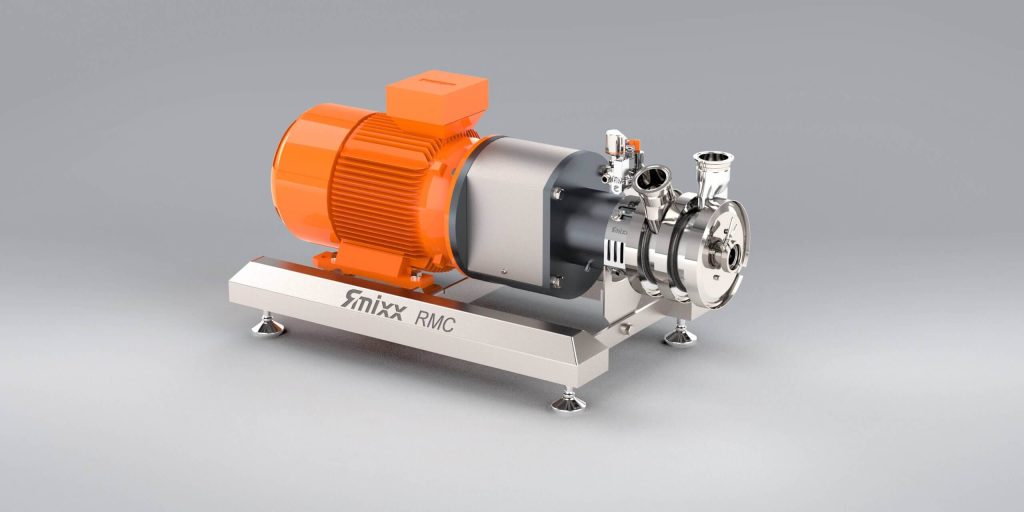 RMC inline powder dissolving machineDraws in powders without generating dust, dissolves them and disperses them in a single pass. No lumps, no charging losses.Discover the RMC›
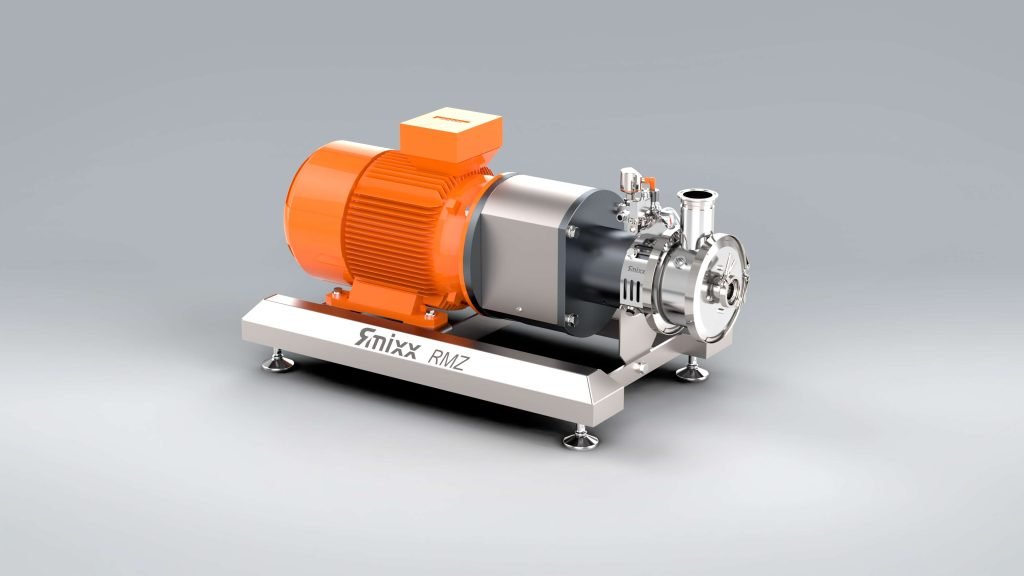 RMZ inline dispersing machineDisperses directly in the pipe or through recirculation. Produces emulsions and suspensions quickly and reproducibly.Discover the RMZ›
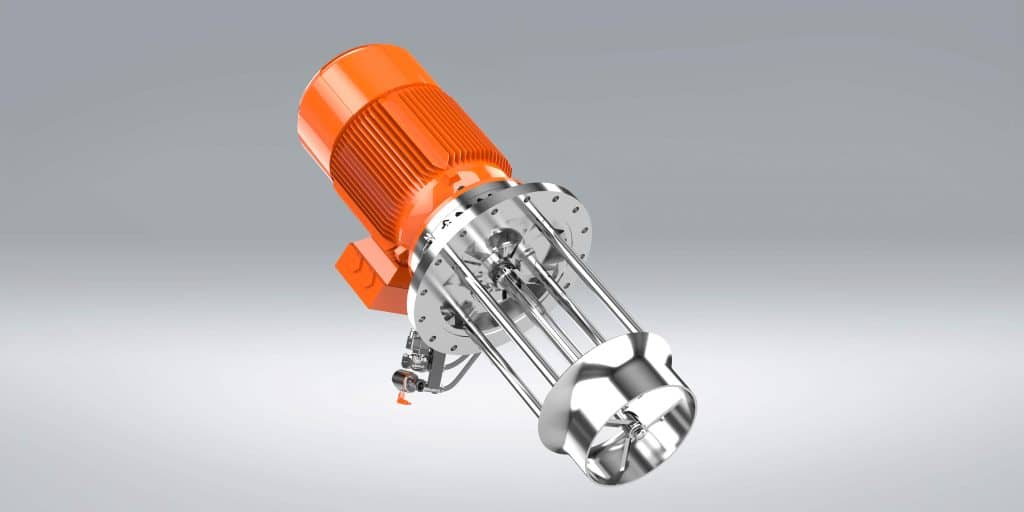 RMY jet stream mixerMixes homogeneously at varying viscosities, without air entrainment. Available as top entry and side entry.Discover the RMY›
The final choice cannot be based solely on the machine category. The RMC inline powder dissolving machine, RMZ inline dispersing machine and RMY jet stream mixer perform different process functions and therefore involve different inspection and cleaning points. A product trial may be required to assess how wettability, viscosity build-up, agglomerates and product film behave in the selected configuration.
ATEX maintenance requires verification of the original protection
In a potentially explosive environment, maintenance must preserve explosion safety and must not introduce a new ignition source. In powder handling, dust deposits, electrostatic charging, hot surfaces, bearing problems, friction and non-matching replacement parts are relevant risks. ATEX Directive 2014/34/EU applies to equipment and protective systems intended for use in potentially explosive atmospheres; the operating environment and zone classification also require appropriate organisational controls.
A component that appears technically suitable is not automatically appropriate for an ATEX version. Material, earthing, temperature behaviour, mechanical fit and the original type of protection may be decisive. Following modifications or repairs, it must therefore be checked whether the design and documentation still correspond to the installation’s safety concept.
Removing dust is both a hygienic and an explosion-safety measure, but the cleaning method must suit the risk. Uncontrolled blowing can disperse dust and form a dust cloud. More practical points for consideration are provided under ATEX maintenance in powder handling.
From calendar-based maintenance to maintenance based on critical function
An effective maintenance plan bases the frequency on function, load, product and the consequences of failure, not only on calendar intervals. A bearing, seal or rotor-stator subjected to heavy loads from abrasive particles requires a different approach from the same component used with a mild, low-viscosity product. Frequent product changeovers and aggressive cleaning chemicals can also determine maintenance requirements more strongly than operating time.
Do you know during which phase of your batch the mechanical and thermal loads are highest? This becomes clear by linking maintenance observations to recipe steps, viscosity build-up, dry-running risk, pressure behaviour and cleaning cycles. Wear that repeatedly occurs after the same product or process phase often indicates a process condition that cannot be resolved by periodic replacement alone.
A practical criticality classification weighs four consequences: risk to people, risk to product quality, risk to the environment and impact on production continuity. Components with major consequences in the event of failure warrant appropriate inspection, spare parts and a clear escalation threshold. Less critical components do not need to be treated with the same intensity; excessive preventive disassembly can actually introduce assembly errors and contamination risks.
Condition monitoring may consist of trends in noise, vibration, temperature, leakage, pressure behaviour, energy consumption or product results, depending on the design. A single observation means little without reference to normal operating conditions. Therefore, also record the product, process phase and cleaning status during which an abnormality was identified.
For installations where continuity and schedulable interventions are particularly important, a maintenance contract for process machines can help organise inspections and maintenance systematically. The content and frequency must always reflect the actual load and risk profile; a standard interval is no substitute for process analysis.
Release connects maintenance, production and QA
A machine may only return to production after technical aspects, safety and hygiene have been checked separately and released jointly. Maintenance can confirm that assembly is technically correct, production can check the operational condition, and QA or QC can assess the cleaning and product status where necessary. Who provides formal release depends on the organisation and the applicable quality system.
A useful release check includes the following points:
- All components, fasteners, tools and temporary provisions have been accounted for and removed.
- Guards, interlocks, emergency stop functions and connections have been restored and checked.
- Product-contact parts have been cleaned in accordance with the applicable procedure and, where necessary, inspected or sampled.
- Seals, gaskets, lubricants and spare parts are suitable for the relevant application.
- The installation is leak-tight, correctly connected and tested with the correct direction of rotation.
- The work order, deviations, measurement results and release have been recorded in a traceable manner.
A functional test using water or a suitable test medium can be useful for checking direction of rotation, leakage and circulation, but does not automatically prove that the product process will operate correctly. The actual viscosity, density and particle load can significantly alter the flow pattern. For a new product, modified geometry or major process modification, a product trial is therefore more reliable than a generic assumption.
When additional maintenance or cleaning is not the solution
Additional maintenance is not the right solution when recurring damage is caused by an incorrect machine choice, cavitation, dry running, excessive abrasion, insufficient product circulation or an unsuitable process sequence. Replacing components more frequently then addresses the consequence, not the cause. The process condition and machine configuration must first be reassessed.
A more intensive cleaning cycle is also inappropriate when design-related dead spaces, poor drainage or material incompatibility cause the problem. Longer exposure to cleaning chemicals can degrade elastomers, damage surfaces and result in more downtime without cleaning the hidden area. In that case, modification, replacement or a different cleaning method is required.
If the recipe, cleaning agent, temperature regime or process route changes, it must be reassessed whether the materials and procedures remain suitable. An installation that has operated without problems for years with one recipe is not automatically safe and hygienic for a new product. For assessment on a practical scale, RS Contracting can conduct trials in Coevorden or on site; through contact with process engineering, you can discuss which product and process data are required.
Frequently asked questions about maintenance, safety and hygiene
How often should an industrial mixer be maintained?
The correct maintenance frequency depends on operating hours, process load, abrasiveness, viscosity, cleaning chemicals, product changeovers and the consequences of failure. Use manufacturer data and in-service inspections as the starting point and adjust intervals based on demonstrable condition. A fixed calendar interval alone is insufficient when different recipes place very different loads on the machine.
Is a visually clean machine also hygienically clean?
No. Visual inspection can reveal visible product residues, but cannot rule out invisible microbiological contamination, allergens, active substances or cleaning-agent residues. The additional checks required depend on the product risk and quality system. Possible measures include targeted sampling, checks of rinse water, surface checks and periodic validation of the cleaning procedure.
Must a mixing installation be cleaned again after every maintenance intervention?
When product-contact zones have been opened or may have been contaminated, cleaning before release is generally necessary. The extent depends on the work, the exposed components and the process risk. An intervention outside the product zone may justify a more limited check, provided it can be demonstrated that no dirt, lubricant or component could have entered the product zone.
When is CIP better than manual cleaning?
CIP is suitable when all relevant surfaces are demonstrably reached, sufficient mechanical cleaning action is generated and the installation can drain properly. Manual cleaning or disassembly is better when inspection is required, contamination is shielded or components are not reliably located within the circulation route. A combination of CIP and periodic open inspection is often the most controllable approach.
Who is responsible for release after maintenance?
Responsibilities must be defined in the organisation’s quality and safety system. Maintenance generally assesses technical assembly, production assesses operational readiness, and QA or QC assesses the hygienic or product-specific status where required. The machine may only start when all required disciplines have demonstrably completed their part.
The best control begins before commissioning
Maintenance, safety and hygiene are controlled most reliably when they are defined as joint requirements during specification and design. Accessibility, ease of disassembly, drainage, material selection, guarding, energy isolation and inspection options are often more difficult to resolve afterwards. A low barrier to purchase can therefore lead to more complex maintenance, longer release times and greater process risk.
You should therefore assess a mixing or dispersing installation not only on the desired mixing result. Also specify how the machine will be safely isolated, which components will wear, how product-contact zones will be cleaned, how cleaning will be verified and what is required for release after maintenance. Only when this chain is complete does the installation support production continuity, product quality and employee safety.