The RMC dispersing machine process time versus agitator technology generally favours the RMC when powder must be drawn in, wetted, dissolved and dispersed quickly. A conventional agitator mainly moves the entire tank volume, whereas the RMC conveys the product inline through a concentrated process zone where powder and liquid make intensive contact. However, the actual time saving is not determined by rotational speed or motor size, but by the slowest step between powder feeding and batch release.
Within the Rmixx machine line, the RMC is effectively an inline powder dissolving machine: the installation combines powder induction, wetting, dissolving and dispersing in a controlled product flow. This makes comparison with an agitator more relevant than merely comparing mixing intensity. The better question is not how quickly a machine rotates, but when your product actually meets the product specification.
Process time encompasses more than the time the motor runs
Process time is the total time from dosing the first raw material until the product is ready for the next process step or quality release. In powder-liquid processes, this time includes dosing, wetting, deagglomeration, dissolving or hydrating, homogenising, deaerating, sampling and, where applicable, reprocessing.
A comparison based solely on mixing time therefore often gives a misleading picture. After the powder has been added, an agitator may need to continue running for a long time to eliminate floating powder islands, wall deposits or partially wetted agglomerates. Conversely, an inline system may have a short active processing time, while a product-specific hydration or reaction time afterwards cannot be reduced any further.
Do you measure only the time between switching the drive on and off, or also the time required for adding powder, final rinsing, deaeration and QC corrections? Only the second measurement shows which technology actually produces the shortest batch cycle.
| Part of the cycle | RMC inline powder dissolving machine | Conventional agitator technology |
|---|---|---|
| Powder feeding | Powder is drawn into a liquid flow in a controlled manner. | Powder is usually added at or near the liquid surface. |
| Initial wetting | A large proportion of the powder surface comes into direct contact with the liquid. | Wetting depends heavily on the vortex, addition point and surface flow. |
| Deagglomeration | Local shear stress and turbulence break down weakly bonded agglomerates. | Bulk circulation distributes the product, but does not always provide sufficient local shear. |
| Homogenisation | Takes place inline or via recirculation around the tank. | Takes place entirely in the tank and depends on tank geometry and the flow pattern. |
| Post-treatment | Can remain limited when the powder is processed correctly from the outset. | Can take longer in the event of lumps, wall deposits, foam or a broad particle size distribution. |
How the RMC reduces powder processing time
The RMC mainly shortens the physical steps that occur consecutively with open powder feeding. With a traditional agitator, powder must first be drawn through the liquid surface, then be wetted and subsequently re-enter an effective mixing zone from the bulk. In the RMC, these operations are brought spatially closer together.
-
The liquid is fed to the process zone. A stable liquid flow is required to entrain the powder in a controlled manner and prevent dry accumulation in the feed.
-
The powder is induced into the liquid flow. As a result, the powder does not first have to be drawn into the liquid from the tank surface.
-
Primary wetting takes place immediately. Liquid penetrates between powder particles, reducing the likelihood of a dry core becoming trapped inside a wet outer layer.
-
Agglomerates are exposed to shear stress. Velocity differences in the process zone help to pull weakly bonded particle clusters apart and redistribute them throughout the liquid phase.
-
The treated product flows onwards to the subsequent process. Depending on the formulation, this takes place in a single pass or through recirculation until the defined endpoint has been reached.
The benefit therefore does not arise because the entire tank volume receives the same high shear everywhere. The RMC concentrates the required energy where powder and liquid meet. This prevents a large proportion of the mixing energy from being spent on product that is already sufficiently homogeneous, while poorly wetted agglomerates continue to circulate elsewhere in the tank.
The operation and configuration of the RMC inline powder dissolving machine must therefore always be matched to the powder properties, liquid phase and desired final quality. In particular, wettability, bulk density, solubility and changes in viscosity during dosing influence the achievable process time.
“Customers often focus too much on how quickly powder disappears from the liquid surface. The real delay lies in trapped dry cores that only become apparent later during screening.”
Bart Brouwer
Sales Manager
An important practical difference only becomes apparent when a formulation becomes less forgiving. A powder that hydrates quickly on the outside may form a gel skin around a dry core if it is added to the surface too quickly. More mixing time does not automatically remove such a lump, because the agglomerate must pass through the effective mixing zone and be subjected to sufficient shear stress there.
Why an agitator can run for a long time without solving the problem
An agitator can provide excellent bulk circulation, but moving the bulk is not the same as dispersing. The agitator element establishes a flow pattern in the tank; the locally available shear stress then depends on the type of agitator element, its position, the tank geometry, the liquid level and the product rheology.
With a low-viscosity product, the flow may be turbulent and reach the entire volume effectively. As viscosity rises, the flow is more likely to become laminar and zones may develop where little product exchange takes place. The centre of the tank may then be visibly moving, while product along the wall, bottom or in corners is not refreshed sufficiently.
Does your product actually flow along the wall and bottom, or do you mainly see movement around the agitator shaft? If tank circulation is insufficient, additional running time extends the process time without eliminating the cause. A different agitator geometry, a jet stream mixer, modified tank internals or a combination with inline treatment may then be more effective.
A second misconception is that a deeper vortex automatically means a faster process. A vortex can draw powder downwards, but it can also entrain air. This air may cause foam, volume errors, oxidation, susceptibility to cavitation or longer deaeration, meaning that faster powder feeding at the start actually costs additional time at the end of the batch.
If you want to maintain a clear distinction between mixing, deagglomeration and size reduction, you can review the process principles in the meaning of dispersing. This distinction prevents a mixing problem from being addressed with more shear or a dispersion problem from being incorrectly accepted by allowing a longer mixing time.
The viscosity peak often determines the actual comparison
The process time of both an RMC and an agitator is strongly influenced by the point at which viscosity rises during the batch. Thickeners, gums, starches and other hydrating raw materials can alter the liquid phase during dosing. This simultaneously changes powder induction, heat transfer, tank circulation and the load on the mixing system.
Do you know at what stage of your batch the viscosity peaks? If the liquid thickens too early, uptake of the remaining powder may slow down and the flow through the pipework or process zone may change. The dosing sequence, liquid temperature, pre-dispersion and concentration during induction are then at least as important as the selected machine type.
An RMC can limit the formation of poorly wetted lumps, but it cannot correct a fundamentally unfavourable formulation sequence. When a hydrocolloid is fed directly into an already highly viscous phase, even powerful local dispersion may provide insufficient bulk transport. Conversely, a correctly selected agitator can achieve the required quality without an additional inline step when processing an easily dissolved powder and a low-viscosity liquid.
The relationship between flow, shear and product behaviour is discussed in greater detail in high and low viscosity. Particularly with thixotropic products, viscosity must be assessed under process conditions; a laboratory measurement at rest does not always describe what the pump, pipework and mixer experience during production.
Dispersion time, dissolution time and hydration time are not the same
A powder lump disappearing more quickly does not automatically mean that the batch is chemically or functionally ready. Dispersing distributes particles and breaks down agglomerates, dissolving brings a substance into the liquid phase at molecular level, and hydration requires time for liquid uptake and structure development. The RMC can significantly improve the first two contacts, but an intrinsic hydration or reaction time remains product-specific.
Is your batch ready as soon as no more lumps are visible, or only when viscosity, particle size distribution, concentration and stability are within specification? The correct answer is the defined QC endpoint. Visual homogeneity is useful as a process observation, but is not always sufficient as a release criterion.
This distinction explains why two suppliers can arrive at different process times using the same formulation. One measurement stops when the powder has been drawn in, another after complete hydration and a third only after deaeration and sample approval. A fair comparison uses the same raw materials, dosing sequence, starting temperature, batch conditions and endpoint criteria.
When agitator technology remains the better and simpler choice
An RMC is not automatically the right solution for every batch. A conventional agitator is well suited when the task mainly consists of bulk homogenisation, heat distribution, keeping already wetted particles in suspension or mixing liquids that combine easily.
-
An agitator is often suitable when the powder dissolves quickly and completely without forming a gel skin, dust problems or agglomerates.
-
An agitator remains necessary when the tank contents must remain continuously homogeneous and thermally uniform during storage or reaction.
-
An inline powder dissolving machine is less self-evident when coarse, fragile or fibrous ingredients must not be conveyed through a concentrated process zone.
-
A trial is required when the product is strongly non-Newtonian, thixotropic, sensitive to foaming or has unknown wetting behaviour.
-
A combination of an agitator and inline processing is often more logical when both complete tank circulation and intensive local powder treatment are required.
In a combined arrangement, each machine performs its own function. The tank mixer prevents dead zones and keeps the batch uniform, the RMC provides powder induction and initial processing, and an RMZ can be used when further inline dispersion or emulsification is required. The shortest process time then results from the correct allocation of tasks, rather than from one machine having to perform all process steps simultaneously.
A useful choice starts with the desired endpoint
The choice between an RMC and agitator technology must be based on the most demanding process requirement. The batch volume or current running time alone is insufficient, because the same volume can exhibit completely different flow and wetting behaviour with two different formulations.
Assess the powder properties first
Poorly wettable, highly dust-generating or rapidly hydrating powders are more likely to benefit from controlled inline induction than readily soluble crystalline substances. A large difference in density between the powder and liquid can also cause sedimentation or floating behaviour. The powder feed must therefore be designed together with the wet process zone.
Define a measurable quality criterion
Define in advance whether the limit is determined by the absence of agglomerates, complete dissolution, viscosity, emulsion appearance, stability or another product specification. Without that endpoint, a short process time may only mean that the machine was stopped earlier. The batch may then still fail later or require reprocessing.
Consider the entire installation
Pipe diameters, valves, pump behaviour, static head, hopper design, tank geometry and return position influence the operation of an inline process. With an agitator, the liquid level, baffles, agitator position and distance from the wall also determine whether the entire tank volume circulates. The machine may be technically suitable while the surrounding installation limits the process time.
Include cleaning and product changeover
A short production time has little value when powder residues in a hopper, pipe or hard-to-reach tank zone require extensive cleaning. In food, cosmetics and pharmaceuticals, hygienic design, drainability, material selection and suitability for CIP or SIP must be included in the total cycle. The same applies to inspection and safe maintenance.
Depending on these criteria, the process solution may consist of tank circulation without air entrainment, inline powder intake or additional rotor-stator treatment. The relevant Rmixx machines are therefore matched not only to capacity, but primarily to the separate functions of mixing, drawing in, dissolving and dispersing.
The right machine for your process
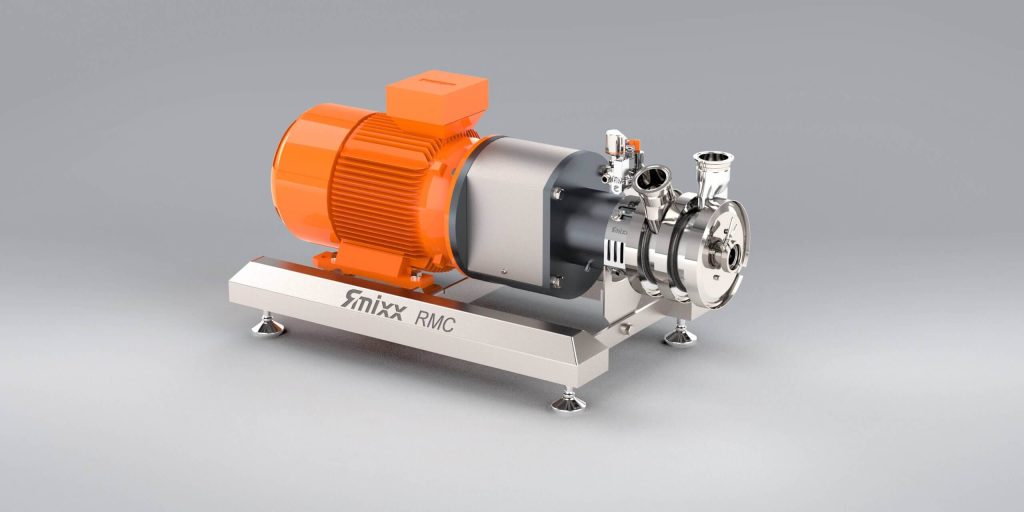 RMC inline powder dissolving machineDraws powders in without dust, dissolves them and disperses them in a single pass. No lumps, no addition losses.Discover the RMC›
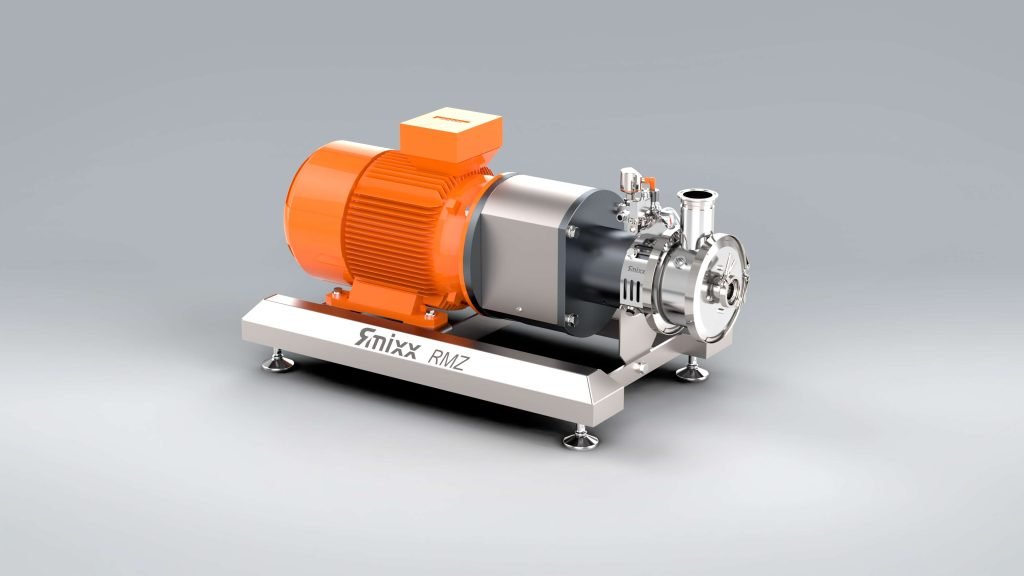 RMZ inline dispersing machineDisperses directly in the line or through recirculation. Produces emulsions and suspensions quickly and reproducibly.Discover the RMZ›
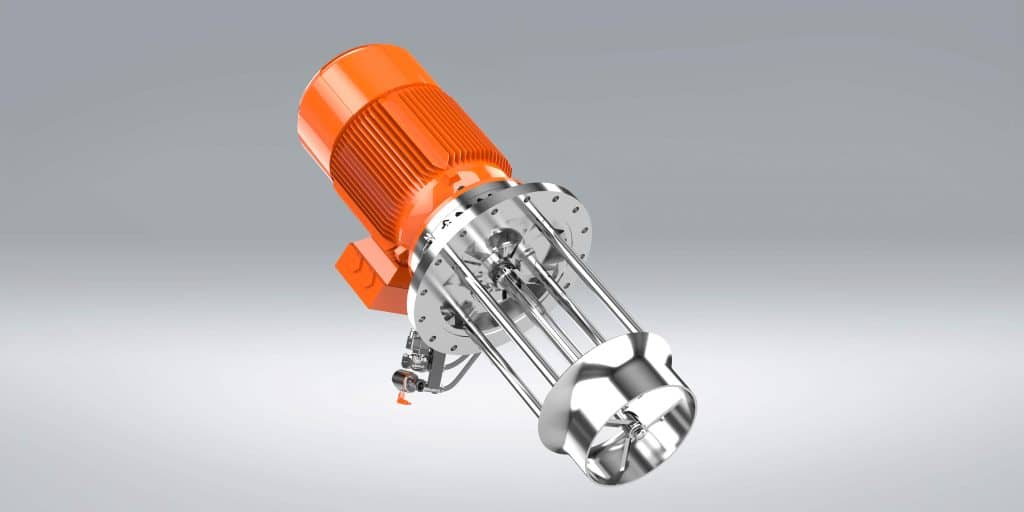 RMY jet stream mixerMixes homogeneously at a range of viscosities without air entrainment. Available as top entry and side entry.Discover the RMY›
For powders that must be fed in a controlled manner, the article about drawing powders in inline also provides additional points for consideration. That article focuses on the powder route, whereas the complete batch cycle is decisive when making a comparison with agitator technology.
How to compare process time on a like-for-like basis
A reliable comparison is performed using the same product, the same raw materials and the same quality criterion. A theoretical calculation can provide an indication, but does not always predict the combination of wetting, rheology, air entrainment and hydration at production scale.
-
Document the current cycle by process step. Record the times for filling, dosing, mixing, dispersing, waiting, deaerating, sampling and correcting separately.
-
Determine where the first deviation occurs. Check whether the delay starts with powder intake, lump formation, viscosity build-up, insufficient tank circulation or the required resting time.
-
Use identical endpoint criteria. Do not compare a visually smooth RMC sample with a fully hydrated sample from the existing installation.
-
Also assess secondary effects. Record air entrainment, foam, wall deposits, product loss, dust formation and cleanability.
-
Translate the trial to the production configuration. Include the pipe layout, recirculation, powder feed, tank geometry and expected viscosity development in the scale-up.
Scale-up in particular requires caution. The same ratio between product volume and drive power does not guarantee the same flow pattern, residence time or shear history. A trial with the actual product shows whether the RMC eliminates the limiting step or whether the bottleneck shifts to hydration, tank circulation or cooling.
RS Contracting can conduct trials in Coevorden or at the customer’s site. A meaningful trial requires a representative formulation, the current operating method, relevant safety information and measurable acceptance criteria; through contact with a process specialist, you can determine which configuration most closely represents the production situation.
Frequently asked questions about the RMC and agitator technology
Is an RMC always faster than an agitator?
No. An RMC is generally faster when powder induction, wetting or agglomerate breakdown is the limiting process step. For readily soluble substances, simple liquid mixing or processes with a fixed chemical reaction or hydration time, an agitator may be equally suitable. A product trial using the same endpoint criteria provides the most reliable comparison.
Can an RMC completely replace the agitator in the tank?
That depends on the function of the tank. When recirculation is sufficient to keep the entire volume homogeneous, an inline solution can perform a large proportion of the processing. For heat transfer, long-term suspension, reactions or tank circulation at high viscosity, an agitator or jet stream mixer often remains necessary. The two machines can therefore be complementary.
Why do lumps remain even if the agitator runs for long enough?
A lump with a wetted outer layer and a dry core may be mechanically strong enough to survive ordinary bulk circulation. A longer mixing time only helps when the agglomerate repeatedly passes through a zone with sufficient shear stress. This does not occur reliably with dead zones, high viscosity or aerated floating lumps, meaning that targeted powder induction or dispersion may be required.
Which time should I measure during a practical test?
Measure the full period from the start of raw material feeding until the agreed quality criterion is achieved. Divide this into dosing, wetting, dispersing, hydrating, deaerating, sampling and any corrections. Also record the product temperature, viscosity development, foam and cleaning, so that a faster mixing step does not come at the expense of another process phase.
The shortest process time results from the right mechanism
Compared with conventional agitator technology, the RMC mainly offers a process-time advantage when powder intake, immediate wetting and deagglomeration delay the batch. The concentrated inline process prevents powder from first having to circulate through the tank for an extended period before it is processed effectively. This may also improve reproducibility between batches.
An agitator remains the logical choice for bulk circulation, heat distribution and simple mixing tasks, and may still be necessary alongside the RMC. Therefore, do not compare machines solely on running time; assess the complete chain through to the product specification. Only when the actual bottleneck is known can it be established whether RMC technology shortens the process time or whether another mixing or process modification has a greater effect.