What is ATEX? ATEX is the European framework for preventing explosions in environments where combustible gases, vapours, mists or dusts can mix with air. It covers both obligations for employers who manage explosion risks and requirements for equipment used in potentially explosive atmospheres. The key is not to order a machine with an ATEX label, but to demonstrably link dust properties, zone classification, potential ignition sources and the design of the complete installation.
This is where things often go wrong in practice. A motor or sensor with an Ex marking does not automatically make a mixing or powder installation explosion-safe; bearings, seals, static electricity, hot surfaces, mechanical sparks and dust accumulation can also form an ignition source. An incorrect assessment can lead to unsafe operation, rejection upon commissioning, costly modifications or production downtime.
ATEX begins with the explosive atmosphere, not the machine
An explosive atmosphere is a mixture of air and a combustible substance in which, after ignition, combustion can spread through the remaining unburned mixture. ATEX is an abbreviation of the French ATmosphères EXplosibles. The framework applies when such an atmosphere can be created by gas, vapour, mist or dust under atmospheric conditions.
An explosion requires fuel, oxygen and an effective ignition source. In dust explosions, the dispersion of fine dust and the degree of confinement also play an important role. The familiar explosion triangle is therefore useful as an initial explanation, but too limited for a complete risk analysis of powder handling.
A combustible substance does not always create an explosive atmosphere
A combustible product only creates an explosion risk when it is mixed with air at a suitable concentration and can be ignited. A compact mass of powder in sealed packaging behaves differently from the same powder during pouring, pneumatic transport or powder induction. A liquid can also form an explosive atmosphere through vapour or mist, even though the liquid itself is not present as a dust cloud.
Do you know where your product is actually mixed with air: in the hopper, around the pouring point, in a filter, in the process line or above the liquid level in the tank? That answer determines where a zone may arise and which parts must be assessed as potential ignition sources. Looking only at the product name or safety data sheet is insufficient for this purpose.
Gas and dust require separate assessments
Gas, vapour and mist atmospheres are classified differently from explosive dust atmospheres. Zones 0, 1 and 2 are used for gas; zones 20, 21 and 22 are used for dust. Equipment markings, dust or gas groups, permitted surface temperatures and relevant types of protection also differ.
For dust, you must also take deposited layers into account. A dust layer can act as thermal insulation, restrict the cooling of a motor or bearing housing and, when disturbed, still form an explosive cloud. Good housekeeping policy is therefore part of explosion safety, not merely hygiene or cleanliness.
ATEX 114 and ATEX 153 divide the responsibilities
The two ATEX directives have different addressees: ATEX 153 focuses on the employer and workplace, while ATEX 114 sets requirements for equipment and protective systems placed on the market for use in potentially explosive atmospheres. This distinction prevents full responsibility from being incorrectly assigned either to the machine supplier or to the user.
ATEX 153 requires the employer to manage the explosion risk
Directive 1999/92/EC, generally referred to as ATEX 153, concerns the protection of workers who may be at risk from explosive atmospheres. The employer must assess the risks, classify hazardous areas, document technical and organisational measures and provide workers with appropriate instructions. In the Netherlands, this framework is applied through occupational health and safety legislation.
Where an explosion hazard may be present, the assessment is documented in an explosion protection document, often abbreviated to EVD. This document describes, among other things, the substances present, potential emission sources, zone classification, ignition sources, measures, work equipment, inspections and work procedures. A change to a recipe, extraction system, machine, cleaning method or process operation may require the EVD to be reassessed.
ATEX 114 determines the suitability of equipment
Directive 2014/34/EU, known as ATEX 114, contains essential health and safety requirements for equipment and protective systems intended for use in places where explosive atmospheres may occur. The manufacturer assesses which ignition sources the product may have and applies an appropriate conformity procedure.
The required procedure depends, among other things, on the equipment group, category and nature of the product. Not every version therefore follows exactly the same procedure involving a notified body. The statement that every ATEX product receives one universal “ATEX certificate” is too general and can lead to incorrect expectations during procurement.
“In practice, purchasers often focus strictly on certified motors, while the actual ignition hazard in mixing installations almost always arises from dry-running seals or mechanical friction.”
Bart Brouwer
Sales Manager
ATEX 114 exists alongside other applicable product legislation. For a machine, general machinery safety and the framework of Regulation (EU) 2023/1230 may also be relevant, for example. ATEX conformity does not replace the risk assessment of moving parts, pressure, noise, cleaning, ergonomics or other machine hazards.
The ATEX zone indicates how often an atmosphere can occur
An ATEX zone expresses how likely it is that an explosive atmosphere will be present and for how long; the zone does not indicate the severity of the consequences of an explosion. The classification follows from the properties of the substance, the nature of the emission, ventilation, process operation, containment and the frequency of malfunctions or activities.
| Atmosphere | Zone | Meaning | Usual minimum equipment category |
|---|---|---|---|
| Gas, vapour or mist | 0 | Present continuously, for long periods or frequently | 1G |
| Gas, vapour or mist | 1 | May occasionally be present during normal operation | 2G |
| Gas, vapour or mist | 2 | Not likely during normal operation and, if it does occur, present only briefly | 3G |
| Combustible dust | 20 | Present continuously, for long periods or frequently as a dust cloud | 1D |
| Combustible dust | 21 | May occasionally be present as a dust cloud during normal operation | 2D |
| Combustible dust | 22 | Not likely during normal operation and, if it does occur, present only briefly | 3D |
Equipment from a higher protection category may, under certain conditions, also be suitable for a less hazardous zone, but only when the complete marking matches the dust or gas present and the conditions of use. The category alone is not a complete basis for selection. The gas group, dust group, temperature classification, maximum surface temperature, ambient temperature and special conditions of use remain relevant.
A common mistake is to classify only the area around an installation. A different and sometimes more hazardous internal zone may apply inside a hopper, filter, mixing tank or line than on the outside. Conversely, an internally classified process volume does not automatically mean that the entire production area receives the same zone; emission sources and ventilation determine this.
From zone classification to a defensible machine specification
An ATEX machine specification is complete only when the zone data are linked to the properties of the medium, the process and all potential ignition sources. “Suitable for zone 21”, for example, is insufficient if the applicable dust group, surface temperature and internal process conditions are unknown.
-
The explosion properties of the product determine which ignition energies, temperatures and protective measures are relevant.
-
The internal and external zone classification determines the required protection level for each component and location.
-
The maximum product and ambient temperatures affect the assessment of hot surfaces and heat generation.
-
The conductivity of the product, pipes, hoses and filters determines where electrostatic charge can arise and how equipotential bonding must be implemented.
-
Mechanical components must be assessed for friction, impact, bearing failure, rubbing and other non-electrical ignition sources.
-
Cleaning, maintenance and operation under fault conditions determine whether protective measures remain effective outside normal production.
Standards from the EN ISO 80079 series may be relevant to non-electrical equipment; the EN IEC 60079 series is generally used for electrical equipment and installation practice. Standards provide technical methods for meeting essential requirements, but the directives and their national implementation form the legal framework. The appropriate edition of a standard and type of protection must be determined for each project.
An Ex nameplate is a summary, not a complete risk analysis
The Ex marking may include information on the equipment group, category, gas or dust application, type of protection, dust or gas group, temperature class or maximum surface temperature and the equipment protection level. Any special conditions of use are generally stated in the accompanying documentation and must not be ignored during selection or installation.
Therefore, do not check only whether the hexagonal Ex symbol is present. The question is whether the full combination of marking, certificate or conformity documentation, manual and installation conditions matches your zone and medium. Cable glands, sensors, couplings and replacement parts must also fit within that assessment.
Powder induction reveals internal and external risks
During powder handling, an explosion hazard can arise from a dust cloud inside the equipment as well as from emissions into the work area. Manual pouring, opening bags, a poorly sealed hopper, filter problems and powder blowing back out of an induction point therefore affect both the zone classification and operator exposure.
Does the dust cloud arise only during filling, or also when bridging is cleared and filters are cleaned? The second situation is regularly overlooked because it occurs outside the normal production step. It is precisely interventions to clear blockages or caking that can stir up dust, while operators are using tools or opening components.
From a process perspective, it helps to supply powder in a controlled manner, limit emissions at the pouring point and wet the product in a controlled manner in the liquid stream. Depending on the recipe, wettability, viscosity and desired particle size distribution, a combination of hoppers, lump breakers, inline powder induction and rotor-stator dispersing can be investigated for this purpose. The design must then align with the established ATEX requirements for the inside and outside.
The right machine for your process
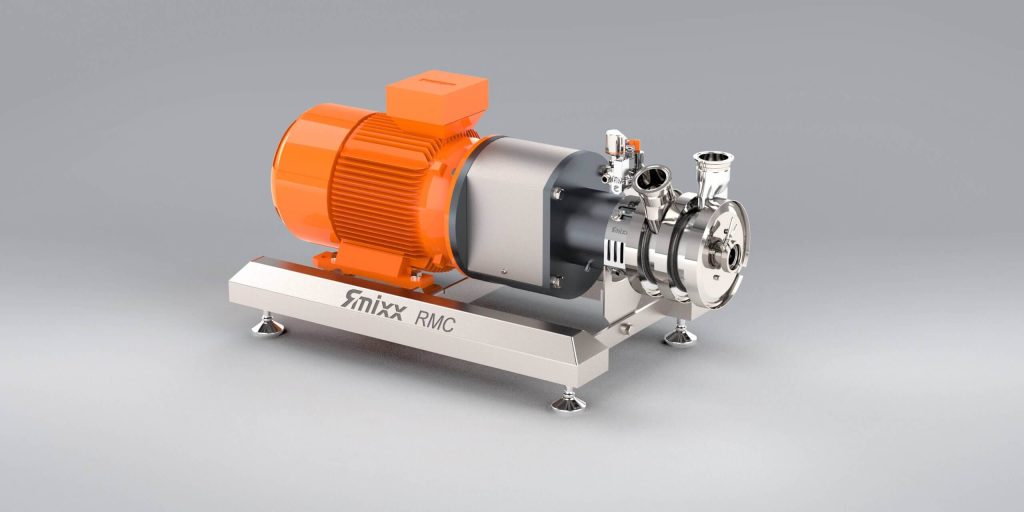 RMC Inline powder dissolving machineDraws in powders without releasing dust, dissolves them and disperses them in a single pass. No lumps, no pouring losses.Discover the RMC›
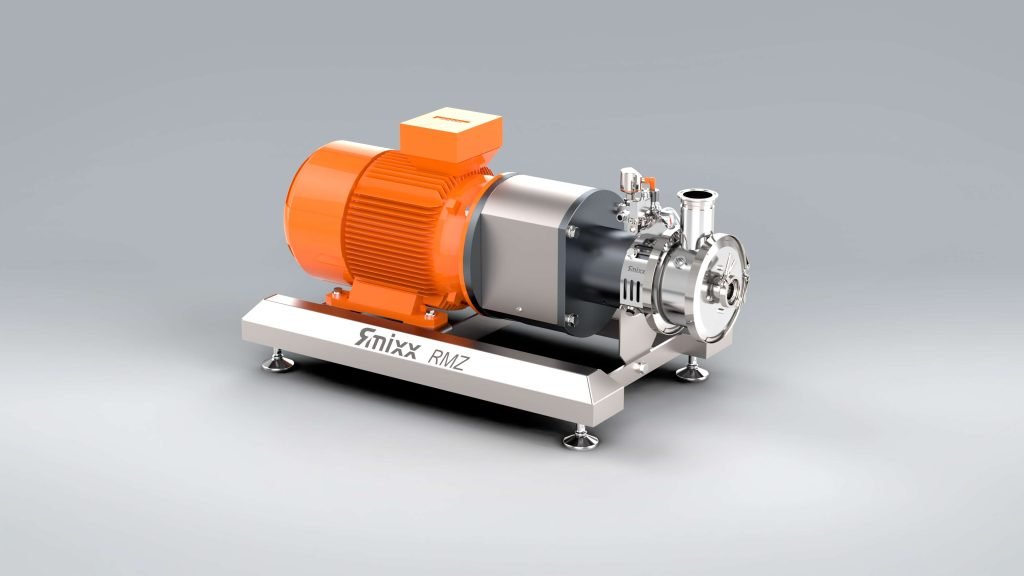 RMZ Inline dispersing machineDisperses directly in the line or through recirculation. Produces emulsions and suspensions quickly and reproducibly.Discover the RMZ›
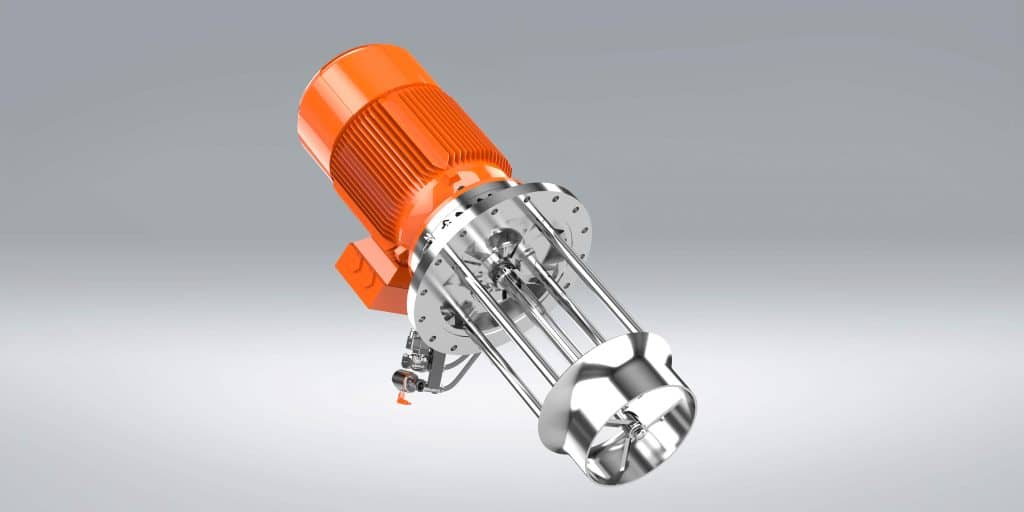 RMY Jet stream mixerMixes homogeneously at various viscosities without entraining air. Available as top-entry and side-entry versions.Discover the RMY›
The choice between a batch or inline configuration also changes the locations where dust can be released and where an explosive atmosphere can arise. On the page about inline powder induction, you will find the process considerations; for the specific installation configuration, an inline powder dissolving machine and suitable ancillary equipment are among the relevant items.
Explosion safety follows a fixed sequence of measures
The preferred sequence is first to prevent an explosive atmosphere from arising, then to prevent ignition and subsequently to limit the consequences of any explosion. Simply adding explosion venting or explosion suppression immediately, without investigating whether the dust cloud can be prevented, omits an important part of risk management.
-
Identify the substances and process conditions. Record which gases, vapours, mists or dusts are present and use reliable, product-specific explosion data.
-
Map the emission sources. Assess normal operation, start-up, shutdown, filling, emptying, cleaning, sampling, maintenance and foreseeable malfunctions.
-
Classify internal and external zones. Substantiate the extent and type of zone based on emissions, ventilation, containment and operating duration.
-
Eliminate or control ignition sources. Assess both electrical and mechanical equipment, static electricity, hot surfaces, welding, open flames and work involving tools.
-
Select and integrate suitable equipment. Check the complete Ex marking, documentation, installation conditions, equipotential bonding and interfaces between components.
-
Ensure inspection and change management. Keep the EVD, maintenance, instructions and equipment register up to date when the recipe, process or installation changes.
An installation may be correct when delivered and still become unsafe later. A replaced bearing, non-original motor, modified hose, painted-over earth connection or changed cleaning agent can compromise the original assessment. Planned maintenance of ATEX installations must therefore cover both mechanical condition and explosion safety functions.
When an ATEX version is not the right answer
An ATEX version is not automatically required when a documented risk analysis shows that no explosive atmosphere can arise. Ordering additional Ex components without zone classification does not demonstrably make a process safer and may divert attention from local exhaust ventilation, process containment, housekeeping or avoiding combustible mixtures.
Inerting, vacuum operation or enclosed processing also does not necessarily make ATEX unnecessary. The reliability of oxygen monitoring, start-up and shutdown phases, leakage, air entrainment during filling and the consequences of a malfunction must be taken into account. A zone may be reduced or removed only if the substantiation and the reliability of the measure permit this.
Do you have product-specific explosion data, or are you basing the machine selection on data for a comparable powder? Properties may change in relevant respects with differences in moisture content, particle size distribution, composition or product form. Without representative data and a substantiated zone classification, a machine builder cannot select a definitive ATEX version.
ATEX is also not a guarantee against fire, process reactions or decomposition outside atmospheric conditions. Self-heating, chemical incompatibility and pressure build-up may require additional safety measures. Combined risks require a broader process safety analysis than an ATEX assessment alone.
Frequently asked questions about ATEX
Is ATEX mandatory for every machine using combustible powder?
No. ATEX is relevant when, during foreseeable use, the powder can form an explosive atmosphere with air and the machine or one of its components can be an ignition source within it. The employer must substantiate this in the risk analysis and zone classification. Combustibility alone is therefore insufficient, but a supposedly closed process is also no reason to omit the assessment.
Who determines the ATEX zone of a mixing installation?
The employer or operator is responsible for the zone classification of the workplace and process. Specialist assessment is often necessary for this purpose. The machine builder provides information about the equipment and can provide input regarding internal volumes and emission points, but cannot independently determine the definitive operating zone without information about dust properties, ventilation, use and the surrounding environment.
Does an ATEX motor mean that the entire machine is ATEX-suitable?
No. A suitable motor covers only the ignition risks and conditions assessed for that component. The complete machine may contain bearings, seals, couplings, sensors, agitators and parts capable of accumulating electrostatic charge. Interfaces, installation and use must also be examined before the assembly can be regarded as suitable for the intended Ex zone.
What is the difference between ATEX and IECEx?
ATEX consists of European directives imposing legal obligations on workplaces and products within the European Economic Area. IECEx is an international certification system based on IEC standards for explosive atmospheres. IECEx documentation may be technically useful, but it does not automatically replace the required ATEX conformity and marking for equipment placed on the European market.
Must an existing ATEX installation be reassessed after a modification?
Yes, when the modification may affect zones, ignition sources or protective measures. Examples include a different powder, a modified batch sequence, new extraction, a higher product temperature, replacement components or an adjusted cleaning procedure. The assessment may show that the existing version still complies, but that conclusion must be substantiated and incorporated into the EVD.
A usable ATEX enquiry contains process data, not a standalone label
For a safe machine enquiry, you need at least the internal and external zones, gas or dust group, temperature data, product properties, environment, process steps and special operating conditions. Also include information about cleaning, maintenance, extraction, equipotential bonding and the locations where operators open bags or take samples.
RS Contracting can adapt the mixing, dispersing and powder handling technology to those process data, but the final design depends on your product and the established ATEX framework. When behaviour during wetting, dispersing or recirculation is uncertain, a product trial can help substantiate the process selection; explosion properties and zone classification must remain available separately. To assess a specific issue, you can discuss your process data with RS Contracting.