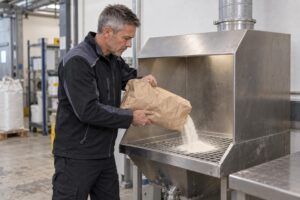
Dust-free powder dumping into a hopper requires an enclosed or locally contained dumping point, controlled extraction and a hopper capable of venting the displaced air without carrying product with it. An extraction connection on an open hopper alone is usually insufficient: dust emissions are determined by the entire process of opening the packaging, dumping, air displacement, filtration and powder discharge. If that process is not correct, dust clouds, product loss, contamination, operator exposure and potentially an explosion risk can still occur.
Dust-free powder dumping starts with control at the source
Dust-free powder dumping is the controlled emptying of bagged goods or other packaging, with any powder released being contained and captured at the dumping point. In practice, dust-free usually means that visible and relevant fugitive emissions are prevented; an absolute guarantee without measurement and a product-specific assessment is not realistic.
The key is control at the source. An opened bag temporarily forms a connection between the product, the operator and the ambient air. During emptying, the powder displaces air from the bag and hopper, while fine particles are entrained by the falling motion and compression of the packaging. This dust-laden air must be given a predictable route to a filter or extraction point.
Does most of the dust escape during cutting open, during free fall or only when the empty bag is folded? The answer determines where containment and extraction are required. A dumping hopper that provides effective extraction only during the fall does not automatically resolve emissions generated when opening and removing the packaging.
Why an open hopper continues to generate dust despite extraction
An open dumping hopper continues to generate dust when the capture air does not flow inwards past all emission points. Air takes the path of least resistance; an extraction connection at the bottom of the hopper therefore does not automatically produce a uniform inward flow along the dumping opening.
Dust generation is generally intensified by four mechanisms:
-
A large free-fall height accelerates the powder and causes agglomerates to break apart on impact, releasing fine fractions into the air.
-
A rapidly emptied bag displaces a large volume of air from the hopper in a short time and can force a dust plume back through the dumping opening.
-
A wide or poorly contained opening allows crossflows from the room to disrupt the intended capture air.
-
A clogged filter or undersized air path increases the pressure in the hopper, causing dust to escape through gaps and the inlet opening.
A common assumption is that more extraction is always better. However, an excessively strong or poorly distributed airflow can draw light powder out of the product stream, place an unnecessary load on filters and pull flexible packaging against the grid or hood. The correct question is therefore not how much air is extracted, but whether there is a stable inward flow at every relevant emission point.
“When dust complaints arise, people usually call for more extraction capacity immediately. In practice, this pulls the bag tightly against the grid, while the airflow at the front disappears completely.”
Bart Brouwer
Sales Manager
Does the extraction pull the bag against the grid while dust still escapes at the front? In that case, the problem is usually not solely a lack of extraction capacity, but unfavourable air distribution caused by the dumping hood, opening and filter resistance. The geometry of the dumping point must be correct first; only then can the airflow control be adjusted effectively.
The dumping cycle determines where dust can escape
A low-dust dumping cycle consists of successive actions that must all take place within the installation’s control zone. The design must therefore be assessed based on the operator’s actual movements, not only on a closed CAD model of the hopper.
-
Bring the packaging to the dumping point in a controlled manner. Damaged or dusty bags can cause emissions and cross-contamination even before they are opened.
-
Position the bag within the capture zone. A dumping hood, airlock or partially enclosed booth prevents airflows from the production area from passing directly over the opened product.
-
Open the packaging without uncontrolled movement. Cutting, tearing open and shaking can generate more dust than the actual discharge of the powder.
-
Empty the bag with a limited free fall. A short, shielded fall path limits impact, air entrainment and the disintegration of fragile agglomerates.
-
Allow the displaced air to escape through the intended filter route. The hopper must be able to vent without conveying powder into the working area or unnecessarily into the central extraction system.
-
Remove and compact the empty packaging in a controlled manner. Powder remaining in folds and seams is often released only when the operator folds the bag or presses it into a waste container.
For a practical design, relevant features include a dumping grid, adjoining hood, filter unit, access door or sleeves, bag compaction and safe access for cleaning. The required combination depends on the packaging, toxicity, dust explosion properties, dumping frequency and required hygiene. The available supporting powder equipment must therefore be selected as part of the process and not as a separate hopper component.
Select the dumping solution based on emission risk and process function
The appropriate solution ranges from local extraction at source to fully enclosed powder transport or direct powder induction into liquid. The more critical the product and the more frequently dumping takes place, the less the process should depend on an individual operator’s dumping technique.
| Process condition | Suitable approach | Main limitation |
|---|---|---|
| Occasional manual emptying of bagged goods with low dust generation | Enclosed dumping hopper with local extraction and a short fall path | Performance remains sensitive to the way in which the bag is opened and emptied. |
| Regular emptying of fine or easily airborne powder | Bag dumping station with integrated filtration and controlled handling of empty bags | Filter loading and cleaning must be adapted to the specific powder. |
| Product with an elevated exposure or contamination risk | Enclosed transfer with suitable containment provisions | A simple open dumping hopper provides insufficient separation between the operator and the product. |
| Powder must be processed directly into a liquid | Enclosed powder induction into a batch or inline mixing process | The wettability and maximum intake rate of the liquid phase remain decisive. |
| Bulk packaging or continuous feed | Enclosed discharge, transport and dosing from a hopper or container | A manual bag dumping station is then usually not the most reproducible solution. |
Local extraction is therefore not always the correct answer. Toxic, highly sensitising or very valuable powders may require a higher level of containment. Where dumping takes place frequently, enclosed vacuum conveying or mechanical conveying may also be more consistent than manual feeding, provided that segregation, product damage and cleanability are taken into account.
A dust-free dumping hopper must also discharge reliably
A dust-free dumping hopper is only usable if the powder flows evenly out of the hopper after dumping. Extraction that controls emissions combined with a hopper that causes bridging, rat-holing or caking merely shifts the problem to the next process step.
Does the product adhere to the wall or does a stable bridge form above the outlet? Moisture, electrostatic charge, cohesion, compaction and unfavourable hopper geometry may then play a role. A steeper wall or larger outlet does not help in every case; flow behaviour differs by product and can change due to storage time, temperature or humidity.
Fluidisation, vibration or a lump breaker can assist discharge, but each technique has limitations. Excessive vibration can compact some powders further, while uncontrolled fluidisation can cause additional dust and irregular dosing. The causes and suitable measures are described in more detail under bridging in a powder hopper.
The filter can also affect the product flow. If captured powder does not return to the hopper or accumulates in areas that are difficult to clean, product loss, cross-contamination and varying recipe ratios occur. With a reverse-cleaned filter, it must be determined whether dust falling back is acceptable for the process and when cleaning may take place.
Powder dumping and powder wetting are different problems
A low-emission dumping hopper does not automatically prevent lumps in the mixing tank. After the hopper, the powder still needs to be transported, dosed, wetted and possibly deagglomerated; particularly during the first contact with liquid, a wet outer layer may form around a dry core.
If the powder lands on the liquid surface, it may remain floating, entrain air in a vortex or end up as a caked deposit on the tank wall. Longer mixing does not always efficiently correct poor initial wetting. The relationship between feed rate, available liquid flow, viscosity and local shear stress determines how much powder can be incorporated without overloading.
When the actual process objective is to introduce powder into a liquid with minimal dust, direct powder induction may be more appropriate than dumping it onto the surface of a vessel. A batch powder induction mixer draws the powder in below the liquid surface, while inline powder induction incorporates the solid into a controlled liquid flow. The choice between these routes depends, among other things, on batch operation, recirculation, hydration behaviour, viscosity build-up and the required particle size distribution; see also inline powder induction.
For processes in which dust control must be combined directly with dissolving, wetting or dispersing, the specific solution is therefore often located downstream of or even replaces the traditional dumping hopper. An RMC inline powder dissolving machine, RMP batch powder induction mixer or RMZ inline dispersing machine links the powder feed to the liquid flow and the required mixing or dispersing function.
The right machine for your process
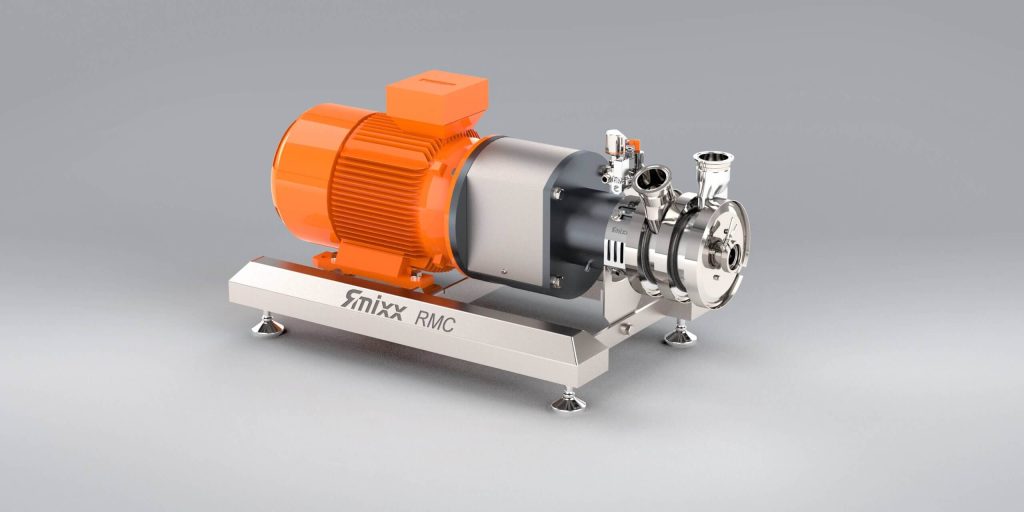 RMC inline powder dissolving machineInducts powders without dust, dissolves them and disperses them in a single pass. No lumps, no dumping losses.Discover the RMC›
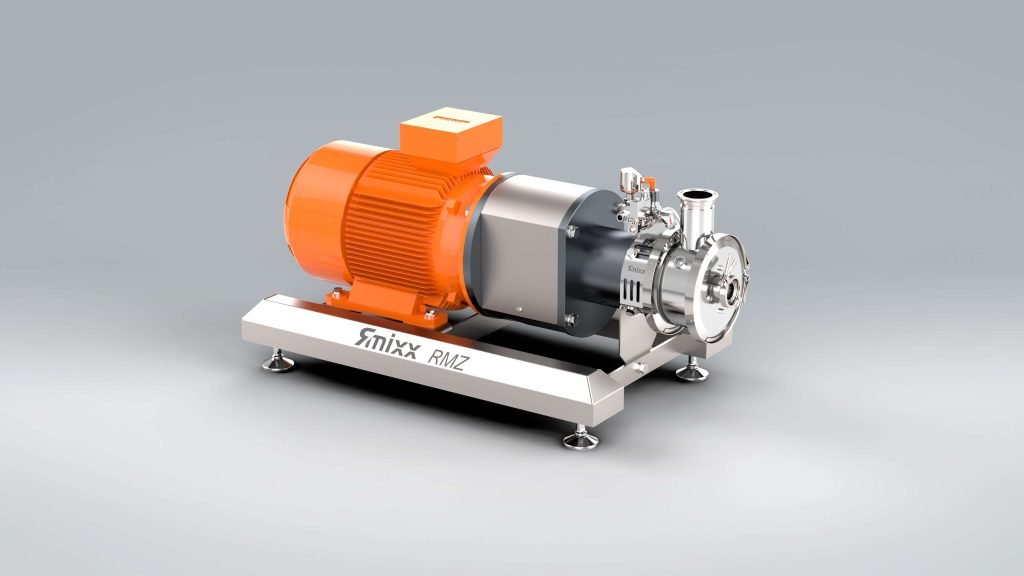 RMZ inline dispersing machineDisperses directly in the pipeline or through recirculation. Produces emulsions and suspensions quickly and reproducibly.Discover the RMZ›
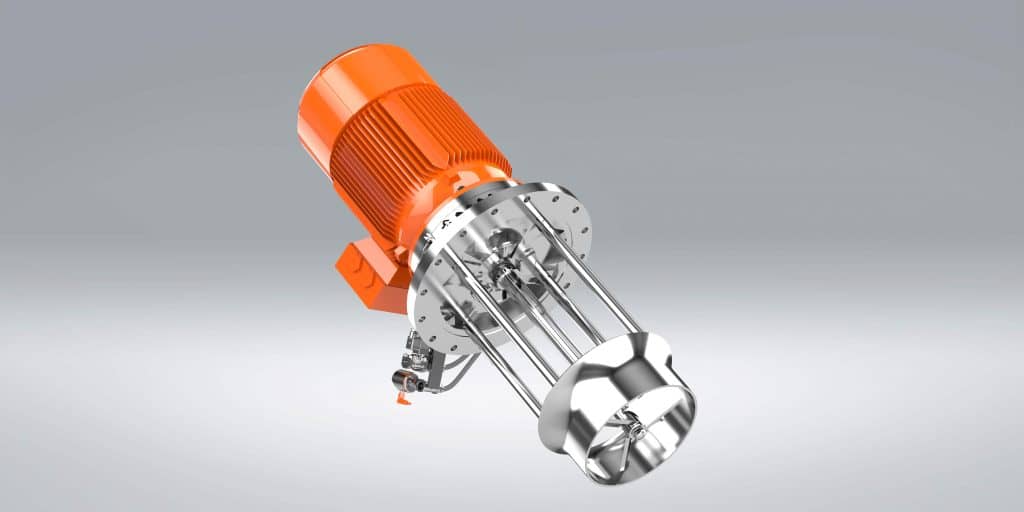 RMY jet stream mixerMixes homogeneously across a range of viscosities without air entrainment. Available as top-entry and side-entry versions.Discover the RMY›
Direct induction is not suitable for every recipe. A powder that hydrates very quickly can block the feed if it comes into contact with moisture too early, while a highly abrasive product imposes additional requirements on pipework and machine components. Without testing, it is therefore impossible to determine for every powder which feeding method provides the best wetting and reproducibility.
ATEX, exposure and hygiene each require a separate assessment
Dust control is an occupational safety, explosion safety and quality issue, but these three objectives are not interchangeable. A system that captures visible dust is not automatically explosion-safe, hygienically designed or suitable for a hazardous substance.
For combustible dust, the operator must assess the possible formation of an explosive atmosphere and classify zones where necessary. Equipment for use in a zoned area must be suitable for the intended zone and dust properties within the framework of ATEX Directive 2014/34/EU. Ignition sources can arise from electrostatic charging, mechanical friction, hot surfaces and unsuitable electrical components, among other causes; further context is provided in the explanation of ATEX and powder processes.
Earthing and equipotential bonding are important, but do not constitute a complete ATEX measure in themselves. The filter construction, dust accumulation, cleaning method, inspectability and configuration of connected equipment must also be included in the risk analysis. The explosion properties of the specific powder cannot be reliably inferred solely from its trade name or visible fineness.
Hygienic design is also important for food, pharmaceuticals and cosmetics. Product-contact parts must be accessible or demonstrably cleanable, dead spaces must be limited, and seals and surfaces must be suitable for the product and cleaning regime. Depending on the process, frameworks such as EHEDG, GMP or EU GMP Annex 1 may be relevant, but their applicability must be determined for each installation and intended use.
Assess the installation with the product and operator
A dust-free dumping solution must be tested with the actual powder, the actual packaging and the normal operating actions. A test using a free-flowing substitute product provides little information about a cohesive, electrostatic or rapidly hydrating production powder.
During a test, record where dust becomes visible, how the bag behaves under extraction, whether the filter entrains product and how completely the hopper empties. Also check the transition to dosing, transport or liquid induction. This makes it clear whether a problem originates at the dumping point or only becomes visible in the subsequent step.
The acceptance criteria should cover more than a visually clean environment. Consider control during the opening and disposal of bags, reproducible product feed, safe accessibility, cleanability, filter maintenance and behaviour during a process stop. For product-specific trials, RS Contracting can conduct tests in Coevorden or on site; to arrange this, discuss your powder process with a specialist.
Frequently asked questions about dust-free powder dumping
Can I make an existing dumping hopper dust-free using extraction alone?
Extraction alone is usually insufficient when the hopper has a large open inlet, a high fall path or gaps outside the capture zone. An effective modification combines extraction with containment, a suitable air path, filtration and controlled removal of empty packaging. Feasibility depends on the hopper geometry, powder properties and available access for operation and cleaning.
Why does dust escape from the hopper when I empty the bag quickly?
A rapidly entering mass of powder displaces air from the hopper and can force that air, together with fine particles, back through the opening. Emissions increase when the venting route or filter has insufficient capacity. Feeding more slowly may help, but a good design must discharge the displaced air in a controlled manner without excessive product extraction.
Is a dumping hopper suitable for every powder?
No, a manual dumping hopper is not the correct solution for every powder. Toxic, highly sensitising, explosion-hazardous or very valuable products may require greater containment. Cohesive or rapidly compacting powders may also discharge poorly. Enclosed transport, direct induction or a product-specific discharge system may then be safer and more reproducible.
How do I prevent lumps after the powder has been dumped dust-free?
You prevent lumps by matching the powder feed to the available wetting and mixing energy. Do not add powder faster than the liquid can incorporate it, and prevent a dry layer from forming on the liquid surface. For critical recipes, direct batch or inline powder induction may be more effective than dumping followed by conventional stirring.
When must a dumping hopper be assessed under ATEX?
An ATEX assessment is required when a combustible powder can form an explosive dust atmosphere during normal operation or a foreseeable malfunction. The operator determines the zone classification based on the risk analysis. The equipment, earthing, filtration, maintenance and potential ignition sources must then be demonstrably suitable for the established conditions.
The best solution controls both dust and the next process step
Dust-free powder dumping into a hopper requires an integrated design covering containment, airflow, filtration, product discharge and operator actions. A hopper that extracts only visible dust but loses product, discharges poorly or causes lumps in the mixing tank is not a complete process solution.
Therefore, first determine where the emissions arise and what must happen to the powder after dumping. For simple applications, a well-designed bag dumping station may be sufficient; where exposure is critical, feeding is frequent or the powder is processed directly into liquid, enclosed transport and powder induction are often easier to control. The final configuration must always be adapted to the actual product, packaging, cleaning regime and risk analysis.