Homogenisation is a process in which you make the composition, particle distribution or droplet distribution of a product as uniform as possible within a predetermined assessment level. This can be achieved through mixing, dispersing, emulsifying, dissolving or a combination of these, depending on what is distributed unevenly. The key question is therefore not only whether a product is homogeneous, but which property must be uniform throughout and on what scale.
A tank may look visually uniform while samples from different positions still differ in concentration, viscosity or particle size distribution. Conversely, a product does not have to be microscopically uniform to meet the process specification. In practice, an incorrect definition of homogeneity leads to unnecessarily long batch times, excessive shear, air entrainment or a product that fails release despite intensive mixing.
Homogeneity is always linked to a measurable property
A homogeneous product is uniform throughout, within the selected sample scale and tolerances, for the properties relevant to the formulation, processing and quality. Simply stating that a mixture must become homogeneous is technically insufficient. You must specify whether this concerns concentration, colour, temperature, pH, viscosity, solids content, droplet distribution, particle size distribution or a combination of these.
The assessment scale also matters. A suspension may be distributed uniformly at tank level, while individual samples still contain local agglomerates. In an emulsion, the ratio between oil and water may be uniform throughout the batch, while the droplets remain too large or too broadly distributed for the required stability.
Do you know which property in your process truly needs to be uniform and where you sample it? The answer determines whether circulation through the vessel is sufficient or whether locally intensive shear stress is required. Without this definition, homogenisation quickly becomes an unfocused attempt to mix for longer or at a higher speed.
-
Homogeneity of concentration primarily requires sufficient product movement throughout the entire tank.
-
Homogeneity of a suspension additionally requires control of wetting, agglomerates and sedimentation.
-
Homogeneity of an emulsion requires droplet size reduction and sufficient protection against coalescence.
-
Homogeneity of temperature requires heat transfer as well as continuous renewal of product along the heat exchange surface.
Mixing, dispersing and emulsifying produce different forms of homogenisation
Homogenisation is the desired process result; mixing, dispersing and emulsifying are operations that you can use to achieve that result. These terms are therefore not interchangeable. The required operation follows from the phases in the product and the mechanism causing the non-uniformity.
| Operation | What happens physically | Suitable process objective | Main limitation |
|---|---|---|---|
| Mixing | Product portions are moved through the vessel by convection and local flow. | Uniformly distribute concentration, temperature or dissolved substances. | Usually does not break down persistent agglomerates or liquid droplets sufficiently. |
| Dispersing | A solid is wetted, distributed and, where necessary, broken free from agglomerates by shear. | Produce suspensions, pigments, thickeners and other powder-liquid systems. | Does not dissolve insoluble primary particles and does not guarantee lasting stability. |
| Emulsifying | One liquid phase is distributed as droplets in another, immiscible liquid phase. | Produce oil-in-water and water-in-oil emulsions. | Without a suitable formulation, droplets may coalesce again after processing. |
| Dissolving | Molecules or ions leave the added substance and distribute themselves in the solvent. | Distribute genuinely soluble raw materials at molecular level. | More shear does not compensate for limited solubility or incorrect process conditions. |
| Wet milling | The size of solid primary particles is mechanically reduced. | Achieve a finer solid particle size distribution when the particles themselves are too large. | Is not the same as separating loose agglomerates. |
The distinction between dispersing and dissolving often causes confusion. A powder may be distributed completely free of lumps while still remaining present as a solid phase. Conversely, the exterior of a soluble powder may hydrate rapidly, creating a gel skin that traps dry material and actually slows dissolution. A more detailed explanation of these mechanisms is provided under the meaning of dispersing.
Flow provides distribution, while shear changes the internal structure
Effective homogenisation requires a suitable combination of macromixing and micromixing. Macromixing moves large product volumes and prevents zones that are barely renewed. Micromixing brings components together locally and, where necessary, provides the shear stress that reduces the size of droplets or agglomerates.
At low viscosity, turbulent flow can distribute product through the tank relatively easily. As viscosity increases or the product becomes thixotropic, flow often decreases sharply further away from the mixing element. The centre may then visibly move while product at the wall, bottom or liquid surface is not incorporated sufficiently.
Does your entire product volume actually pass through the active mixing zone, or is it mainly the area around the mixing element that moves? You answer this question using samples from representative locations, flow observations and measurements during the critical formulation phase. Differences between the bottom, centre, wall and outlet indicate insufficient circulation, an unsuitable position of the mixing element or unfavourable tank geometry.
A rotor-stator operates differently from a conventional agitator. The rotor accelerates the product and directs it through openings or a narrow gap past the stator, where strong velocity gradients occur. The resulting shear can break apart agglomerates and reduce the size of liquid droplets, while recirculation ensures that new product continuously passes through the active zone.
However, greater intensity is not automatically better. Excessive shear can break down a desired structure, increase temperature, damage sensitive ingredients or disperse air more finely through the product. The correct setting therefore follows from the required endpoint, not from the maximum available power.
“You cannot compensate for poor tank circulation with more shear. Simply running the rotor-stator faster will generally only introduce unnecessary heat and air into a stagnant batch.”
Bart Brouwer
Sales Manager
For process selection, this means that you must always answer two questions in parallel: how much bulk circulation is required, and how much local shear can the product tolerate or does it require? The balance between the two also changes during a batch as powders hydrate, an emulsion develops or a thixotropic product becomes thinner under load.
Homogenisation proceeds from raw material feed to a controlled endpoint
A reproducible homogenisation process is created by controlling feed, wetting, distribution, structure formation and final control as separate steps. Recording only the total mixing time is insufficient, because the same duration can produce a different result with a different order of addition or viscosity build-up.
-
Define the quality objective. Specify which product properties must be uniform, the sample scale on which you assess them and the applicable acceptance criteria.
-
Create sufficient initial circulation. Before addition, ensure that the liquid renews the feed zone and that no stagnant areas exist along the wall or bottom.
-
Dose at a controllable rate. Do not add powder or liquid faster than the system can absorb, wet and transport it away.
-
Apply the required energy locally. Use shear when agglomerates or droplets must be reduced in size, but limit it once the required endpoint has been reached.
-
Allow time for product-specific processes. Hydration, dissolution, deaeration and structure formation may continue after the visible distribution already appears uniform.
-
Perform representative checks. Compare samples from relevant positions or process stages and assess the properties specified in the first step.
The order of addition can be more important than the final mixing time. For example, thickeners tipped too quickly onto a poorly wetted surface form lumps with a hydrated outer layer. Suitable powder induction and sufficient liquid renewal around each particle prevent dry cores from becoming trapped.
In liquid-liquid systems, the addition also determines which phase becomes continuous and which phase is distributed as droplets. The choice of emulsifier, temperature and viscosity ratio subsequently influences how much shear is required and whether the resulting droplet distribution remains stable. For oil-in-water systems, this is explained further in relation to the process behind an oil-in-water emulsion.
A homogeneous appearance does not yet prove a stable product
Homogenisation makes a product uniform at the time of assessment, but does not automatically prevent the phases from separating again later. Sedimentation, creaming, coalescence, crystal growth and flocculation are determined by factors including density differences, particle or droplet behaviour, viscosity and interfacial chemistry.
A suspension may be uniform immediately after production but settle during storage because the liquid phase has insufficient carrying capacity. An emulsion may appear visually smooth and still separate later because droplets collide and coalesce. In such cases, a longer mixing time is not a structural solution; the formulation, particle or droplet distribution and rheology must be assessed together.
Does your product remain homogeneous only while the mixer is running? If so, the problem is probably not solely a lack of mixing. You must determine whether temporary movement is masking sedimentation, whether the developed structure recovers insufficiently after stopping and whether the product specification requires a stable storage condition or only a uniform processing condition.
This distinction prevents overprocessing. A product that only needs to remain uniform during dosing may benefit from gentle conditioning in the tank. A product that must remain stable for months will generally also require formulation measures; a more powerful homogeniser alone is then not the right answer.
Batch, inline or recirculation depends on the process function
Machine selection follows from product behaviour, required shear, tank circulation and the location where the critical operation can best take place. Batch equipment processes the product directly in the vessel, while inline equipment processes a defined product stream in the pipe. Recirculation combines a tank with repeated inline processing.
Batch processing keeps process steps in a single vessel
Batch homogenisation provides direct control over each batch and is suitable when additions, reaction time or formulation phases take place in the same vessel. The tank geometry, fill level and position of the mixing element determine whether the entire contents pass through the active zone often enough. When viscosity changes significantly, a single geometry may not provide the same circulation in every process phase.
Inline processing provides a defined active zone
Inline homogenisation directs the product flow through a rotor-stator or another processing zone. This allows the local process conditions to be defined more precisely and can separate powder induction, dispersing or emulsifying from bulk circulation. However, an inline machine does not resolve poor tank flow when recirculation continually draws product from the same well-moving area while dead zones remain.
Recirculation links bulk renewal to controlled shear
A recirculation loop is useful when the tank serves for buffering and macromixing and the product requires multiple passes through an inline processing zone. The residence time distribution then becomes important: not every portion of the product automatically passes through the zone the same number of times. The suction point, return position, line losses and changing flow behaviour of the product must be designed as a single system.
In practice, homogenisation may therefore require an inline dispersing machine for emulsions and suspensions, an inline powder dissolving machine for controlled powder induction or a jet stream mixer for powerful tank circulation without unnecessary air entrainment. The appropriate combination depends on whether your bottleneck lies in local shear, wetting or product movement.
The right machine for your process
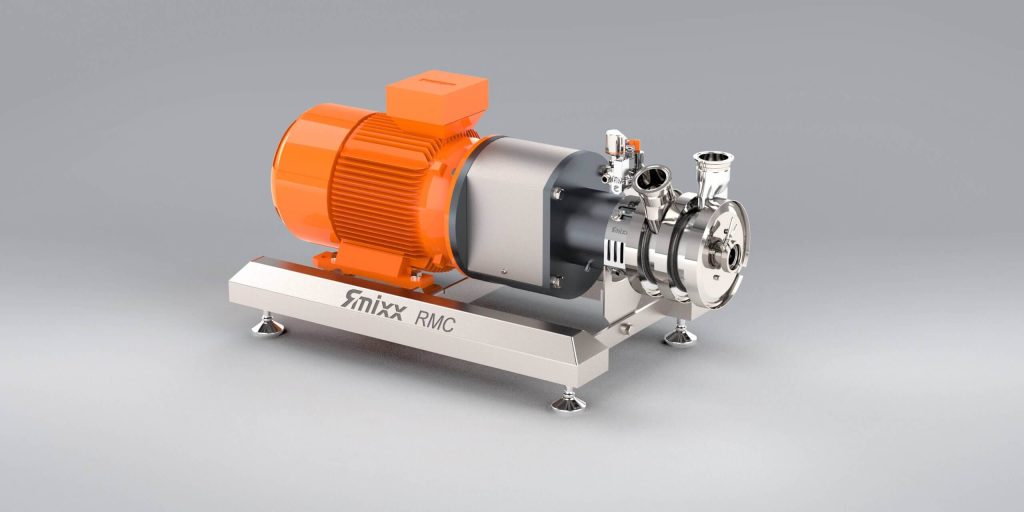 RMC Inline powder dissolving machineDraws powders in without dust, dissolves them and disperses them in a single pass. No lumps, no charging losses.Discover the RMC›
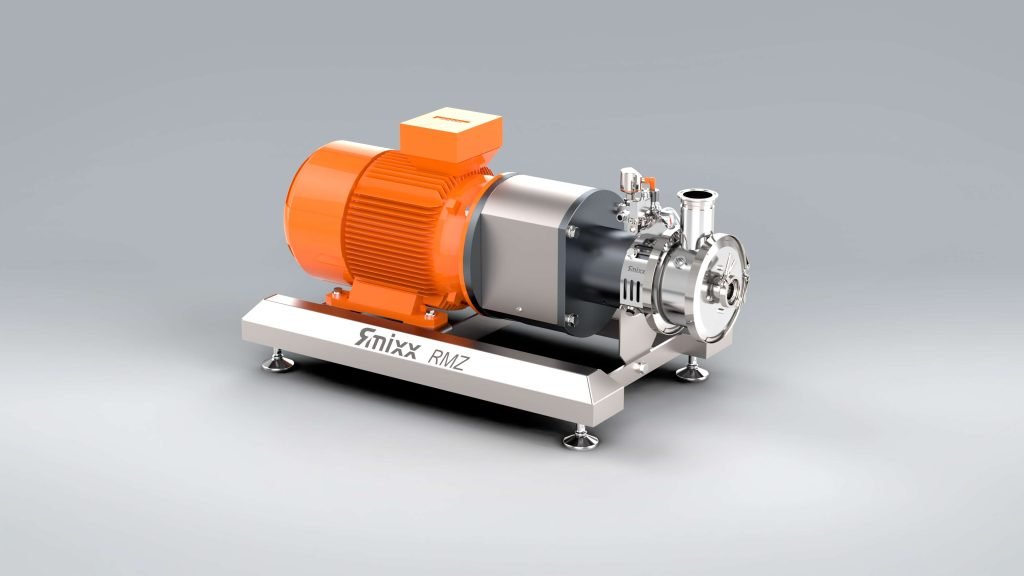 RMZ Inline dispersing machineDisperses directly in the line or through recirculation. Produces emulsions and suspensions quickly and reproducibly.Discover the RMZ›
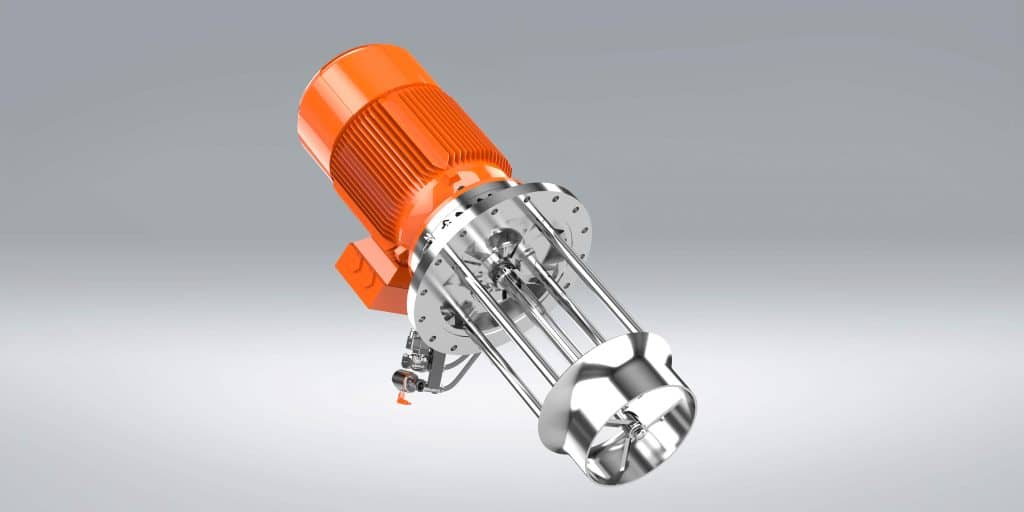 RMY Jet stream mixerMixes homogeneously at varying viscosities without air entrainment. Available as top entry and side entry.Discover the RMY›
You can find a technical comparison of the two basic configurations under inline and batch dispersing. For processes in which viscosity changes significantly, the relationship between the flow regime, mixing element and rheology is also decisive.
Viscosity, air and heat change the homogenisation result
Product specifications can change during homogenisation, which means that a well-chosen initial condition may no longer be suitable later in the process. Viscosity affects circulation, air affects density and measured values, and mechanical energy can change the product temperature. These effects must be monitored during trials and scale-up.
The highest viscosity may occur midway through the batch
Final viscosity alone is not a reliable basis for machine selection. Hydrating powders, concentrated intermediate phases and temperature changes may temporarily cause a higher viscosity than in the final product. The installation must continue to supply sufficient product to the active mixing zone precisely during this critical phase.
Air entrainment can imitate or disrupt homogeneity
A visible vortex and foam give the impression of intensive mixing, but entrained air can hinder wetting and distort volume, density or viscosity measurements. Finely dispersed air is also more difficult to remove than large bubbles. Suitable immersion, feed position, gentle bulk circulation or vacuum may therefore be more important than additional rotational speed.
Temperature affects both flow and product structure
A temperature change can reduce viscosity, alter solubility or affect the action of emulsifiers and thickeners. This makes cooling or heating part of the homogenisation process rather than merely an auxiliary facility. Measurements must therefore be linked to a defined product condition so that batches can be compared fairly.
Scaling up based on mixing time alone rarely works
Homogenisation does not scale reliably by transferring laboratory processing time directly to a production tank. Tank geometry, flow path length, heat transfer, residence time and the ratio between local shear and total product mass change during scale-up. A laboratory sample may therefore become uniform quickly while zones along the wall or bottom lag behind at production scale.
For scale-up, you must first determine which mechanism controls the result. If bulk circulation is limiting, the flow pattern and circulation time are important. If droplet or agglomerate size reduction is limiting, rotor-stator geometry, passes through the active zone and product-specific shear load carry more weight.
Without a trial, it is not possible to establish which configuration will achieve the required endpoint for every formulation. Viscosity, density, wettability, thixotropy and agglomerate strength differ between products. RS Contracting can therefore conduct trials with the customer’s product in Coevorden or on site, allowing laboratory, pilot and production conditions to be compared on the basis of relevant quality characteristics.
Cleanability and validation are part of process performance
An installation only homogenises reproducibly when product-contact parts remain clean in a controlled manner and process conditions can be reset. Residual product in gaps, pipes or poorly flushed zones can affect a subsequent batch. Hygienic design, surface accessibility and an appropriate CIP or SIP strategy are therefore functional design requirements.
For food and cosmetics, EHEDG principles and, where relevant, 3-A Sanitary Standards provide useful frameworks for hygienic design. In pharmaceutical processes, design, cleaning and documentation must align with GMP and the applicable validated process operation. These frameworks do not automatically prescribe which homogeniser is required, but they do influence material selection, seals, drainability and the cleaning concept.
A reproducible process recipe contains more than a set running time. At a minimum, record the order of addition, product temperature, mixing phase, sampling point and objective endpoint criteria. During maintenance, the rotor-stator clearance, wear, seals and flow obstructions must be monitored because mechanical changes can directly affect shear and residence time.
For further information on cleanability and product safety, hygienic design of process installations provides practical points for consideration. The relevant level depends on the industry, product risk and selected cleaning method.
Frequently asked questions about homogenisation
What is the difference between mixing and homogenisation?
Mixing is an operation in which product portions are moved by flow; homogenisation is the intended result in which a selected property is sufficiently uniform throughout. An agitator can mix a liquid homogeneously, but is not always capable of reducing the size of agglomerates or emulsion droplets. Additional dispersing or emulsification technology may be required for this purpose.
Is homogenisation the same as pasteurisation?
No. Homogenisation changes the distribution of ingredients, particles or droplets within a product. Pasteurisation is a heat treatment aimed at microbiological control. The processes may occur in the same production line, but have different objectives and require separate process parameters, controls and equipment.
Can every product be homogenised with a high-shear mixer?
No. High shear is suitable when droplets or agglomerates must be reduced in size, but may be undesirable for shear-sensitive structures, fibrous ingredients or products in which air entrainment and temperature increase are critical. For simple concentration or temperature distribution, a jet stream mixer or another low-shear mixing principle may be more effective.
How do you know when a product has been homogenised sufficiently?
A product has been homogenised sufficiently when representative samples meet predefined criteria for properties such as concentration, viscosity, colour, pH, particle distribution or stability. Visual assessment alone is generally insufficient. The sampling plan must take account of the tank position, process stage and any changes occurring after the mixer has stopped.
Why do lumps or phase separation reappear after homogenisation?
New lumps or phase separation often indicate incomplete hydration, flocculation, sedimentation or coalescence rather than insufficient initial distribution. More shear only helps when residual agglomerates are the problem. Where stability is limited, the formulation, order of addition, temperature, rheology and storage conditions must also be adjusted.
The right question is which mechanism makes your product non-uniform
Homogenisation does not simply mean mixing as intensively as possible, but specifically eliminating the cause of non-uniformity. Bulk differences require circulation, agglomerates require wetting and suitable shear, emulsion droplets require droplet size reduction and stabilisation, and storage problems often require changes to the formulation or rheology.
Therefore, begin with the quality characteristic, the relevant process stage and representative sampling. Then determine whether mixing, dispersing, emulsifying, dissolving or wet milling provides the necessary physical change. Only then can you make a substantiated choice between batch, inline and recirculation and avoid using additional mixing time to compensate for the wrong process mechanism.