High and low viscosity in mixing processes determine how much resistance a product offers to flow, but the viscosity value alone does not determine which mixer is suitable. At low viscosity, the emphasis is usually on controlled tank circulation and avoiding a vortex, while at high viscosity, sufficient bulk movement, torque and local shear are needed to prevent dead zones. The correct choice also depends on temperature, shear rate, time-dependent flow behaviour, particle loading and the process step in which the viscosity develops.
Viscosity is the resistance that a liquid or semi-solid product offers to deformation and flow under the influence of shear stress.
High and low viscosity are not fixed values
The distinction between high and low viscosity is always relative to the process conditions and the equipment used. A product that flows easily from a vessel may thicken considerably during powder addition; a paste that barely moves at rest may become readily pumpable under shear. A label such as “thick” or “thin” is therefore insufficient for machine selection.
Dynamic viscosity describes the relationship between shear stress and shear rate. Kinematic viscosity also takes density into account, but for mixing technology assessments, dynamic or apparent viscosity and the complete flow behaviour are usually more relevant. A reliable product specification therefore also states the measurement temperature, measurement method and applied shear rate.
| Process characteristic | Low viscosity | High viscosity |
|---|---|---|
| Bulk flow | The product is set in motion relatively easily and can quickly form a vortex. | The product moves with difficulty and is more likely to remain stationary at the wall, bottom or liquid surface. |
| Flow regime | Turbulent mixing is generally easier to achieve. | Laminar flow and local deformation are more likely to dominate. |
| Main mixing task | Circulation throughout the entire tank and control of air entrainment. | Active movement of the entire mass without dead zones. |
| Powder addition | Powder may float, create dust or be drawn into the product together with air. | Powder may remain on the surface and form dry agglomerates. |
| Heat transfer | Convection generally distributes heat through the tank more easily. | A stationary boundary layer may delay heating or cooling and cause local temperature differences. |
| Typical design risk | Considerable movement at the surface, but insufficient effective mixing in the tank. | Good local shear at the mixing element, but insufficient renewal of the product around that mixing element. |
Apparent viscosity changes during mixing
Many food products, coatings, cosmetics and pharmaceutical suspensions are non-Newtonian: their viscosity changes with the shear rate. Shear-thinning products become thinner as soon as a mixer, pump or rotor-stator introduces energy. By contrast, shear-thickening products offer more resistance as shear increases, meaning that a higher speed does not automatically result in better processing.
Thixotropic products gradually become thinner under sustained shear and rebuild their structure at rest. Other formulations have a yield stress: the product only begins to flow perceptibly once the applied shear stress exceeds this threshold. The most common mistake is therefore to use a laboratory viscosity value directly as a constant design value for the entire batch.
“In practice, people focus blindly on the viscosity of the final product, while it is the peak viscosity during powder dosing that determines whether the installation seizes up or keeps running.”
Bart Brouwer
Sales Manager RS Contracting
For complex products, a rheogram is more useful than a single measurement point. It shows how the apparent viscosity changes across the relevant shear range and whether hysteresis, thixotropy or a yield stress is present. For scaling up, this information must be linked to pumps, pipework, tank geometry and mixing zones.
Temperature and formulation can reverse viscosity
Temperature directly affects viscosity and can also activate melting, hydration, gelation or crystallisation. During heating, a product may initially become thinner and subsequently thicken considerably due to a reaction, cooling or structure formation. As a result, a mixer selected only for the initial viscosity may fall short precisely during the critical process phase.
The dosing sequence is also decisive. Powders increase the solids loading, binders may locally bind water, and polymers may form a network after hydration. The design must therefore be able to handle not only the final viscosity, but the complete viscosity profile from the first liquid through to deaeration, cooling and discharge.
Low viscosity requires circulation without apparent mixing
At low viscosity, the main task is usually to create a predictable flow pattern throughout the entire tank. A rapidly rotating liquid surface may give the impression that intensive mixing is taking place, while layers of liquid rotate together in the horizontal plane and vertical exchange remains limited. A vortex is therefore not proof of homogeneity.
Axial flow or a directed jet stream transports the product between the bottom, wall and surface. Tank proportions, liquid level, mixer position and any baffles determine whether this circulation loop reaches the entire contents. The correct geometry is often more important than simply increasing the speed.
High local shear stress is only required for a low-viscosity product when the process objective goes beyond mixing. A rotor-stator may be appropriate for breaking agglomerates, refining a dispersion or forming an emulsion; for merely distributing two readily miscible liquids evenly, such an intensive technique may be unnecessary. The distinction between mixing and technical dispersing prevents oversizing and undesirable product stress.
Air entrainment is a process risk with low-viscosity products
Low viscosity makes the product susceptible to vortex formation, surface splashing and air entrainment. Entrained air can cause foam, accelerate oxidation, disrupt effective pump capacity and affect density or filling measurements. In emulsions and suspensions, air bubbles may also obscure the assessment of homogeneity and particle distribution.
The solution is not always to mix more slowly. A different installation position, suitable immersion depth, an adjusted flow pattern or closed powder induction can limit air entrainment without losing the necessary circulation. When the product itself foams heavily or deaeration proceeds slowly, mixing under vacuum may be useful, but vacuum does not correct incorrectly selected mixing geometry.
High viscosity makes bulk transport decisive
At high viscosity, the mixer must deform and move the entire product mass, rather than merely create an intensive zone around the mixing head. Due to the limited turbulence, momentum is distributed through the tank less easily. As a result, wall layers, bottom zones and the area above or below the mixing element may remain virtually stationary while considerable energy is introduced locally.
A rotor-stator provides strong local shear, but is not automatically a complete solution for a viscous batch. If insufficient fresh product reaches the rotor-stator, the same small volume is treated repeatedly while the rest of the tank lags behind. A separate circulation function, a dispersing jet stream or a suitable combination of mixing elements may then be necessary.
In inline processing, the product must also be able to feed the machine reliably. A highly viscous product, high yield stress or poor inflow may result in insufficient filling, air entrapment or cavitation. The pipe diameter, bends, valves, suction conditions and pump used are therefore part of the mixing system and must not be regarded as separate utilities.
More shear can damage the product
High shear is not always the correct answer to high viscosity. Structure-sensitive emulsions, fibrous products, crystals or fragile particles may be damaged when the local stress exceeds what the formulation can tolerate. Undesirable heating may also occur because mechanical energy enters the product as heat.
For some processes, slow but complete turnover is better than intensive dispersing. The desired final structure, maximum permissible temperature and sensitivity to shear must therefore be established before selecting a mixing principle. With complex rheology, it is not always possible to predict reliably which combination will provide the best balance without a product trial.
Viscosity already changes during powder induction
Powder induction is often the point at which a free-flowing liquid changes into a suspension, solution or gel that is difficult to mix. The local ratio of powder to liquid may be much higher at the surface than in the bulk, causing a viscous skin to form around dry powder cores. These agglomerates then become increasingly difficult to wet.
- First establish stable liquid circulation. Without complete tank circulation, added powder reaches only a limited proportion of the liquid.
- Dose powder in proportion to the available wetting capacity. Excessively rapid addition causes local overloading, floating islands or dust formation.
- Make every particle accessible to the liquid phase. Sufficient surface renewal and shear stress break through the air layer around powders that are difficult to wet.
- Break down formed agglomerates before the viscosity increases further. As hydration or dissolution progresses, the load required to break down lumps generally increases.
- Allow the product time for dissolution, hydration or structure formation. A homogeneous appearance immediately after dosing does not automatically mean that the final product is rheologically stable.
Inline powder drawing-in can limit dust and floating powder layers because the powder is incorporated directly into a liquid stream. However, this technique is not suitable for every powder: very rapidly reacting, highly swelling or poorly pumpable formulations may block the induction zone if dosing, liquid flow rate and process sequence are not coordinated. The mechanisms behind drawing powders in inline must therefore be assessed together with the viscosity profile.
Machine selection for high and low viscosity
A suitable mixing installation is selected on the basis of the most demanding process phase and the required processing, not on the basis of the product name. “Cream”, “sauce” or “coating” provides insufficient information because formulations within the same product group may differ considerably in yield stress, thixotropy, particle behaviour and temperature sensitivity. The following criteria guide the selection.
- The mixer must generate sufficient bulk circulation at the highest relevant apparent viscosity.
- The local shear stress must be appropriate for dissolving, dispersing or emulsifying without unnecessarily damaging sensitive structures.
- The flow path must effectively renew the product at the wall, bottom, liquid surface and any heating or cooling zones.
- Pumps and pipework must be able to transport the product to an inline machine and back to the tank under all process conditions.
- The installation must control air entrainment, foam formation and dust emissions where they occur.
- Cleanability and product loss must be assessed at the final viscosity because viscous residues are difficult to remove from pipes, valves and dead spaces.
Batch and inline fulfil different functions
Batch mixing provides direct treatment in the vessel and is suitable when formulation sequence, residence time and control per batch are central considerations. Inline processing passes the product through a defined mixing zone and can therefore provide reproducible local shear. During recirculation, the number of effective passes, together with tank circulation, determines how uniformly the entire batch is treated.
Inline processing is not automatically faster or better at high viscosity. If the product does not flow properly to the inline machine, the theoretical capacity is not utilised and treatment may become unstable. A comparison of inline and batch dispersing must therefore also include pumpability, pressure losses in pipework, residence time distribution and cleaning.
In practice, the process function can be divided between tank circulation, controlled powder intake and targeted dispersion. A jet stream mixer supports bulk movement at different viscosities, an inline powder dissolving machine combines induction with wetting, and an inline dispersing machine provides reproducible shear in a pipe or recirculation loop.
The right machine for your process
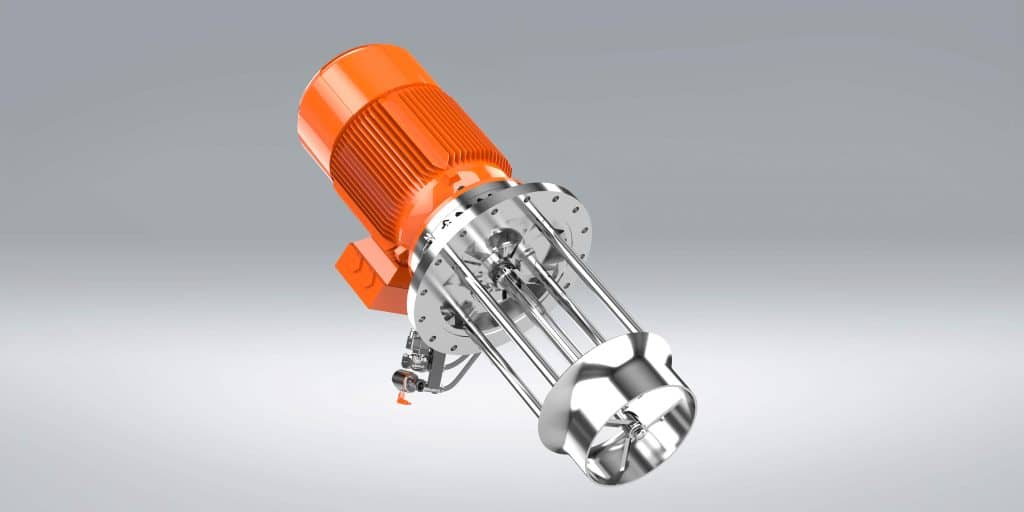 RMY Jet Stream MixerMixes homogeneously at different viscosities without air entrainment. Available as top entry and side entry.Discover the RMY›
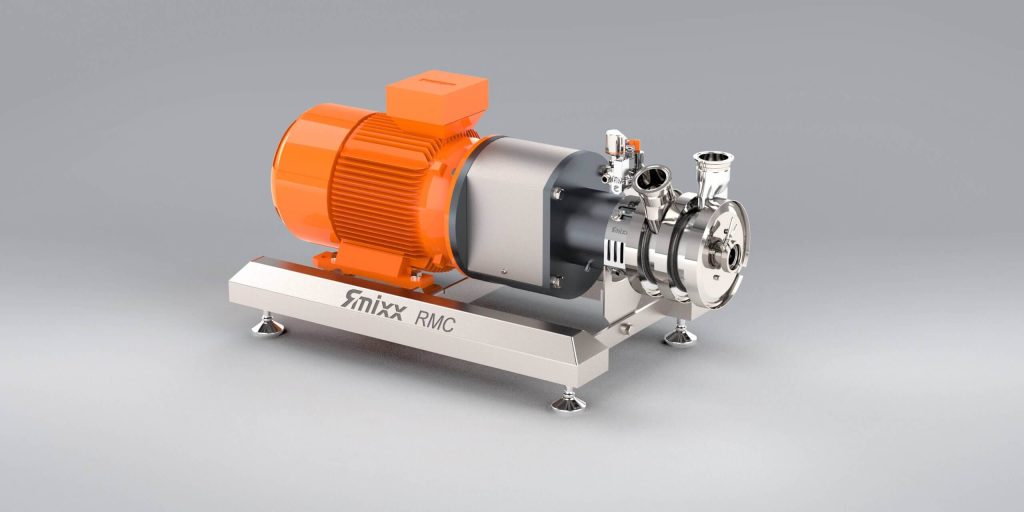 RMC Inline Powder Dissolving MachineDraws in powders without dust, dissolves them and disperses them in a single pass. No lumps, no charging losses.Discover the RMC›
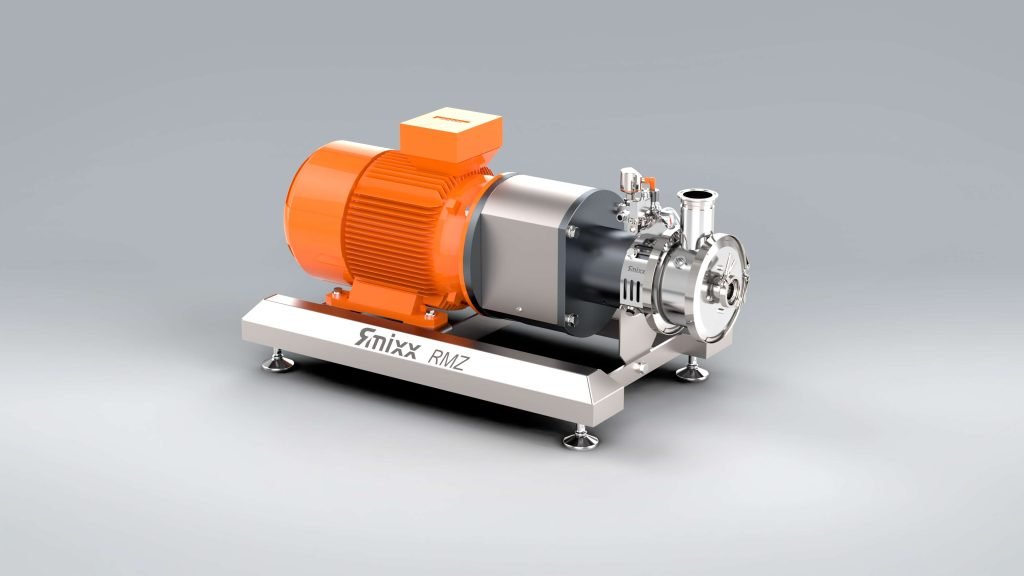 RMZ Inline Dispersing MachineDisperses directly in the pipe or through recirculation. Produces emulsions and suspensions quickly and reproducibly.Discover the RMZ›
A combined installation is only useful when each machine fulfils a demonstrable process function. Additional equipment also increases the complexity of control, cleaning and maintenance. A product trial can determine whether one mixing principle is sufficient or whether separate functions are genuinely required.
Scaling up requires more than the same mixing time
A laboratory trial cannot be scaled up merely by maintaining the same mixing time. In a larger tank, the distances over which the product must circulate, the ratio between the mixing element and the tank, heat transfer and residence time distribution all change. Particularly at high viscosity, insufficient bulk movement often becomes apparent only at production scale.
The same tip speed does not guarantee an identical result either. Tip speed affects local shear, while homogenisation time, power draw, torque and pumping capacity describe other aspects of the process. When scaling up, it must be established which parameter is genuinely decisive for product quality: agglomerate break-up, droplet formation, suspension stability, dissolution or overall tank homogeneity.
A representative trial uses the same raw materials, dosing sequence and relevant temperature profile as final production. Measure not only the final viscosity, but also the torque profile, time to complete wetting, air entrainment, temperature development and reproducibility. RS Contracting can conduct these trials in Coevorden or on site; an initial approach can also be explored using the machine configurator for mixing processes.
Process deviations often indicate flow, not power
Problems involving high and low viscosity are often incorrectly attributed to insufficient motor power. More power only helps when the mixing element converts that energy into the required bulk flow or shear stress. An unfavourable installation position, incorrect process sequence or inadequate product supply will persist even with a more powerful drive.
| Observation | Probable cause | Logical intervention |
|---|---|---|
| Rapid vortex, but concentration differences in the tank | Collective horizontal rotation without sufficient axial exchange. | Adjust the flow direction, installation position or tank geometry before increasing the speed. |
| Lumps after powder addition | Local overdosing and wetting of only the outside of the agglomerate. | Match dosing to circulation and wetting capacity. |
| Viscosity differs between sampling points | Incomplete tank circulation, temperature differences or ongoing hydration. | Check multiple sampling points and allow the product the required conditioning time. |
| Inline machine draws in product irregularly | Insufficient feed, air entrapment or excessive resistance in the pipework. | Assess the pump, suction line, valves and yield stress as one system. |
| Product becomes thinner during mixing and thickens again later | Thixotropy or temporary structural breakdown due to shear. | Define the measurement time, rest time and shear history in the quality method. |
Cleaning and safety change with viscosity
An installation that mixes a product effectively is not automatically easy to clean at the same viscosity. Viscous product residues adhere to walls, remain in branches and are less easily carried away by the cleaning flow during CIP. Hygienic design therefore requires self-draining pipes, accessible surfaces and the avoidance of dead spaces, adapted to the product and cleaning regime.
At low viscosity, a cleaning liquid may simply flow through a pipe without exerting sufficient stress on the wall; at high viscosity, a product displacement or pre-rinse step may first be required. For food products, cosmetics and pharmaceutical applications, EHEDG, 3-A Sanitary Standards, GMP and EU GMP Annex 1 may be relevant design frameworks, depending on the process and market. These frameworks do not replace a product-specific risk analysis or cleaning validation.
The explosion risk must also be assessed during powder dosing. Dust formation, ignition sources and zone classification determine whether equipment must be designed in accordance with ATEX Directive 2014/34/EU. A closed induction system can limit dust emissions, but does not eliminate the need for an ATEX assessment.
Frequently asked questions about viscosity in mixing
Is a high-viscosity product always more difficult to mix?
A highly viscous product is not automatically more difficult to mix, but it generally requires more attention to bulk movement, torque and dead zones. A shear-thinning product may circulate well under load, while a low-viscosity product may become poorly homogenised because of an unfavourable flow pattern. Complete rheological behaviour is therefore more important than viscosity at rest alone.
Which mixer is suitable for low viscosity?
For low viscosity, a mixer is usually needed that creates a controlled circulation loop throughout the entire tank without excessive vortex formation and air entrainment. If only two miscible liquids are being homogenised, bulk circulation may be sufficient. Additional rotor-stator shear may be required for emulsions, agglomerate break-up or fine dispersions.
Which mixer is suitable for high viscosity?
For high viscosity, the mixer must provide both sufficient torque and effective product movement. The choice may be a jet stream mixer, a batch disperser, an inline system with suitable feed or a combination of these. The appropriate design depends on yield stress, shear-thinning, particle loading, tank geometry and the desired final structure.
Why does my product become thinner during mixing?
A product that becomes thinner during mixing often exhibits shear-thinning or thixotropic behaviour. The applied shear temporarily breaks down an internal structure, reducing the apparent viscosity. After resting, this structure may return partially or completely. A temperature increase may simultaneously contribute to the measured thinning.
Can I select a mixer based on a single viscosity measurement?
A single viscosity measurement is usually insufficient for machine selection unless the product is demonstrably Newtonian and is processed under virtually constant conditions. Complex formulations require measurements across relevant shear rates, temperatures and rest times. The process profile, dosing sequence, tank geometry and desired product quality must also be included in the assessment.
When is a rotor-stator not the correct solution?
A rotor-stator is not the correct solution when only gentle bulk circulation is required, when sensitive structures are damaged by high local shear, or when a viscous product does not reach the mixing head sufficiently. In such situations, a different mixing element or a combination with active tank circulation may be technically more suitable and simpler.
The correct viscosity analysis prevents incorrect machine selection
A sound mixing design begins with the viscosity profile throughout the complete process, not with a single final value. Record when the product thickens or thins, what shear is required, how powders are added, where air can enter and which zones in the tank must be renewed. This clarifies whether the core task is circulation, dissolution, dispersing, emulsifying or a combination of these.
For simple Newtonian liquids, a calculation using known product data may provide sufficient guidance. In the case of thixotropy, a yield stress, extensive hydration or a critical emulsion structure, a trial with the actual formulation is more reliable. This ensures that the installation is selected on the basis of demonstrable process behaviour rather than the assumption that “thin” is easy and “thick” only needs to be mixed vigorously