You choose more or less shear based on the desired product change, not on the highest achievable mixing intensity. Shear is the shearing load that occurs when adjacent liquid layers move at different velocities. Too little shear leaves agglomerates, coarse droplets or a broad particle size distribution; too much shear can break down structure, entrain air, build up heat and introduce unnecessary energy into the product.
The better question is therefore not how much shear a machine can deliver, but how much effective treatment each part of the product requires and can withstand. Do you know where viscosity peaks in your process, which structure must be preserved and whether all the product actually passes through the active mixing zone? These factors determine the result more often than rotational speed or motor power alone.
More or less shear starts with the desired product change
The process objective determines whether you primarily need circulation, wetting, dispersion, emulsification or preservation of structure. These operations do not require the same form of energy input. Homogeneous mixing is primarily a distributive task, while breaking up agglomerates or droplets requires sufficiently high local shear stress.
| Process objective | Required treatment | Risk of too little shear | Risk of too much shear |
|---|---|---|---|
| Homogenising liquids | Good macrocirculation with generally limited local shear | Dead zones, concentration differences and long mixing times | Air entrainment, heating and unnecessary product loading |
| Wetting and dissolving powder | Rapid wetting, controlled powder dosing and sufficient liquid renewal | Lumps, floating layers and enclosed dry powder | Foaming or damage to shear-sensitive thickeners |
| Dispersing agglomerates | Local shear stress that exceeds the cohesive forces within the agglomerate | Coarse particle distribution, sedimentation and insufficient functionality | Excessive heating or damage to primary particles and product structure |
| Forming an emulsion | Droplet deformation and break-up, combined with rapid stabilisation of the new interface | Coarse droplets, separation and limited stability | Temperature rise, air entrainment or damage to sensitive components |
| Preserving an existing structure | Sufficient flow for homogeneity, with limited peak loading | Incomplete distribution of ingredients | Breakdown of polymers, crystals, flocs or developed rheology |
A common mistake is to equate dispersion with intensive agitation. Agitation moves product through the tank, but it only breaks up an agglomerate when the local stress is greater than the forces holding it together. Conversely, a rotor-stator zone can disperse powerfully while the overall batch remains uneven if tank circulation does not transport enough product to that zone.
When dispersing in liquid, micro- and macromixing are therefore inseparably linked. The dispersing head provides the local treatment; the flow in the tank or pipe determines which part of the product receives that treatment and how often this occurs.
Shear is a local load, not a machine setting
Shear arises from a velocity gradient in the liquid and only becomes shear stress in combination with the product’s rheology. At the same velocity gradient, a more viscous product may experience higher stress than a low-viscosity liquid. In non-Newtonian products, the apparent viscosity also changes during treatment, which means that shear conditions can shift during a batch.
A rotor-stator generates high local velocity differences in and around the rotor-stator gap and the stator openings. A smaller passage or different geometry can intensify shear, but it also affects flow, pressure build-up, residence time and susceptibility to blockage. Therefore, selecting rotor-stator geometry is not an isolated choice for maximum shear.
The product result is determined by the combination of shear intensity, exposure time and the number of effective passes. A highly intensive zone is of little benefit if part of the batch does not reach it. Moderate treatment may, in fact, be sufficient when every part of the product is treated in a controlled manner and the process stops as soon as the target specification has been reached.
“In practice, we rarely solve dispersion problems by applying more power to the mixing head, but by adjusting the bulk circulation so that the product actually reaches that zone.”
Bart Brouwer
Sales Manager RS Contracting
The viscosity peak is often decisive in this respect. A formulation may start at low viscosity, thicken considerably during hydration or powder uptake and subsequently exhibit shear thinning again. If you use only the initial or final viscosity when selecting a machine, you may choose a system that provides insufficient circulation or powder uptake precisely during the critical process phase.
More shear only helps when the limiting step requires break-up
More shear is useful when agglomerates or droplets only become smaller after a higher local load has been reached. The cohesion of the agglomerate, the viscosity of the continuous phase, the interfacial tension and stabilisation by surfactants determine how much treatment actually has an effect. As soon as another process step becomes limiting, additional shear provides hardly any further product improvement.
During powder addition, wetting is often the first limiting step. Powder that is dumped too quickly onto a liquid surface may hydrate on the outside and form a tough shell around dry material. Adding more shear afterwards then requires additional processing and does not always reach the enclosed powder immediately; controlled powder induction and rapid liquid renewal at the contact point prevent the problem earlier in the process.
A robust sequence for powder-liquid processes is:
- Establish stable circulation in the liquid phase so that added raw material is immediately carried away from the dosing point.
- Dose the powder in proportion to the liquid’s wetting and uptake capacity.
- Wet each particle before hydration, swelling or surface structure can form a barrier.
- Then apply sufficient local shear to break up the remaining agglomerates or form the desired dispersion.
- Allow dissolving, hydration or stabilisation to take place without applying a high load for longer than necessary.
- Assess the endpoint using a product property, such as viscosity, homogeneity, particle size distribution or emulsion stability, and not solely by elapsed mixing time.
A similar mechanism applies to emulsions. Shear deforms and breaks up droplets, but the newly formed interface must be stabilised rapidly. If the emulsifier concentration, temperature or phase ratio is incorrect, an even more intensive mixer will not resolve the underlying instability.
Less shear protects rheology and vulnerable structures
Less shear is the right choice when the product must be distributed but its molecular, crystalline or developed structure must be preserved. This applies, for example, to shear-sensitive polymers, certain thickeners, floc structures, crystal suspensions and products whose mouthfeel or application behaviour depends on specific rheology. High shear is then not a quality improvement, but a potential source of product damage.
Thixotropy requires extra attention. A thixotropic product temporarily becomes less viscous under load and rebuilds its structure at rest. A low viscosity measured immediately after intensive mixing therefore does not automatically mean that the formulation is incorrect; the measurement time, history and recovery period must be the same for each batch to allow meaningful comparisons.
Air entrainment may also be a reason to reduce the intensity or change the flow geometry. A vortex draws air from the liquid surface into the product, after which intensive dispersion can make it more difficult for small air bubbles to escape. This can cause foam, oxidation, volume errors, filling problems and misleading viscosity measurements.
Are you working with a product that becomes much less viscous during shear but recovers poorly after standing? It must then be established whether this is reversible thixotropy or permanent structural breakdown. The solution may be less local shear, shorter exposure or a different mixing sequence; additional mixing time actually makes permanent breakdown worse. The relationship between flow and rheology is discussed further under high and low viscosity.
Process deviations reveal whether shear is distributed incorrectly
Deviations in the product and system usually show whether the intensity, circulation or treatment time is insufficient. However, one symptom may have several causes, so a higher setting without diagnosis may shift the problem rather than solve it.
| Observation | Likely process cause | Targeted check |
|---|---|---|
| Lumps with a dry core | Powder hydrates faster than it is fully wetted | Check dosing rate, contact point, liquid renewal and powder induction |
| Coarse dispersion despite a long mixing time | Local shear stress is too low or insufficient product passes through the active zone | Check rotor-stator geometry, circulation and effective passes |
| Differences between samples from the same batch | Insufficient macromixing or the presence of dead zones | Take samples at different locations and times |
| Viscosity remains too low after processing | Incomplete hydration, incorrect measurement conditions or permanent structural breakdown | Compare resting time, temperature, mixing history and order of addition |
| Foam or air bubbles | Vortex formation, leakage on the suction side or overly intensive air distribution | Check liquid level, flow pattern, connections and direction of rotation |
| Product heats up without any further quality improvement | Additional mechanical energy is no longer converted into useful size reduction | Determine the actual process endpoint and limit recirculation or treatment time |
Does your product actually flow along the tank wall and bottom, or is it mainly the area around the mixing element that moves? A stationary or slowly moving area near the wall indicates insufficient bulk circulation, particularly when viscosity increases during the process. More local shear in the centre does not resolve this automatically; the flow direction, positioning and ratio between the mixing zone and vessel must then be reviewed.
The machine determines where and how often the product experiences shear
Equipment must be selected based on the required combination of local treatment and product transport. An inline rotor-stator system forces a defined product flow through the active zone, while a batch disperser depends on circulation within the vessel. A jet stream mixer, by contrast, emphasises directed bulk flow and can homogenise without creating a high peak load throughout the product.
Inline treatment makes passes controllable
An inline dispersing machine is suitable when a product must undergo controlled treatment in a single pipe pass or through recirculation. The process result depends not only on the rotor-stator, but also on feed conditions, pipe resistance, viscosity development and residence time distribution. During recirculation, the tank must be mixed properly; otherwise, part of the product passes through repeatedly while another part remains behind.
Batch dispersion combines local shear with vessel circulation
A batch disperser is suitable when additions, visual process control and treatment per batch are key. The dispersing head must remain sufficiently submerged and the flow pattern must convey product from the wall, bottom and surface to the active zone. On a production scale, dead zones and an unfavourable ratio between the mixing head and vessel become much more apparent than during a laboratory trial.
Jet stream mixing prevents unnecessary peak loading
A jet stream mixer is suitable when homogeneity and controlled circulation are more important than intensive particle or droplet size reduction. The directed flow field can also be combined with a separate dispersing step. As a result, one mixing element does not have to provide maximum macromixing and maximum local shear at the same time.
In practice, the choice therefore often comes down to three functions: reproducible inline dispersing, drawing in and immediately wetting powder, or homogenising an entire tank with limited air entrainment. These functions can be used separately or combined as process steps, depending on the formulation, viscosity profile and desired endpoint.
Machines from RS Contracting
The right machine for your process
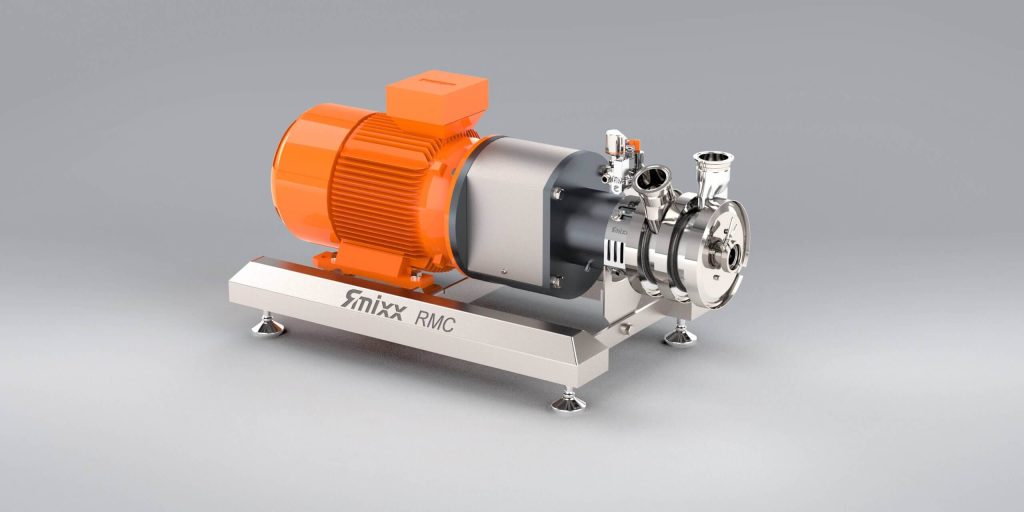 RMC Inline powder dissolving machineDraws in powders without dust, dissolves them and disperses them in a single pass. No lumps, no spillage losses.Discover the RMC›
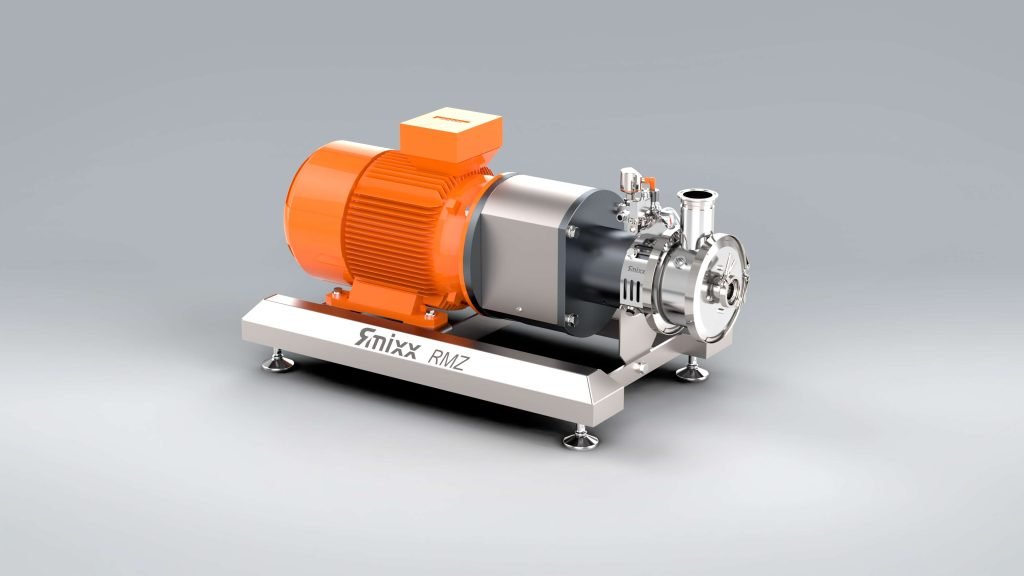 RMZ Inline dispersing machineDisperses directly in the pipe or through recirculation. Quickly and reproducibly creates emulsions and suspensions.Discover the RMZ›
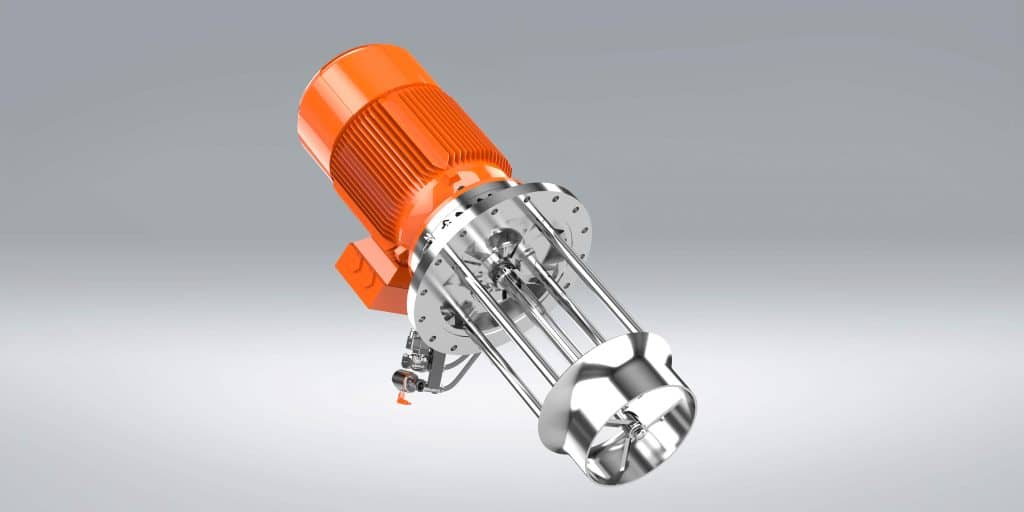 RMY Jet stream mixerMixes homogeneously at a range of viscosities, without air entrainment. Available as top entry and side entry.Discover the RMY›
The trade-off between treatment in a pipe and treatment in the vessel is explained further under inline or batch dispersing. For a specific inline configuration, you can also view the inline dispersing machines.
A trial must establish both the shear limit and the process sequence
A representative trial determines not only whether a product becomes sufficiently fine or homogeneous, but also when additional treatment no longer provides any benefit. For this purpose, the raw material condition, order of addition, temperature, sampling time, resting time and analysis method must be recorded. Otherwise, the effect of shear will be confused with variations in the formulation or sample handling.
At least three conditions are useful for the assessment: insufficiently treated, at product specification and treated beyond what is necessary. This reveals whether the process has a broad operating window or rapidly shifts from insufficient dispersion to product damage. Without this limit test, a successful laboratory batch may still prove difficult to reproduce on a production scale.
When scaling up, using the same rotational speed is not a valid scaling criterion. Vessel diameter, rotor-stator geometry, flow path, residence time and rheology change the mechanical load and circulation. Good scale-up therefore preserves the relevant process function: the same wetting conditions, sufficient local stress, a comparable treatment distribution and the same product-specific endpoint.
RS Contracting can conduct trials with your product in Coevorden or on site. This is particularly relevant when wettability, density, viscosity development or shear sensitivity cannot be reliably derived from raw material data. In such cases, a trial is not a formality, but the only responsible way to choose more or less shear.
Decide based on the product effect rather than maximum intensity
The right amount of shear is the lowest effective treatment that reproducibly achieves the desired product result without damaging the relevant structure. Use the following decision criteria in this order:
- Define the endpoint: establish whether homogeneity, dissolution, droplet distribution, particle distribution, viscosity or stability determines release.
- Determine the limiting step: distinguish between insufficient wetting, local stress that is too low and insufficient bulk circulation.
- Map rheology across the entire process cycle: do not design solely on the basis of initial or final viscosity.
- Identify vulnerable structures: determine which polymers, crystals, droplets, flocs or active ingredients cannot withstand prolonged high loading.
- Control exposure: manage not only intensity, but also residence time, number of passes and recirculation.
- Validate the operating window: test both insufficient and excessive treatment and record the corresponding product properties.
More shear is therefore not a universal route to a better product, and less shear is not automatically cleaner or gentler. The right solution links a specific product transformation to the location, duration and distribution of the mechanical load. If the operating window is unknown, it must first be established using the actual product.
Frequently asked questions about more or less shear
Does a higher rotational speed always mean more shear?
A higher rotational speed generally increases local velocity differences, but does not describe the full product load. Rotor-stator geometry, viscosity, flow, residence time and number of passes also determine what the product experiences. A higher rotational speed may also primarily result in additional circulation, heat or air entrainment if the limiting process step lies elsewhere.
How do I recognise too little shear in my mixing process?
Too little effective shear is often evident from persistent agglomerates, coarse droplets, a broad particle size distribution or product that does not meet specification after a long mixing time. Also check tank circulation: a suitable dispersing head may produce insufficient results if product near the wall or bottom barely reaches the active zone.
Can too much shear reduce viscosity?
Yes, but the cause must be distinguished. In thixotropic products, viscosity may temporarily decrease and recover later. Shear-sensitive polymers or developed structures may break down permanently, preventing recovery. Therefore, compare samples at the same temperature, resting time and using the same measurement method before concluding that the formulation or mixer is incorrect.
When is high shear not the right solution?
High shear is not the right solution when the problem is mainly caused by poor bulk circulation, incorrect powder dosing, insufficient wetting or an unstable formulation. For vulnerable crystals, polymers, flocs or desired product structures, a jet stream mixer or mild mixing element may also be more suitable than intensive rotor-stator treatment.