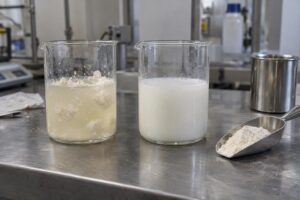
You can prevent agglomerates during dispersing by wetting each powder particle in a controlled manner, matching the powder feed to the available liquid flow and only then applying sufficient shear stress. A higher speed or longer mixing does not always remedy incorrect powder induction, because a wet outer layer can trap a dry core. The real point of attention is therefore not only how much shear your machine delivers, but where and when powder, liquid and shear come together.
An agglomerate is a coherent group of particles that behaves as one larger unit during storage, dosing or wetting. During dispersing, this structure must be wetted and broken apart without the released particles clumping together again.
Preventing agglomerates starts before high shear
Preventing agglomerates starts with the first contact between powder and liquid, not with the final dispersing step. As soon as a poorly wettable powder lands on the liquid surface as a compact mass, the outside can become wet and swell while the core remains dry. This creates a fish eye: an elastic or pasty shell around unwetted powder.
The most common assumption is that additional mechanical power will eventually break every lump. This is only true if the agglomerate passes through the active dispersing zone, the shear stress is high enough and the product structure can withstand that load. In a tank with insufficient macromixing, the central section may circulate vigorously while floating powder, wall zones and the bottom are barely refreshed.
Do you know whether your lumps form immediately during powder feeding or only after the product has circulated for some time? Lumps that form immediately generally indicate insufficient wetting or an excessively high local powder load. Agglomerates that return later are more likely to require investigation into stabilisation, hydration, viscosity build-up or reagglomeration.
Wetting determines whether liquid can penetrate the pores
A powder only wets properly when the liquid can displace what is on the particle surface and penetrate between the particles. Surface tension, contact angle, particle shape, porosity and any hydrophobic behaviour determine how easily this happens. Trapped air acts as a barrier: the liquid cannot reach the inside of the agglomerate until that air can escape.
A large vortex is therefore not automatically beneficial. The vortex can draw powder downwards, but at the same time entrain air and introduce powder in concentrated packets. Controlled induction into a liquid flow generally creates a larger contact area and prevents the dispersing head from first having to process a compact powder mass.
“In practice, I often see additional power being applied to lumps, while an agglomerate with a tough outer layer simply flows around the dispersing head like an elastic ball.”
Bart Brouwer
Sales Manager
High shear only becomes effective when the product actually passes through the rotor-stator zone. A smaller gap and a higher relative speed generally increase the local shear stress, which can cause weak bonds between particles to fail. The influence of head geometry, product throughput and recirculation is discussed further under selecting rotor-stator geometry.
Three different causes require three interventions
Not every visible particle cluster is the same problem, so one standard setting is rarely sufficient. You must distinguish between agglomerates already present in the supplied powder, lumps formed during wetting and particles that have already been broken apart but come together again. The point at which they form determines where you must intervene in the process chain.
Supplied agglomerates form before the liquid phase
Supplied powders may already contain lumps due to moisture, pressure, prolonged storage or cohesive particle behaviour. A disperser can often break apart soft structures, but hard lumps can make powder dosing irregular or restrict induction before they reach the dispersing zone. Screening, breaking lumps, controlled discharge and a uniform hopper feed may then be more important than additional shear in the liquid.
Wetting lumps are created by the process itself
Wetting lumps form when more powder is introduced locally than the liquid can absorb and carry away. The outer particles become wet, swell or partially dissolve and form a barrier around the dry core. This is common with hydrocolloids, thickeners, starches and other powders that build viscosity rapidly, but the mechanism can also occur with pigments, minerals and active ingredients.
Reagglomeration occurs after successful deagglomeration
Reagglomeration means that particles that have already been separated form a larger structure again. The primary cause is then not the powder feed, but insufficient stabilisation, an unsuitable pH, ionic interactions, an incorrect temperature or insufficient separation between particles. More shear may temporarily reduce the cluster size, but it does not provide a lasting solution to an unfavourable formulation or interfacial chemistry.
Your product symptom indicates the missing process step
The shape, location and time at which agglomerates become visible provide a useful initial diagnosis. Assess the product during addition, immediately after dispersing and after the relevant resting or storage period. Examining only a final sample can conceal the fact that the problem arose earlier in the batch.
| Observation | Probable cause | First process intervention |
|---|---|---|
| Lumps with a wet shell and dry core | Powder feed is too rapid or concentrated, with insufficient wetting | Meter the feed and introduce powder directly into an active liquid flow |
| Dry powder or a floating layer on the surface | Insufficient surface flow or poorly wettable powder | Adjust the feed point and macromixing before applying more shear |
| Lumps at the wall, bottom or liquid line | Dead zones, caking or insufficient tank circulation | Check the flow pattern, tank geometry and position of the mixing element |
| A large amount of foam alongside remaining lumps | Air entrainment due to vortex formation or powder carrying air with it | Draw in powder under controlled conditions and limit free fall |
| Fine dispersion immediately after production, flocs later | Reagglomeration due to insufficient colloidal stability | Assess the formulation, order of addition, pH and stabiliser performance |
| Hard granules that do not become smaller | Strong aggregate, contamination or unsuitable or insufficient break-up energy | Investigate powder quality and assess whether wet milling is necessary |
Do the problems mainly arise at the wall and bottom while the centre of the tank appears homogeneous? In that case, additional local shear is usually not the first solution. The tank must first transport sufficient product to and through the active zone; otherwise, the disperser repeatedly treats the same partial volume.
Process sequence for preventing agglomerates during dispersing
A robust dispersing cycle deliberately separates preparation, wetting, deagglomeration and stabilisation. These steps can take place in one installation, but they must remain identifiable within the process. This makes faults easier to locate and recipes more reproducible.
-
Condition the liquid phase. Bring the liquid to the product-specific composition and temperature before adding the critical powder. An incorrect viscosity, pH or solvent composition can delay wetting or instead cause premature swelling.
-
First establish stable macromixing. The tank flow must carry fresh product to the addition point and remove wetted material. A deep vortex is not required; a controlled flow pattern without dead zones is more important.
-
Do not dose powder faster than the process can wet it. The limit is determined by powder properties, liquid viscosity, available surface renewal and removal from the induction zone. Accumulation at the feed point is a direct indication that feed and uptake are not in balance.
-
Bring powder and liquid together in a controlled manner. Inline powder induction, vacuum or suitable batch feeding can limit free fall, dust and local overconcentration. The selected method must allow air to escape without drawing the powder into the liquid as a compact plug.
-
Apply deagglomerating shear at the right time. Rotor-stator action is effective when wetted agglomerates move through the narrow active zone. For some products, applying extreme shear too early can finely disperse air or damage sensitive structures, while shear applied too late has difficulty reaching fish eyes that have already formed.
-
Allow the required time for hydration or dissolution. A particle may be mechanically distributed without being fully hydrated or dissolved. Therefore, assess not only the visible level of lumps, but also viscosity development, particle size distribution and product-specific functionality.
-
Stabilise and verify the result. Check whether the dispersion remains stable after production, transfer and storage. A good result immediately after high shear does not yet prove that reagglomeration has been prevented.
An important recipe detail is the point at which the viscosity increases. Does your viscosity increase during powder feeding, causing the same mixer to generate much less tank circulation later? If so, do not automatically add strongly thickening components first; the optimal sequence depends on hydration, formulation and product specification.
Shear without product transport allows agglomerates to circulate
Deagglomeration requires both local shear stress and sufficient product transport through the active zone. High shear describes what happens locally, while macromixing determines which part of the batch receives that treatment. A good dispersing head in an unfavourable flow pattern can therefore produce a broad residence time distribution and variable product quality.
With low-viscosity products, turbulent circulation can refresh the tank volume relatively easily. As viscosity and thixotropy increase, the flow can become locally laminar and zones with very little exchange can form more readily. A jet stream mixer, anchor geometry or combined mixing and dispersing solution may then be required to feed the dispersing zone continuously.
Furthermore, more shear is not always better. Crystals, fibres, polymers, emulsion droplets or functional structures can be sensitive to mechanical stress. The right question is therefore which minimum process intensity produces a reproducible particle size distribution without undesirable heating, air entrainment or product damage; background information on this consideration is provided under more or less shear.
Selecting equipment to prevent agglomerates during dispersing
The right equipment follows from where the problem arises: during dosing, wetting, tank circulation or deagglomeration. A batch disperser provides direct treatment in the tank, while an inline rotor-stator system provides a defined active zone in a pipe or recirculation loop. For the fundamental difference, you can use the comparison between inline and batch dispersing.
Batch processing is suitable for direct control of each batch
A batch configuration is suitable when recipe sequence, visual process control and flexibility between batches are important. The dispersing head must be positioned so that product is supplied from the entire vessel and powder does not land in a poorly circulated zone. With strongly changing viscosity, a separate mixing function may be required in addition to the local high-shear action of batch dispersing machines.
Inline processing links induction to an active liquid flow
Inline powder induction is suitable when powder must be incorporated directly into a circulating liquid flow in a controlled manner and with less dust. The method only prevents lumps when the liquid flow, powder feed and pressure conditions are matched; an overfed induction zone can still become blocked or allow poorly wetted product to pass through. Its operation and points of attention are described in more detail under drawing in powders inline.
Dust-free powder induction, reproducible inline deagglomeration and sufficient tank circulation are different functions. Depending on the recipe, one machine may combine several functions, or a combination of powder dissolution, inline dispersing and jet stream mixing may be required to control both initial contact and complete batch homogeneity.
The right machine for your process
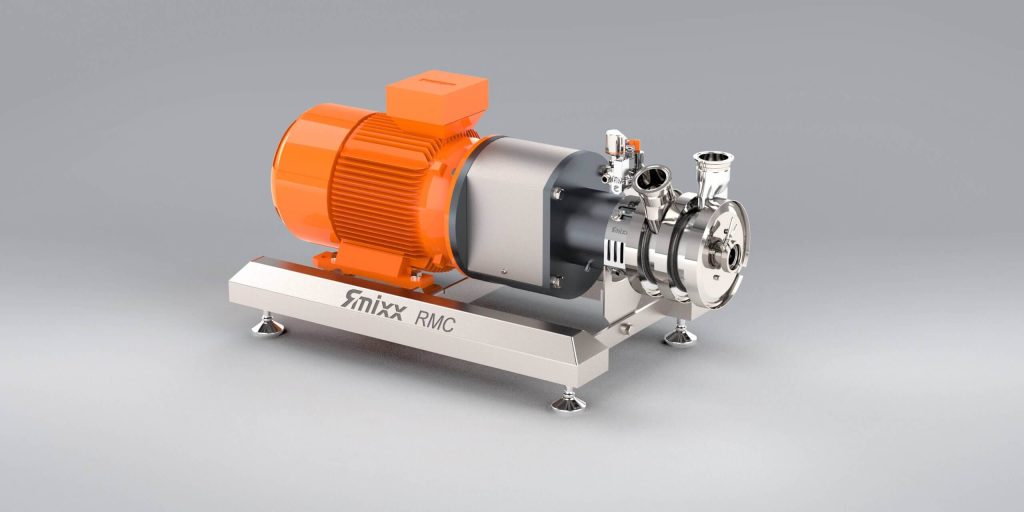 RMC Inline powder dissolving machineDraws in powders without dust, dissolves them and disperses them in a single pass. No lumps, no charging losses.Discover the RMC›
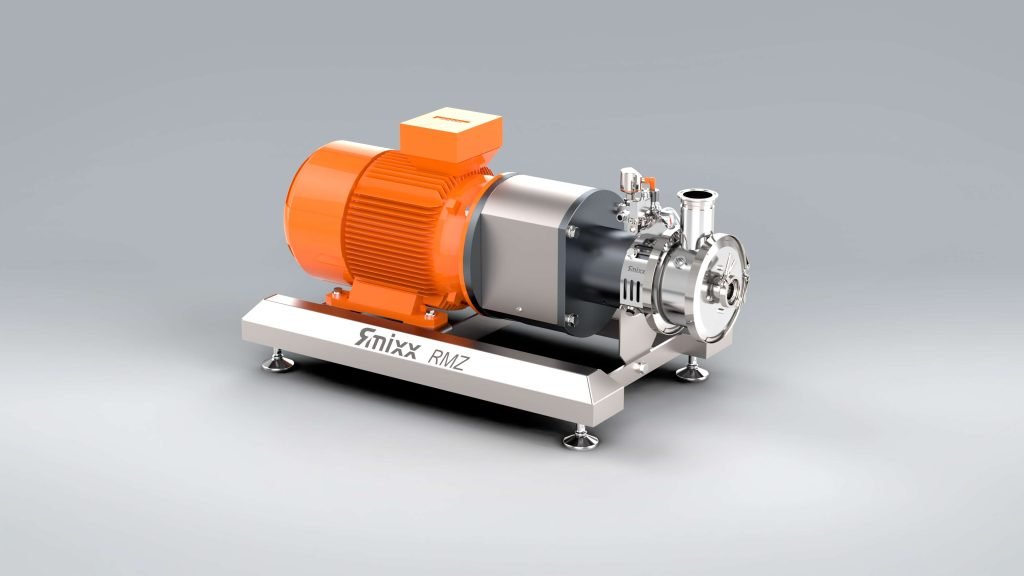 RMZ Inline dispersing machineDisperses directly in the pipe or via recirculation. Produces emulsions and suspensions quickly and reproducibly.Discover the RMZ›
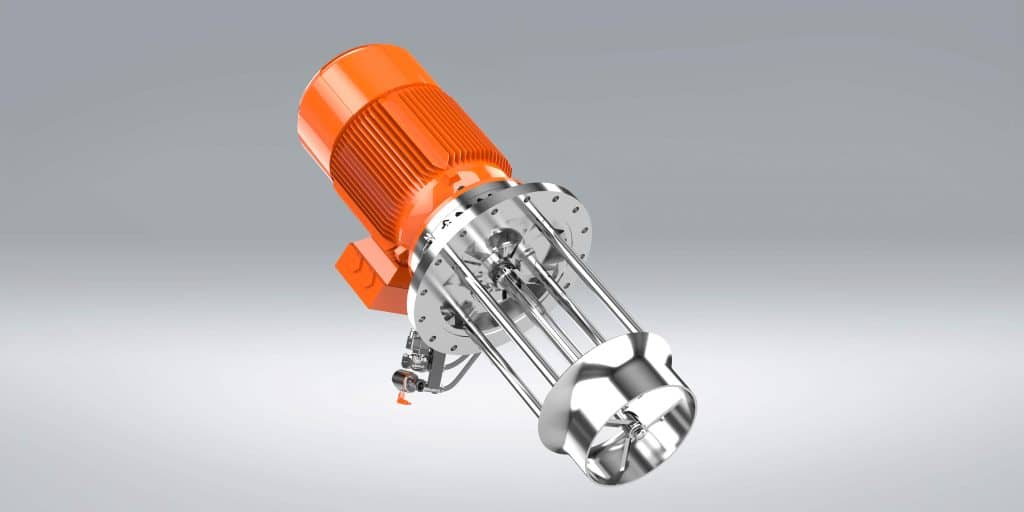 RMY Jet stream mixerMixes homogeneously at a range of viscosities without air entrainment. Available as top entry and side entry.Discover the RMY›
The machine cannot be selected solely on the basis of the product name or industry. Viscosity development, density difference, wettability, powder cohesion, sensitivity to air, required cleaning and desired operating mode determine the design. A trial with the actual product is particularly useful when laboratory behaviour, production scale and formulation cannot be readily predicted from one another.
Scaling up changes both flow and residence time
A successful laboratory trial only prevents agglomerates at production scale if the relevant process mechanisms are retained. Merely selecting the same agitation principle or the same nominal speed is insufficient, because tank geometry, powder feed, liquid level, circulation path and residence time all change at the same time. The ratio between local shear and complete batch turnover is more important here than any single machine parameter.
At small scale, powder often falls close to the mixing element and virtually all the product quickly reaches the dispersing zone. In a production tank, the same addition position can result in a long route, a floating surface layer or a deposit on the wall. What appears to be a dispersing problem in a beaker therefore regularly proves to be a transport and dosing problem at scale.
During trials, record not only the final quality, but also the order of addition, feed behaviour, viscosity development, temperature profile, air entrainment and sample location. Assess samples at representative times and locations; a sample from an intensively treated recirculation line may appear homogeneous while the tank still contains agglomerates. RS Contracting can conduct product trials in Coevorden or on site when the process choice cannot be determined reliably without a trial.
When mechanical dispersing is not the right solution
Mechanical dispersing is not the right primary solution when the problem is caused by hard aggregates, an incorrect raw material condition or insufficient colloidal stability. Strongly bonded structures may require wet milling, while moisture-damaged powder must first be addressed during storage and handling. In the case of reagglomeration, the formulation must be corrected before additional shear can have a lasting effect.
Safety and cleanability also limit the process choice. Combustible powder clouds may require an assessment in accordance with ATEX Directive 2014/34/EU; dust-free feeding reduces exposure but does not replace a formal risk assessment and zone classification. For food, cosmetics and pharmaceutical products, product-contact parts, seals, dead spaces and the CIP or SIP strategy must be consistent with the required hygienic design, for which EHEDG or 3-A principles can serve as a design framework.
An installation that prevents lumps but is difficult to clean completely shifts the quality risk to the next batch. Residual product in gaps, pipes or sealing zones can dry out and later return as hard particles. Cleanability must therefore be considered from the initial process design onwards, not only after the dispersing performance has been established.
Release testing must measure more than visible lumps
A dispersion is only reproducible when the selected quality measurement matches the function of the final product. Visual inspection detects coarse fish eyes and floating material but says little about a broad particle size distribution, incomplete hydration or subsequent sedimentation. Therefore, combine product-specific measurements with a documented sampling procedure.
-
The absence of visible lumps does not prove that all particles have been fully wetted, hydrated or dissolved.
-
Stable viscosity development may be more important than the viscosity immediately after dispersing.
-
Samples from different tank zones reveal whether macromixing reaches the entire batch.
-
An assessment after the relevant resting or storage period shows whether particles reagglomerate, cream or settle.
-
A reproducible recipe records both the settings and the sequence, dosing method and process transitions.
In the event of deviations, the analysis must return to the point at which the difference first became visible. A final measurement shows that the batch does not comply, but not whether the cause was powder handling, wetting, shear, stabilisation or sampling. This process-oriented recording prevents operators from trying to correct every deviation by mixing for longer.
Frequently asked questions about lump-free dispersions
Why do agglomerates not disappear with longer mixing?
Longer mixing only helps when the agglomerates continue to pass through the active mixing or dispersing zone and can be broken mechanically. A fish eye with a tough, hydrated outer layer can shield a dry core for a long time. Furthermore, with insufficient tank circulation, only part of the batch moves through the high-shear zone, so additional time mainly treats the same product.
Must powder always be added slowly?
Powder does not necessarily have to be added slowly, but it must be added in balance with the available wetting and removal capacity. Controlled inline induction can process powder faster than freely pouring it onto a tank surface because each portion immediately comes into contact with flowing liquid. As soon as powder accumulates, creates dust or is drawn in as a plug, the feed rate is too high or the feed is positioned unfavourably.
Does a rotor-stator always prevent fish eyes?
A rotor-stator only prevents fish eyes when powder and liquid come together properly before or within the active zone and the agglomerate that forms actually passes through the slot. A powerful dispersing head does not compensate for dead tank zones, poor powder dosing or premature gel formation. Rotor-stator action is therefore a deagglomeration mechanism, not a substitute for controlled wetting and macromixing.
When is a product trial necessary?
A product trial is necessary when wettability, thixotropy, hydration, particle strength or sensitivity to air cannot be reliably derived from raw material data. A trial can also reduce uncertainty during scaling up or when changing the recipe, powder supplier or order of addition. Use the actual product and assess both immediate dispersion and stability after the relevant process time.
How do you prevent agglomerates from returning after dispersing?
You prevent reagglomeration by keeping the released particles sufficiently separated from one another. This may depend on pH, ionic strength, wetting agents, stabilisers, viscosity and order of addition. When the interfacial chemistry is unfavourable, additional shear only produces smaller clusters temporarily; the formulation must then be optimised together with the mechanical process.
A robust process controls contact, transport and stability
You prevent agglomerates on a lasting basis by controlling the entire chain of causes: powder condition, dosing method, initial wetting, tank circulation, local shear stress, hydration and final stabilisation. High shear is an important tool in this process, but it is not the starting point for diagnosis. Start at the time and place where the first abnormal cluster forms.
When the cause cannot be identified from process observations, a trial with the actual recipe provides more certainty than a selection based solely on nominal machine data. This can establish whether batch dispersing, inline powder induction, recirculation, jet stream mixing or a combined installation provides the required flow and wetting mechanism.