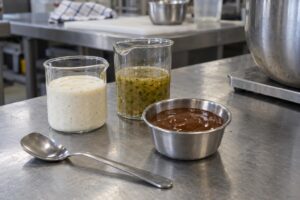
Producing sauces and dressings requires controlled interaction between ingredient order, powder wetting, mixing, dispersing, emulsifying, temperature and residence time. The right system introduces each ingredient into the right process zone at the right time, so that the desired viscosity, droplet distribution, flavour and stability are achieved reproducibly without lumps or excessive air entrainment. The key question is therefore not how much shear a mixer can provide, but where and when the product requires shear, circulation or, conversely, gentle mixing.
A sauce is a liquid to paste-like food product in which dissolved substances, solid particles, fat droplets or a combination of these are distributed; a dressing is generally a pourable, often acidified sauce with a water phase, fat phase or both. Considerably different processes lie behind that simple description. A clear vinaigrette, a starch-thickened cooking sauce, a mayonnaise-like emulsion and a dressing containing herbs cannot be processed using the same process sequence.
The end product determines which mixing operations are required
The desired product structure determines whether you primarily need to dissolve, hydrate, disperse, emulsify or simply mix homogeneously. These operations may occur alongside one another in a single formulation, but they impose different requirements on shear stress and product circulation. A system that disperses intensively is therefore not automatically suitable for every stage of the process.
| Product type | Dominant processing task | Main risk | Suitable mixing action |
|---|---|---|---|
| Clear sauce or marinade | Dissolving salts, sugars and flavourings | Undissolved components or sediment | Complete tank circulation with limited shear |
| Thickened sauce | Wetting and hydrating starch or hydrocolloids | Lumps and local overdosing | Controlled powder induction and sufficient liquid renewal |
| Emulsified dressing | Distributing oil as fine droplets in the water phase | Creaming, coalescence or emulsion breakdown | Targeted high shear followed by gentle homogenisation |
| Sauce containing herbs or particulates | Distributing solid components evenly | Damage, sedimentation or uneven dosing | Low shear with circulation throughout the entire vessel |
| Viscous emulsion sauce | Emulsifying while viscosity increases | Dead zones, air entrainment and insufficient heat transfer | Combination of local shear and powerful bulk flow |
The most common assumption is that higher speed or more shear solves every problem. This is only true when the limiting step is actually droplet size reduction or agglomerate breakdown. If powder remains on a poorly circulating liquid surface, the viscosity rises locally too early or the product does not flow along the tank wall, additional local shear mainly increases the temperature and air entrainment.
Do you know at which point in your formulation the viscosity rises most sharply? That point determines whether the mixing system can still convey enough product to the active mixing zone after hydration. The initial viscosity of water says little about the flow after gum, starch, protein or a concentrated oil fraction has been added.
The process sequence for producing sauces and dressings
A robust production sequence first creates a uniform continuous phase, then wets ingredients that are difficult to dissolve and only then forms the desired emulsion or final structure. The exact sequence remains dependent on the formulation, because acidity, temperature, salt, sugar and mutual interactions affect hydration and emulsion stability. The steps below therefore provide a technical starting point, not a universal formulation.
-
Make the liquid phase homogeneous. Dose the base liquids and set the entire tank contents in motion before adding powders. Local stagnant zones cause concentration differences that are difficult to correct later.
-
Dissolve readily soluble ingredients. Salt, sugar, acids and liquid flavour components must be added in accordance with the formulation. The order is important because a high concentration of dissolved substances can affect the hydration of some thickeners.
-
Wet and disperse powders in a controlled manner. Starch, gum, protein and other functional powders must be incorporated into the liquid separately or as a well-designed premix. Each particle must encounter liquid before a viscous skin can form on its surface.
-
Allow ingredients time to hydrate. Dispersing distributes a powder, but the full viscosity can only develop afterwards. Assessing the viscosity too early can easily lead to overdosing or unnecessarily prolonged mixing.
-
Form the emulsion under controlled shear. Add the dispersed phase so that the rotor-stator or another high-shear zone can process the incoming oil directly. Adding it too quickly can temporarily form large oil pockets that do not pass through the system evenly.
-
Add delicate components later. Visible herbs, vegetable pieces and other particulates are generally added after the intensive dispersing step has been completed. This helps preserve their shape, visual colour and desired bite.
-
Homogenise without imposing unnecessary stress on the product. Allow the total volume to circulate sufficiently to make samples from different positions comparable. Stop intensive shear once the desired structure has been achieved; processing for longer is not automatically better.
-
Check before transfer or filling. Assess factors including appearance, viscosity behaviour, pH according to the product specification, the presence of lumps and the distribution of visible components. The measurement method and sample preparation must be defined so that batches can be compared fairly.
This sequence also explains why a test using only water does not provide a reliable prediction of the production process. At production scale, circulation length, heat transfer, dosing time and residence-time distribution change. Moreover, it only becomes apparent during viscosity development whether the liquid is genuinely moving throughout the entire vessel or only around the mixing head.
For formulations in the food industry, the process selection must therefore be based on the behaviour of the actual product. A test using the customer’s product at laboratory, pilot or production scale can demonstrate which sequence and mixing action are reproducible.
“In practice, scale-up is rarely about additional shear force. The problem arises when the sauce becomes so thick after hydration that the mass simply no longer reaches the mixing head.”
Bart Brouwer
Sales Manager
The best scale-up does not simply preserve a rotational speed or mixing time, but preserves the relevant processing action. Depending on the formulation, this may be the ratio between powder feed and liquid renewal, the passage frequency through a rotor-stator, the bulk circulation in the tank or the specific thermal history of the product.
Powders only become functional after complete wetting
Lumps form when the outside of a powder agglomerate hydrates faster than liquid can penetrate to its core. The resulting gel skin isolates dry powder, after which prolonged stirring may have little effect. Rapidly hydrating hydrocolloids and fine powders in particular therefore require controlled feeding and immediate distribution in sufficiently moving liquid.
Does your powder fall onto the liquid surface, or is each particle drawn directly into an active liquid flow? In the first case, the surface dynamics determine how much powder is actually wetted; in the second, the powder feed and liquid flow can be coordinated. The mechanism behind powder wetting without lumps is therefore more important than the nominal mixing time.
A premix only helps under the right conditions
Dry premixing with sugar, salt or another carrier material can reduce the local concentration of a hydrocolloid and improve its distribution. This approach does not work automatically if the mixture is subsequently dumped all at once onto a calm surface. Differences in particle size, density and flow can also cause segregation during storage or transport.
A liquid premix may also be useful, provided that the powder can be distributed in it completely and stably. If the premix already thickens substantially before reaching the main batch, you merely move the circulation problem to a smaller vessel. The choice between dry predilution, inline powder induction and batchwise addition must therefore be based on the ingredient’s behaviour.
Hydration is different from dispersing
Dispersing breaks down agglomerates and distributes solid particles throughout the liquid; hydration is the absorption or binding of liquid through which the ingredient develops its functional structure. A smooth sample immediately after dispersing may thicken further later. Conversely, a product may fail to achieve the intended viscosity when temperature, ionic strength or acidity limits hydration.
A process check immediately after powder addition is therefore insufficient. Define the point in the process at which viscosity is assessed and the measurement conditions, because thixotropic sauces produce a different reading after intensive movement than after a resting period.
A stable emulsion forms before the sauce appears thick
In an oil-in-water emulsion, the oil must be distributed into droplets that remain separated by the continuous water phase. High shear deforms and breaks larger droplets, while a suitable emulsifier stabilises the newly formed interface. Thickening then slows the movement and collision of droplets, but cannot always repair a poorly formed emulsion.
The order of emulsifier, oil, water, acid and thickener is product-specific. Some emulsifiers must first be dissolved or dispersed in a particular phase; some proteins react to pH and salt; some starches require thermal treatment. The physics of an oil-in-water emulsion remains the same, but the appropriate process route differs for each formulation.
Oil dosing must match the processing capacity of the shear zone
A stable emulsion requires an oil flow rate that the active mixing zone can incorporate directly. When oil first collects as a free layer or as large pockets, different residence times and a broad droplet distribution result. One part of the product is then processed intensively, while another part barely passes through the rotor-stator.
Does the oil enter the active mixing zone in a controlled manner, or does it first reach the free product surface? The answer determines whether the dosing strategy is part of emulsion formation or merely a logistical operation. A well-chosen feed point prevents the system from having to correct an unfavourable phase distribution afterwards.
Too much shear can impair the product specification
Intensive shear is not the right solution when coarse herbs, seeds or vegetable pieces must remain intact. Unnecessarily prolonged dispersing can also raise the product temperature, distribute air into bubbles that are difficult to release and temporarily make a thixotropic product appear thinner. This may cause an operator to add extra thickener incorrectly.
After a sufficiently fine and stable emulsion has formed, the processing task shifts from droplet size reduction to uniform bulk flow. For that phase, a jet stream mixer or another low-shear mixing principle is often more logical than continuous recirculation through a high-shear machine.
Bulk flow prevents only the centre of the tank from participating
A sauce only becomes homogeneous when product from all tank zones regularly flows through the relevant mixing action. The rotor-stator provides high shear stress locally, but cannot compensate for insufficient bulk circulation if the viscous mass outside that zone barely moves. Tank geometry, liquid level, mixer position and changing rheology must therefore be considered as part of the same design question.
At the highest viscosity, does your sauce still flow along the wall and bottom, or does only the product around the mixer shaft rotate? Wall deposits, temperature differences and differing samples from different positions indicate insufficient macro-mixing. The solution may be a different flow pattern, modified positioning or a combination of mixing principles, not necessarily a more powerful dispersing head.
For sauce and dressing lines, three functions often come together: low-dust powder intake, reproducible inline dispersing and tank-wide circulation with little air entrainment. Depending on the formulation and process configuration, these functions can be implemented separately or as an integrated line.
The right machine for your process
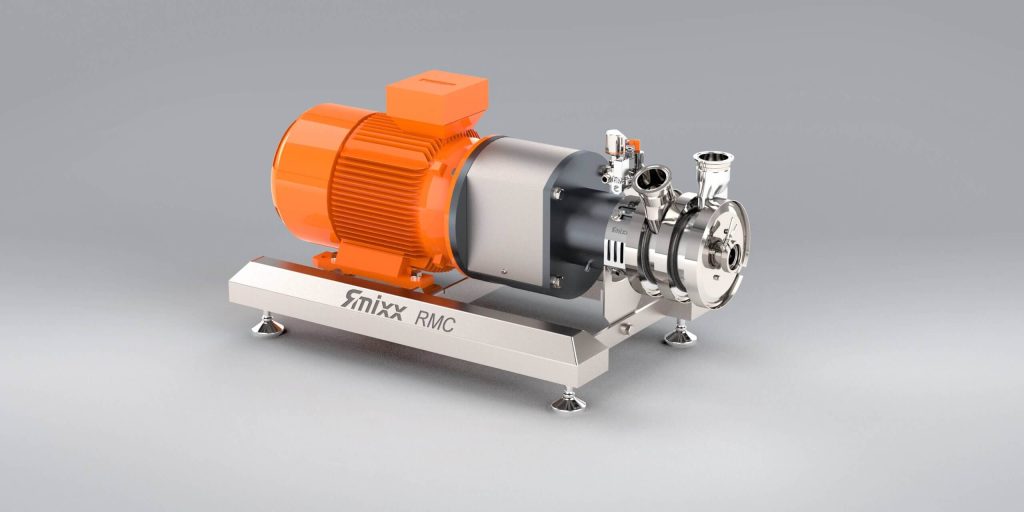 RMC Inline powder dissolving machineDraws in powders without dust, dissolves them and disperses them in a single pass. No lumps, no charging losses.Discover the RMC›
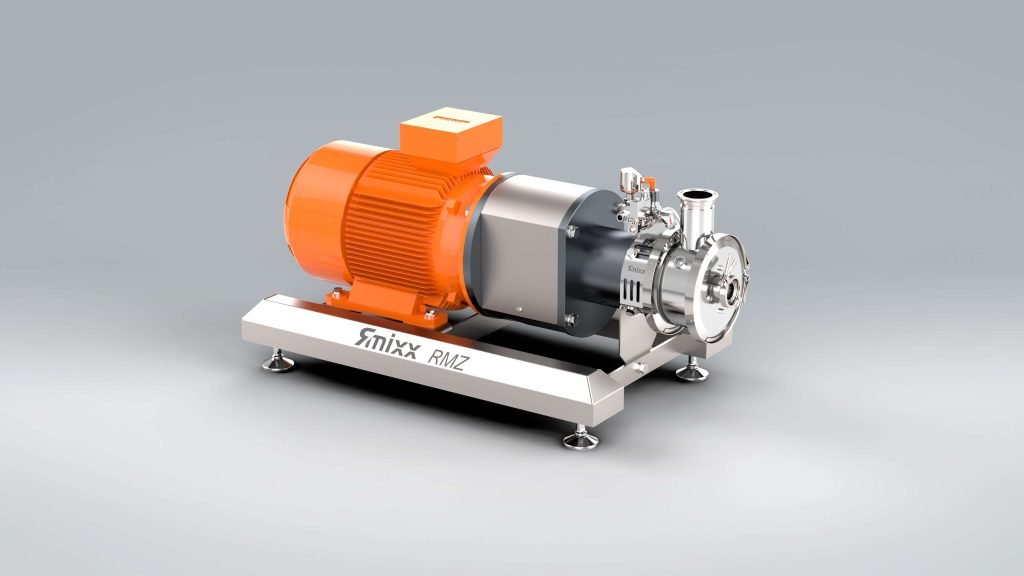 RMZ Inline dispersing machineDisperses directly in the pipeline or through recirculation. Produces emulsions and suspensions quickly and reproducibly.Discover the RMZ›
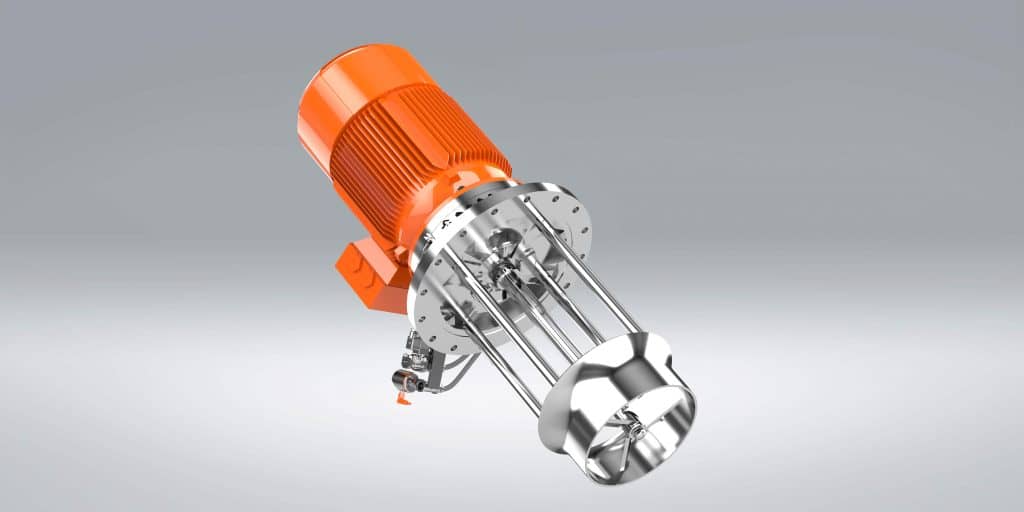 RMY Jet stream mixerMixes homogeneously at a range of viscosities, without air entrainment. Available in top-entry and side-entry versions.Discover the RMY›
The choice between batch and inline is not a choice between bad and good. Batch dispersing provides direct processing in the vessel and may be suitable for changing formulations or manageable batches. Inline processing creates a defined process zone and can be used during transfer or recirculation; the considerations are discussed in greater detail in relation to the difference between inline and batch.
Air entrainment affects more than just appearance
Air entrainment can affect the measured density, filling behaviour, visual colour and oxidative load of a sauce. Small air bubbles can also be stabilised by proteins, emulsifiers or high viscosity, preventing them from rising to the surface by themselves. A smooth surface in the tank therefore does not prove that the product is free of air.
Air can enter through a vortex, a powder stream, leaking connections on the suction side or a return line above the product level, among other routes. The source must be limited first; vacuum mixing or deaeration is only logical when the formulation and system otherwise do not allow sufficient air to escape. Vacuum is not a universal solution, because volatile flavourings, foaming behaviour and product expansion differ by formulation.
Sampling can also distort the picture. A sample from a calm upper layer may contain less air than the product at the outlet, while vigorous pouring can introduce additional air. A fixed sampling procedure is therefore part of reproducible quality control.
Temperature and acidity are active process parameters
Temperature affects viscosity, solubility, fat-phase behaviour, hydration and heat-sensitive ingredients. Heating can activate a starch or make a fat phase processable, but can also adversely affect flavourings and significantly change viscosity during the process. The mixing system must therefore function at both the lowest and the highest process viscosity.
The location and rate of acid addition can also be decisive. A locally low pH may cause proteins or other components to react differently than when the same acid is first diluted uniformly. Dosing points must therefore be located in a zone with direct and predictable incorporation.
A heat-exchange step does not correct poor tank circulation. When viscous product barely flows along a heated or cooled wall, local temperature differences and deposits arise. Thermal treatment and mixing must be designed as a single process, even when the equipment physically consists of separate components.
Cleanability must be established before selecting the machine
Hygienic design begins with avoiding product accumulation, poorly drainable sections and surfaces that are not predictably reached by the cleaning liquid. Sauces and dressings may combine fat, protein, starch, herbs and colouring ingredients, meaning that a single cleaning regime is not automatically suitable for all formulations. The design must be compatible with the selected CIP strategy and with any components that are cleaned manually.
EHEDG guidelines provide a useful framework for hygienic design, but a hygienic component does not automatically make an entire line cleanable. Connections, valves, measuring instruments, return lines and low points also determine whether product residues remain. More background information is provided in the article on hygienic design and cleaning.
Cleanability is also a process question: can the cleaning liquid reach the same product zones when the product mixer is stationary, or is active circulation required? A design that only circulates effectively at low viscosity may have problem areas during production that remain invisible during a water test.
From laboratory formulation to reproducible production batch
Scale-up of sauces and dressings must be based on process criteria, not on a linear increase in mixing time or rotational speed. In a small vessel, the feed point and mixing head are close together, whereas powder and oil may travel a longer route in a production tank. Differences in residence time and tank circulation also increase.
During a test, therefore, do not record only whether the final sample is approved. Record the ingredient order, dosing method, temperature history, visible flow, point of viscosity development, sample location and condition of the product after resting. This clarifies which process variables must be transferred to production scale.
-
A successful water test demonstrates the direction of rotation and flow, but not the powder wetting or emulsion formation of the formulation.
-
A final sample from one position does not demonstrate the homogeneity of the entire batch.
-
A shorter mixing time is only valuable when hydration, droplet distribution and product stability also meet the specification.
-
A flexible system is only flexible when changing formulations does not cause residual volumes that are difficult to clean or uncontrollable process routes.
RS Contracting can perform tests with the customer’s product in Coevorden or on site. Without such a test, no reliable general statement can be made about the required shear, residence time or most suitable rotor-stator geometry, because viscosity, density, wettability and ingredient interactions differ by formulation.
Frequently asked questions about industrial sauce production
Which mixer is suitable for sauces and dressings?
The suitable mixer depends on the dominant process step. A rotor-stator is appropriate for powder dispersing and emulsion formation, while a jet stream mixer may be suitable for tank-wide homogenisation with limited air entrainment. Viscous emulsions often require a combination. The choice must be tested using the actual formulation and expected viscosity development.
How do you prevent lumps in sauce?
Lumps are prevented by feeding powder in a controlled manner into a liquid flow that immediately wets every particle. Sufficient circulation, a suitable order of addition and time for hydration are essential. Simply mixing for longer does not help when a hydrated outer layer has enclosed dry powder; the agglomerate must then be dispersed in a targeted manner.
When do you choose inline rather than batch dispersing?
Inline dispersing is appropriate when you require a defined, reproducible process zone during recirculation or transfer. Batch dispersing is appropriate when direct processing in the vessel and flexibility between batches carry more weight. The best choice depends on product volume, viscosity profile, ingredient feed, cleaning strategy and whether delicate components may pass through the dispersing zone.
Why does a dressing become thinner or thicker after production?
A dressing may change after production because hydrocolloids continue to hydrate, starch develops its structure, fat crystallises or a thixotropic network recovers after shear. Temperature and the measurement method also affect the observed viscosity. You should therefore assess the product specification at a fixed point in time, with defined sample handling and under reproducible measurement conditions.
Can one system produce all sauces?
One system can process multiple formulations when its mixing heads, flow pattern, dosing route and cleaning are sufficiently flexible. It is not automatically suitable for both fine emulsions and products containing delicate pieces. Separate process steps or interchangeable mixing elements are sometimes better than one machine that attempts to perform every operation simultaneously.
The right question is which structure is required during each process phase
Producing sauces and dressings becomes reproducible when each process phase has a clear function: dissolving, wetting, hydrating, dispersing, emulsifying or maintaining homogeneity. The machine selection follows from these functions and from the viscosity profile, not the other way round. This prevents lumps, unstable emulsions or long batch times from being addressed afterwards with additional shear.
You should therefore first identify the critical transition points: when does viscosity develop, where does powder come into contact with liquid, where is oil first distributed and when must delicate components be added? With this information, a test can demonstrate which combination of powder induction, inline dispersing and bulk circulation is technically appropriate for your formulation and cleaning regime.